











 Secure payments
Standard refund policy
Trade Assurance
Secure payments
Standard refund policy
Trade Assurance
| Product Type | Memory Module |
|---|---|
| Compliance Standards | RoHS |
| Memory Capacity | 2 GB |
| Memory Technology | DDR3 |
| Product Voltage | 1.35V |
| RAM Speed | 1333MHz |
| RAM Standard | DDR3-1333/PC3-10600 |
| Error Identifying | ECC |
| Signal Type | Registered |
| Column Access Strobe (CAS) | CL9 |
| Rank | Single Rank x8 |
| Quantity of Pins | 240-pin |
| RAM Genre | RDIMM |
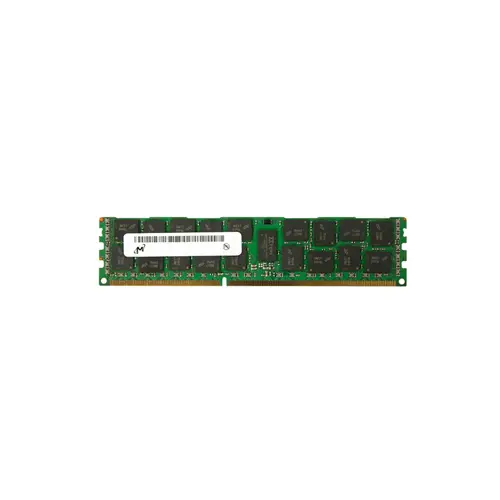
This 2GB DDR3-1333 RDIMM with 1.35V low-voltage operation and ECC is purpose-built for entry-level server platforms, delivering reliable data integrity for light virtualization, small-scale memory databases, and network appliance workloads. Its registered signal type combined with single-rank x8 organization ensures stable signal integrity and lower loading on the memory bus, while the CL9 latency keeps response times predictable under sustained access.
1. ECC protection eliminates single-bit memory errors, safeguarding transactional data integrity in financial or database server workloads where even a single undetected fault can cause costly corruption.
2. Registered buffering stabilizes signal paths across high-density memory configurations, preventing electrical loading issues that would otherwise risk sudden system crashes in virtualized server clusters.
3. Low-voltage operation trims overall power draw and thermal output per DIMM, directly reducing cooling demands and energy costs in dense rack-scale deployments.
4. The balanced clock speed delivers steady, predictable throughput for legacy enterprise applications where consistent data delivery over long uptime windows matters more than raw peak performance.
5. Purpose-built capacity suits lightweight embedded controllers or dedicated microservice nodes, provisioning exactly the resources needed without over-allocating expensive RAM in hyperconverged infrastructure.
Designed for enterprise server environments, the Micron MT9KSF25672PZ-1G4D1D is a DDR3-1333 Registered DIMM that turns four critical specifications into real-world reliability where downtime is not an option. In a dense virtualization cluster running dozens of VMs per host, its Registered signal buffer stabilizes the command and address lines across multiple DIMMs, preventing the signal degradation that would otherwise cause random crashes during peak consolidation, while the single-rank x8 organization reduces electrical loading to maintain clean timing margins. For an in-memory database like Redis or a transactional SQL engine, the module’s ECC engine constantly detects and corrects single-bit errors; a silent bit flip in a cached financial record or a hypervisor page table could corrupt results or trigger a node failure, and ECC eliminates that risk before it propagates. Meanwhile, the 1.35V low-voltage operation directly slashes thermal output in a fully populated rack, cutting cooling costs and allowing higher memory density without exceeding power budgets, and the CL9 latency at 1333MHz delivers the predictable, low-latency throughput that latency-sensitive applications depend on under sustained load.
General Virtualization
For light to moderate virtualization hosts, install at least six to eight of these 2 GB DDR3-1333 RDIMMs (12–16 GB total) to run multiple VMs comfortably. Populate memory channels evenly—three modules per channel on triple‑channel platforms or four per channel on quad‑channel systems—to maximize memory bandwidth. This configuration keeps overhead low while supporting common hypervisors and guest operating systems.
In‑Memory Database
In‑memory databases demand both capacity and data integrity, so ECC Registered memory is essential. With 2 GB modules, populate all available DIMM slots to reach the highest possible capacity within your server’s limits, preferably 64 GB or more. Use balanced interleaving and identical single‑rank modules across channels to minimize latency and sustain rapid read/write operations.
High‑Performance Computing (HPC)
HPC clusters benefit from the reliability of ECC RDIMMs and the power savings of 1.35 V operation. Deploy these modules in fully populated configurations—typically 12 or 16 modules per node—to deliver both memory bandwidth and fault tolerance. Strive for uniform single‑rank DIMMs across all memory channels, which ensures predictable latency and stable throughput for tightly coupled parallel workloads.
Rigorously tested and verified for Dell PowerEdge R720, HP DL380p Gen8, Lenovo RD530, and compatible servers.
Q: Can I mix this MT9KSF25672PZ-1G4D1D with other memory modules of different brands or speeds?
A: Mixing is strongly discouraged in servers. Different brands, speeds, or ranks may cause signal integrity issues, instability, or prevent boot. Always install identical registered ECC modules for validated reliability.
Q: Is this memory compatible with my server? Which Intel or AMD platforms are supported?
A: This 2GB DDR3-1333 ECC RDIMM supports platforms like Intel Xeon 5500/5600 series and AMD Opteron 6100/6200 series. Verify your server board explicitly supports 1.35V registered DIMMs.
Q: What is the recommended DIMM population order for optimal performance?
A: Follow your server board manual; typically, populate identical DIMMs in matching-colored slots per memory channel. For single rank x8 RDIMMs, install sequentially starting from the farthest slot from each CPU.
Q: Does this module support overclocking or XMP profiles?
A: No. This is a server-class ECC registered DIMM running at fixed JEDEC standard DDR3-1333 CL9. It operates at rated specifications and does not support overclocking or XMP.
Q: What warranty and typical failure rate can I expect for this memory?
A: It includes a 1-year warranty. Typical failure rate is extremely low for this enterprise-grade module, with an expected AFR well under 0.5% under normal server operating conditions.