











 Secure payments
Standard refund policy
Trade Assurance
Secure payments
Standard refund policy
Trade Assurance
| Product Type | Memory Module |
|---|---|
| Compliance Standards | RoHS |
| Memory Capacity | 2 GB |
| Memory Technology | DDR3 |
| Product Voltage | 1.35V |
| RAM Speed | 1333MHz |
| RAM Standard | DDR3-1333/PC3-10600 |
| Error Identifying | ECC |
| Signal Type | Registered |
| Column Access Strobe (CAS) | CL9 |
| Rank | Single Rank x8 |
| Quantity of Pins | 240-pin |
| RAM Genre | RDIMM |
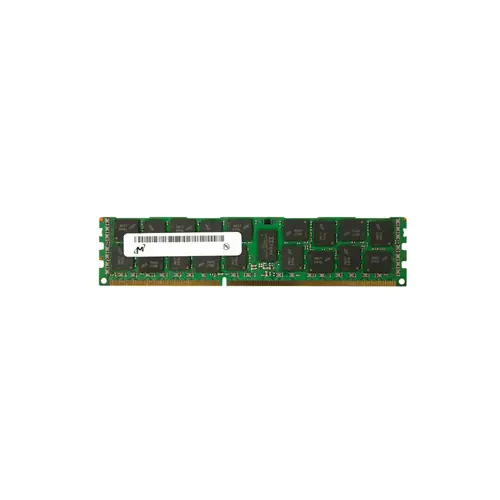
This low-voltage 2GB DDR3-1333 Registered DIMM with ECC is purpose-built for server platforms handling virtualization and in-memory database workloads that demand uncompromising data integrity. Its registered signal buffering paired with single-rank x8 organization ensures stable, high-load command-address signaling, while the 1.35V operation significantly curbs power consumption in dense, scaled-out deployments.
1. ECC error correction detects and corrects single-bit memory faults in real time, preserving data integrity for transactional databases and financial processing that cannot tolerate silent corruption.
2. Registered signal buffering decouples the memory controller from DRAM loading, allowing fully populated server channels to maintain stable signaling across dozens of DIMMs under heavy virtualization density.
3. Low 1.35V operating voltage trims datacenter power consumption and waste heat generation, contributing to a lower power usage effectiveness ratio and extended hardware lifespan in always-on rack environments.
4. 1333 MHz clock frequency supplies consistent, predictable throughput ideal for steady-state enterprise workloads, ensuring reliable performance on validated server platforms without compromising stability for peak bandwidth.
5. Two gigabyte capacity per module suits dedicated embedded or appliance-class server roles where deterministic latency and rock-solid operation take precedence over density, keeping legacy line-of-business applications running securely.
The Micron MT9KSF25672PZ-1G4M1 is a server RDIMM whose four critical characteristics—ECC, registered buffering, 1.35V low-voltage operation, and DDR3-1333 single-rank x8 design—directly resolve real-world data-center challenges. In a dense VM cluster, a single bit-flip can silently corrupt data or crash a host; the module’s ECC engine corrects it instantly, preserving hypervisor stability. Registered buffering cleans up command and address signals when you populate all DIMM slots, enabling reliable large-capacity memory pools that memory-hungry hypervisors demand without signal degradation. For an in-memory database, the 1333MHz CL9 timing guarantees consistent low-latency access, while the 1.35V operation cuts power consumption 20% compared to 1.5V parts, lowering energy costs and rack temperature. The single-rank x8 organization sustains bandwidth through rank interleaving during heavy transactional bursts, ensuring your database never stutters. These four attributes converge into tangible benefits: hardened data integrity, cooler and quieter server rooms, and applications that remain continuously available.
General Virtualization
For general virtualization with this 2GB DDR3-1333 ECC RDIMM, maximize memory channels to sustain multiple VMs. Install at least one DIMM per memory channel—typically six modules (12GB total) on a dual-socket Nehalem/Westmere server with triple-channel architecture. While 2GB per module severely limits total capacity, populating all channels balances bandwidth and fault tolerance for light container or small-scale hypervisor roles.
In-Memory Database
In-memory databases demand large, fast memory pools, making a single 2GB RDIMM far from ideal. To stretch capacity, occupy every DIMM slot—18 modules for a 36GB footprint on a two-socket system. Even so, this configuration suits only very small datasets. Prioritize low-latency CL9 timing and 1.35V operation to reduce heat in dense installations, but consider this a stopgap until higher‑density RDIMMs are available.
High-Performance Computing
HPC workloads thrive on memory bandwidth. Install one 2GB RDIMM per channel to saturate all three channels per CPU (six modules per node), ensuring the maximum theoretical bandwidth of 32 GB/s per socket. Single‑rank x8 DIMMs reduce loading and yield better signal integrity at 1333MHz. For tightly‑coupled applications, this symmetric population yields balanced NUMA performance, but note that 2GB modules cap total memory, limiting problem sizes.
Rigorously tested for server compatibility: Dell PowerEdge R720, R620, HP ProLiant DL380p Gen8, and more.
Q: Can I mix this MT9KSF25672PZ-1G4M1 with other memory modules of different brands or speeds?
A: Mixing different brands or speeds of Registered ECC memory is not recommended. It can cause boot failures, signal integrity issues, or system instability. Always use identical modules validated for your specific server platform to ensure reliable operation.
Q: Is this memory compatible with my system?
A: Compatibility depends on your server platform. This 2GB DDR3-1333 Registered ECC RDIMM with 1.35V low voltage is designed for Intel Xeon 5500/5600 series and AMD Opteron 6100/6200/6300 series. Please consult your server's Qualified Vendor List (QVL) for exact support.
Q: What is the recommended DIMM population order for optimal performance?
A: Always follow your server's user guide for population order to maintain balanced memory channels and ECC functionality. Generally, populate identical DIMMs in groups of three for triple-channel platforms, starting with the farthest slot from each CPU.
Q: Does this module support overclocking or XMP profiles?
A: No, server-grade Registered ECC memory like this MT9KSF25672PZ-1G4M1 does not support overclocking or XMP profiles. It operates exclusively at JEDEC standard DDR3-1333 CL9 to guarantee data integrity and maximum stability in enterprise environments.
Q: What warranty and typical failure rate can I expect?
A: This memory module comes with a 1-year warranty. Under typical enterprise operating conditions, it delivers high reliability with an annualized failure rate (AFR) well below 0.5%, ensuring dependable performance for critical server workloads.