











 Secure payments
Standard refund policy
Trade Assurance
Secure payments
Standard refund policy
Trade Assurance
| Model | MT18JSF25672AZ-1G4G1ZE |
|---|---|
| Product Type | Memory Module |
| Compliance Standards | RoHS |
| Memory Capacity | 2 GB |
| Memory Technology | DDR3 |
| Product Voltage | 1.5V |
| RAM Speed | 1333MHz |
| RAM Standard | DDR3-1333/PC3-10600 |
| Error Identifying | ECC |
| Signal Type | Unbuffered |
| Column Access Strobe (CAS) | CL9 |
| Rank | Dual Rank x8 |
| Quantity of Pins | 240-pin |
| RAM Genre | UDIMM |
Based on its UDIMM form factor with ECC support, this module is an entry-level server or workstation memory designed for platforms that demand data integrity, such as file servers, network appliances, or light virtualization hosts. Its unbuffered ECC implementation actively corrects single-bit errors to prevent data corruption, while the dual-rank x8 organization enables rank interleaving for improved memory bandwidth efficiency in sustained workloads.
1. ECC error correction instantly detects and fixes single-bit memory faults, preserving data integrity for critical always-on services like authentication and logging.
2. Unbuffered signal topology cuts command latency to the absolute minimum, giving single-processor servers a responsiveness edge for caching and light database workloads.
3. Dual Rank x8 organization interleaves memory banks to keep the memory channel supply saturated, essential for maintaining steady throughput when hosting multiple lightweight virtualized environments.
4. 1333MHz frequency provides a reliable bandwidth foundation for entry-level server duties such as file serving and web hosting, balancing performance with thermal simplicity.
5. A modest 2 GB capacity serves as a power-efficient, dependable building block for dedicated appliances where deterministic uptime matters far more than total density.
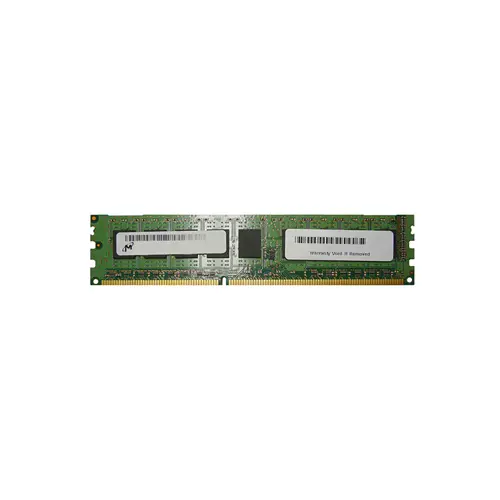
The Micron MT18JSF25672AZ-1G4G1ZE is a 2GB DDR3-1333 ECC Unbuffered DIMM purpose-built for entry-level servers and workstations where data accuracy and responsiveness are mission-critical. Its four defining traits—ECC error correction, unbuffered architecture, dual-rank organization, and tight CL9 timing—directly answer real-world pain points. ECC actively detects and fixes single-bit memory errors, eliminating silent data corruption that could crash your virtual machines or distort financial transactions in a lightweight database. For a small office running two VMs on a single-socket host, this means avoiding expensive downtime and hidden data loss. The unbuffered design removes the registration clock delay found in registered modules, cutting access latency for faster query responses in a memory-resident Redis cache. Meanwhile, dual-rank interleaving boosts effective bandwidth by letting concurrent VM and database threads fetch data simultaneously without stalling. Finally, the standard 1333MHz speed at CAS 9 guarantees predictable, stable operation on legacy server boards. For businesses relying on virtualized workloads or memory databases, this module delivers continuous, accurate performance, making it a smart investment that protects your critical operations without unnecessary cost.
General Virtualization
Deploy at least eight MT18JSF25672AZ modules across the server’s memory channels for a 16 GB pool, sufficient for 4–6 lightweight VMs. Enable mirroring or sparing in the BIOS to leverage ECC protection, and populate identical DIMMs in each channel to maintain balanced interleaving.
In-Memory Database
Single 2 GB DIMMs are severely limiting for in-memory workloads. Combine the maximum supported modules on the board—often 24 or more—to reach 48–64 GB as a temporary baseline, but prioritize migrating to higher‑capacity RDIMMs. Keep all ranks populated evenly to sustain low latency under heavy write‑back loads.
High‑Performance Computing
Populate all six or eight memory slots per socket with these ECC UDIMMs to achieve 12–16 GB per node, enough for embarrassingly parallel jobs with small working sets. For memory‑bandwidth‑sensitive CFD or weather codes, use a balanced dual‑rank configuration (2 DIMMs per channel) to exploit rank interleaving, but plan an upgrade once problem sizes exceed the 2 GB granularity.
Rigorously tested, compatible with servers like Dell PowerEdge R210 II, T110 II, HP ProLiant MicroServer Gen8, Lenovo ThinkServer TS140.
Q: Can I mix this MT18JSF25672AZ-1G4G1ZE with other memory modules of different brands or speeds?
A: Mixing is not advised. Unbuffered ECC modules require strict matching of rank, speed, and timings. Mixed configurations may cause POST failures or memory errors in server environments.
Q: Is this memory compatible with my Intel Xeon E3 or AMD Opteron server system?
A: It is compatible with platforms supporting DDR3 ECC Unbuffered DIMMs. Verify your board accepts 2GB Dual Rank x8, 1333MHz, 1.5V UDIMMs. Check the system's qualified vendor list.
Q: What is the recommended DIMM population order for optimal performance with this module?
A: Refer to your server board manual. Typically, populate identical modules in pairs, starting with the slots farthest from the CPU socket per channel to maintain balanced dual-channel interleaving.
Q: Does this module support overclocking or XMP profiles?
A: No. This server-grade UDIMM adheres to JEDEC DDR3-1333 standard timings. It does not feature XMP nor support overclocking, ensuring consistent stability for mission-critical workloads.
Q: What warranty and typical failure rate can I expect?
A: It includes a 1-year warranty. The module undergoes rigorous testing; annualized failure rates are extremely low, reflecting enterprise-class quality and adherence to RoHS standards.