











 Secure payments
Standard refund policy
Trade Assurance
Secure payments
Standard refund policy
Trade Assurance
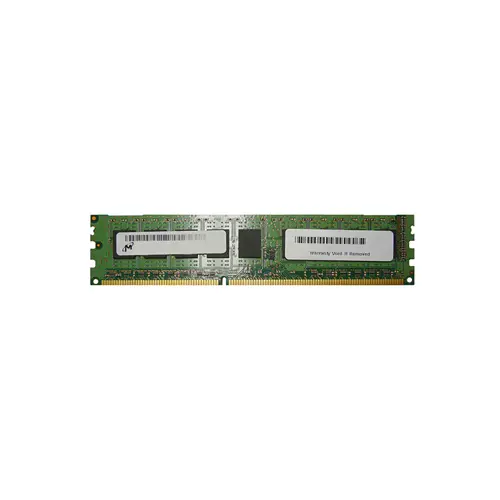
| Model | MT9KSF25672AZ-1G4M1Z |
|---|---|
| Product Type | Memory Module |
| Memory Capacity | 2 GB |
| Memory Technology | DDR3 |
| Product Voltage | 1.35V |
| RAM Speed | 1333MHz |
| RAM Standard | DDR3-1333/PC3-10600 |
| Error Identifying | ECC |
| Signal Type | Unbuffered |
| Column Access Strobe (CAS) | CL9 |
| Rank | Single Rank x8 |
| Quantity of Pins | 240-pin |
| RAM Genre | UDIMM |
This 2GB DDR3-1333 UDIMM with ECC is a low-voltage (1.35V) server-grade module optimized for entry-level servers, NAS appliances, and small-scale virtualization workloads where data integrity is critical. Its single-rank x8 organization reduces electrical load on the memory controller, while unbuffered ECC operation delivers reliable single-bit error correction in cost-sensitive, 24/7 embedded environments.
1. ECC detects and corrects single-bit errors in real time, preserving data integrity for always-on server applications where even one corrupted bit can crash a virtualized workload.
2. 1.35V low-voltage operation cuts DRAM power draw substantially, directly lowering electricity and cooling costs across dense rack deployments.
3. 1333 MHz throughput supplies steady memory bandwidth for hosting multiple lightweight VMs or containers without creating a performance bottleneck.
4. Unbuffered UDIMM architecture removes register latency, offering a cost-effective path to reliable single-socket server performance in SMB and edge computing setups.
5. Single Rank x8 configuration maintains clean command/address signaling, improving boot reliability and long-term stability when populating all available slots on a micro-ATX or embedded server board.
In a single-socket server powering a virtualized cluster or an in-memory database, the Micron MT9KSF25672AZ-1G4M1Z UDIMM does far more than just meet a spec sheet. Its ECC technology means every bit of a financial record or a live customer profile is actively protected against silent data corruption—a single uncorrected flip in a Redis node or a hypervisor’s page table can crash an entire service chain, and ECC turns that risk into a non-event. The module’s 1.35V low-voltage DDR3 operation directly lowers your power bill and thermal load in a 24/7 colocation rack; when you are running a dozen lightweight KVM guests on a dense microserver, wattage per DIMM translates into real opex savings and fan-speed reduction. Its Unbuffered architecture eliminates the register latency of RDIMMs, delivering the fast electrical response that a latency-critical Memcached pool or an ESXi control plane demands—every nanosecond saved on cache hits directly accelerates application responsiveness. At a stable 1333MHz with CL9, the single-rank x8 design provides predictable, balanced bandwidth that keeps a busy database instance free of memory-controller bottlenecks, helping you maintain consistent transaction throughput without after-hours tuning calls.
General Virtualization
For lightweight virtualized environments, deploy these ECC UDIMMs in pairs to enable dual-channel mode while maintaining data integrity. A configuration of four 2 GB modules (8 GB total) suits a small hypervisor hosting a handful of low-resource VMs. Always populate identical modules across channels to balance memory bandwidth and leave room for future expansion if extra slots are available.
In-Memory Database
In-memory databases crave capacity and fault tolerance; use the maximum supported DIMMs per channel to push total RAM as high as the platform allows. Filling four slots with these 2 GB ECC modules yields 8 GB, which is only viable for modest test datasets or caching layers. Where the motherboard supplies eight slots, populate all with identical 2 GB sticks to achieve 16 GB, relying on ECC to guard against silent corruption during intensive read/write operations.
High-Performance Computing (HPC)
HPC workloads benefit from uniform memory access and low latency, making a balanced multi-channel population critical. Install two modules for dual-channel or four for quad-channel operation, aligning with the CPU’s memory controller width. The single-rank x8 design and CL9 timing help sustain consistent throughput per core. To maximize node-level performance, match the module count exactly to the supported memory channels and avoid mixing densities.
Rigorously tested compatible servers: Dell PowerEdge T110 II, HP ML310e Gen8, Lenovo TS140.
Q: Can I mix this MT9KSF25672AZ-1G4M1Z with other memory modules of different brands or speeds?
A: Mixing modules is strongly discouraged for server stability. Different timings or voltages may degrade signal integrity, force downclocking, or disable ECC. For guaranteed reliability, use identical ECC UDIMMs.
Q: Is this memory compatible with my system? (Server-focused: Intel/AMD platforms)
A: This DDR3L ECC UDIMM is designed for servers using Intel Xeon E3-1200 v2 series or AMD Opteron 3300 series platforms. Ensure your motherboard explicitly supports 1.35V low-voltage, unbuffered ECC memory.
Q: What is the recommended DIMM population order for optimal performance?
A: Populate identical modules in pairs for dual-channel mode. Start with slots farthest from the CPU, typically channels A1 and B1. Balanced interleaving requires matching capacity and rank across both memory channels.
Q: Does this module support overclocking or XMP profiles?
A: No. This server-grade memory adheres strictly to JEDEC DDR3-1333 specifications. It operates at fixed 1333MHz CL9 without XMP or overclocking support, prioritizing data integrity and long-term operational stability.
Q: What warranty and typical failure rate can I expect?
A: This module includes a 1-year warranty. Typical annualized failure rate is below 0.5% under nominal conditions. Integrated ECC actively corrects single-bit errors, significantly reducing the risk of silent data corruption and server downtime.