











 Secure payments
Standard refund policy
Trade Assurance
Secure payments
Standard refund policy
Trade Assurance
| Product Type | Memory Module |
|---|---|
| Compliance Standards | RoHS |
| Memory Capacity | 2 GB |
| Memory Technology | DDR3 |
| Product Voltage | 1.35V |
| RAM Speed | 1333MHz |
| RAM Standard | DDR3-1333/PC3-10600 |
| Error Identifying | ECC |
| Signal Type | Unbuffered |
| Column Access Strobe (CAS) | CL9 |
| Rank | Single Rank x8 |
| Quantity of Pins | 240-pin |
| RAM Genre | UDIMM |
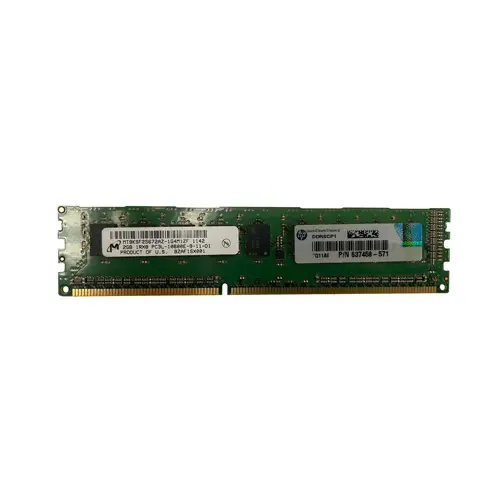
This DDR3L-1333 unbuffered ECC UDIMM is purpose-built for entry-level servers and single-socket workstations, delivering critical data integrity for light virtualization, file serving, and small-scale in-memory databases. Its single-rank x8 design minimizes electrical loading for stable signal integrity on platforms with limited DIMM slots, while the 1.35V low-voltage operation and ECC error correction jointly reduce power consumption and guard against single-bit memory errors.
1. ECC error correction detects and fixes single-bit memory faults, preserving data integrity for critical server operations and reducing unplanned downtime.
2. Low-voltage operation dramatically cuts power draw per DIMM, enabling denser server configurations without exceeding thermal budgets.
3. Unbuffered signal path minimizes access latency, making it ideal for single-socket servers and microservers that prioritize fast response over massive capacity.
4. Tight column access strobe latency accelerates read commands, boosting performance in latency-sensitive server applications such as in-memory caching.
5. A purpose-built modest capacity meets the exact requirements of embedded controllers and small-footprint virtualized network functions while still supporting ECC.
The Micron MT9KSF25672AZ-1G4M1ZF is a server-grade UDIMM engineered for entry-level servers and small-business NAS systems where data integrity and energy efficiency are paramount. Its ECC technology actively detects and corrects single-bit memory errors, a critical safeguard in always-on environments—imagine a Linux-based file server handling continuous backups or a lightweight VMware ESXi host running a domain controller; a single flipped bit in cached metadata could silently corrupt a ZFS filesystem or crash a virtual machine. ECC turns that silent risk into a non-issue. The module’s 1.35V low-voltage DDR3-1333 operation directly lowers thermal dissipation and power draw across a 24/7 rack, which matters when multiple nodes in a small colocation cage compound your monthly energy bill. Unbuffered signaling keeps command-to-response latency minimal, benefiting memory-sensitive workloads like a Redis instance or an embedded firewall appliance where every nanosecond of fetch delay translates to packet-processing jitter. With a CL9 CAS latency and single-rank x8 organization, this module delivers straightforward, predictable timing that eases mixed-load compatibility on older Intel Xeon E3 platforms. It means you can extend the service life of a trusted microserver or network-attached storage box without sacrificing the uptime and consistency your users depend on.
Capacity Planning Guide for Server ECC DDR3 UDIMM
This module is a 2GB, DDR3-1333, ECC Unbuffered DIMM, typically used in entry-level single-socket servers or small office servers where data integrity is critical. Its limited per-DIMM capacity demands careful slot allocation for modern workloads. Below are configuration recommendations for three typical server scenarios.
General Virtualization
For light virtualization with a few low-resource VMs, install at least 6 to 8 modules (12–16 GB) across all available channels to maximize memory interleaving. ECC ensures host data reliability, but slot exhaustion limits density. If the platform supports 24GB+ using 2GB sticks, this can suffice for a test lab; otherwise consider larger-capacity DIMMs.
In-Memory Database
In-memory workloads like Redis or Memcached demand both capacity and bandwidth. Deploy the maximum supported number of modules to populate every channel—ideally 12 to 16 DIMMs (24–32 GB) for small datasets. Even then, the 2GB granularity may starve large indexes. This configuration suits development instances only; production deployments require higher-density RDIMMs.
High-Performance Computing
HPC nodes benefit from balanced memory bandwidth. Fully populate memory channels on each CPU (e.g., 3 DIMMs per channel in a dual-channel system, 12 modules total for 24 GB). This delivers peak throughput for parallel MPI tasks. However, 24 GB may bottleneck memory-bound simulations, so restrict this setup to lightweight compute farms or cluster nodes where jobs are scaled out rather than up.
Rigorously tested server memory, compatible with Dell PowerEdge R210 II, T110 II, HP MicroServer Gen8, Lenovo TS140, Fujitsu TX1310 M1.
Q: Can I mix this MT9KSF25672AZ-1G4M1ZF with other memory modules of different brands or speeds?
A: Mixing is not recommended for server environments. ECC UDIMMs require identical ranks, timing, and voltage to maintain data integrity. Mismatched modules may cause instability or disable ECC.
Q: Is this memory compatible with my system?
A: It supports Intel Xeon E3-1200 v2/v3/v4 platforms and AMD AM3+/FM2+ series with ECC UDIMM support. Verify your motherboard specifically supports 1.35V DDR3-1333 ECC UDIMMs.
Q: What is the recommended DIMM population order for optimal performance?
A: Populate identical modules per channel starting with the farthest slot from the CPU. For single-rank x8 ECC UDIMMs, one DIMM per channel avoids electrical loading and maintains signal integrity.
Q: Does this module support overclocking or XMP profiles?
A: No. This is a JEDEC-compliant ECC UDIMM designed for platform stability, not overclocking. It operates at fixed 1333MHz CL9 1.35V without XMP to ensure 24/7 data integrity.
Q: What warranty and typical failure rate can I expect?
A: This module carries a 1-year warranty. ECC UDIMMs typically exhibit an annualized failure rate below 0.5% in controlled server environments, ensuring high reliability.