











 Secure payments
Standard refund policy
Trade Assurance
Secure payments
Standard refund policy
Trade Assurance
| Product Type | Memory Module |
|---|---|
| Memory Capacity | 2 GB |
| Memory Technology | DDR3 |
| Product Voltage | 1.5V |
| RAM Speed | 1333MHz |
| RAM Standard | DDR3-1333/PC3-10600 |
| Error Identifying | ECC |
| Signal Type | Unbuffered |
| Column Access Strobe (CAS) | CL9 |
| Rank | Single Rank x8 |
| Quantity of Pins | 240-pin |
| RAM Genre | UDIMM |
This unbuffered ECC UDIMM is ideally suited for entry-level servers and workstations requiring data integrity, leveraging its single-rank x8 configuration to minimize electrical load on the memory controller and ensure stable operation at DDR3-1333 with CL9 latency. It provides robust error correction for mission-critical applications such as light virtualization or financial computing, delivering reliable performance on platforms that demand ECC without the higher cost of registered memory.
1. ECC error correction continuously detects and fixes single-bit memory faults, preserving data integrity for entry-level servers handling financial records or customer databases.
2. Unbuffered signal design eliminates the register stage, reducing access latency in microservers and small business NAS appliances where quick response is non-negotiable.
3. The 1333 MT/s transfer rate sustains 10.6 GB/s per channel, comfortably supporting concurrent light virtualization instances without starving CPU throughput.
4. CL9 column access latency speeds up read-intensive server tasks such as web caching and metadata lookups, shaving microseconds off every transaction.
5. Single Rank x8 organization lowers electrical loading on the memory controller, stabilizing ECC operations when multiple DIMMs are installed in a compact server chassis.
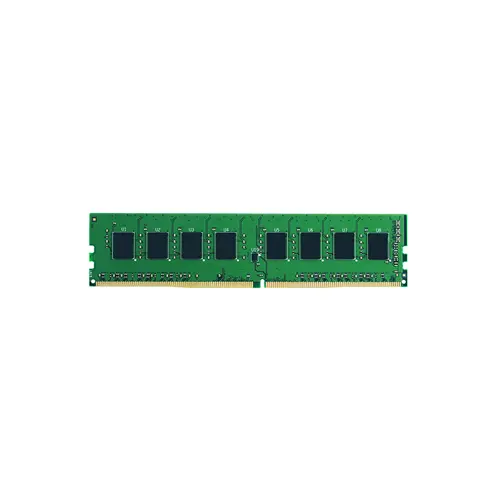
This Micron memory module, identified by its 240-pin UDIMM form factor and ECC support, is engineered for entry-level servers and critical workstations where data integrity cannot be compromised. In a small business NAS that continuously safeguards financial records, its ECC technology silently detects and corrects single-bit errors, preventing silent data corruption from cosmic rays or electrical noise that could otherwise corrupt a file-system or land a transaction in limbo. Because it is unbuffered, the module skips the extra clock cycle needed by registered DIMMs, delivering the lower latency that keeps a lightweight virtualization host responsive when juggling multiple business containers. The single-rank x8 design fires all DRAM chips in parallel, maximizing the theoretical 10.6 GB/s bandwidth of PC3-10600; this translates into faster in-memory database lookups for an inventory management system or snappier response when a web server caches hot content. Running at 1333 MHz with a CAS latency of 9 and the reliable 1.5V standard, it provides predictable, stable timing for round-the-clock operation. For the IT manager building a resilient microserver or a dedicated appliance, this module means that memory errors simply do not become the hidden root cause of downtime.
General Virtualization
For light virtualization with 2GB ECC UDIMMs, a dual‑socket entry‑level server should be populated with at least 12 identical modules (24 GB total) to run a few modest VMs. Distribute modules evenly across memory channels in each socket to maintain interleaved performance and ECC protection. Beyond basic lab use, 2GB DIMMs severely limit VM density, so migration to 8GB or 16GB modules is strongly advised.
In‑Memory Database
In‑memory databases demand large, fast memory pools well beyond the 2GB per‑DIMM capacity. A realistic deployment using these modules would max out a 12‑slot server with 24 GB, which is only viable for tiny development datasets. Configure all channels identically with matched single‑rank DIMMs in one‑DIMM‑per‑channel mode to minimize latency, but plan an immediate upgrade to 16GB RDIMMs for any production workload.
High‑Performance Computing
HPC nodes relying on this 1333MHz ECC UDIMM must populate all available slots—often 12 or 16 per node—to deliver 24–32 GB of memory bandwidth‑optimized capacity. Place one DIMM per channel in a balanced configuration to exploit the full 10.6 GB/s per channel. Such a setup only suits embarrassingly parallel jobs with small memory footprints; modern HPC suites quickly outgrow 2GB modules and need denser, higher‑speed alternatives.
Stress-tested for server reliability. Compatible with Dell PowerEdge R210 II, T110 II, HP ProLiant MicroServer Gen8, Lenovo ThinkServer TS140.
Q: Can I mix this MT9JSF25672AZ-1G4M1 with other memory modules of different brands or speeds?
A: Mixing is not recommended for server environments. Mismatched modules may cause instability, force lower speeds, or disable ECC. For guaranteed reliability, use identical part numbers across all channels.
Q: Is this memory compatible with my system?
A: It suits platforms requiring DDR3 ECC Unbuffered 240-pin UDIMMs, such as Intel Xeon E3-1200 series with C200/C600 chipsets or select AMD Opteron 3000 systems. Verify your board’s QVL for ECC UDIMM support.
Q: What is the recommended DIMM population order for optimal performance?
A: Follow your server board’s manual, typically populating slots farthest from the CPU first. For dual-channel operation, install identical pairs in matching colors to enable interleaving and maximize memory bandwidth.
Q: Does this module support overclocking or XMP profiles?
A: No. This is a JEDEC-compliant server-grade ECC UDIMM. It prioritizes data integrity and stability over overclocking, offering no XMP profiles. Operation is locked to DDR3-1333 with CL9 timings.
Q: What warranty and typical failure rate can I expect?
A: It includes a 1-year warranty. Built with Micron’s stringent testing, the module delivers a low annualized failure rate, ensuring dependable 24/7 operation in mission-critical server and workstation environments.