











 Secure payments
Standard refund policy
Trade Assurance
Secure payments
Standard refund policy
Trade Assurance
| Product Type | Memory Module |
|---|---|
| Compliance Standards | RoHS |
| Memory Capacity | 2 GB |
| Memory Technology | DDR3 |
| Product Voltage | 1.5V |
| RAM Speed | 1333MHz |
| RAM Standard | DDR3-1333/PC3-10600 |
| Error Identifying | ECC |
| Signal Type | Registered |
| Column Access Strobe (CAS) | CL9 |
| Rank | Dual Rank x8 |
| Quantity of Pins | 240-pin |
| RAM Genre | RDIMM |
This RDIMM is engineered for server-class platforms, making it an ideal fit for virtualization, in-memory databases, and other mission-critical workloads where 24/7 data integrity is non-negotiable. Its registered signal architecture paired with ECC ensures stable operation at higher memory densities, while the dual-rank x8 configuration maximizes bandwidth efficiency to support sustained heavy transaction processing.
1. Error Identifying with ECC actively corrects single-bit memory errors, preventing silent data corruption in long-running database and file-serving workloads.
2. Registered signal type buffers the command and address buses, enabling stable operation when populating multiple DIMMs per channel in dense virtualization hosts.
3. Dual Rank x8 organization leverages rank interleaving to overlap sequential accesses, boosting effective bandwidth for mixed-tenant cloud environments.
4. RAM Speed of 1333MHz delivers PC3-10600 peak throughput, sustaining responsive performance under moderate concurrent user loads without oversubscribing the memory controller.
5. CAS latency of CL9 strikes a balance between access time and clock speed, reducing transaction latency for latency-sensitive enterprise applications like in-memory caching.
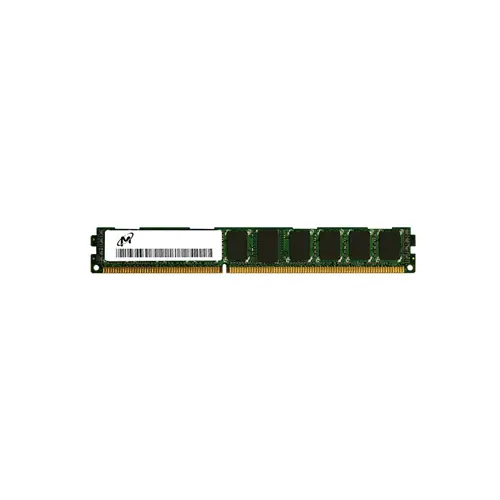
When you deploy a virtualization cluster hosting multiple mission-critical instances or run an in-memory database like Redis, every memory transaction must be flawless. The Micron MT18JSF25672PDZ-1G4G1 is a server-grade DDR3-1333 Registered DIMM built specifically for these scenarios, and its four defining characteristics translate directly into infrastructure resilience. ECC error correction continuously detects and corrects single-bit memory errors caused by background radiation or electrical noise, preventing silent data corruption that could crash a hypervisor or poison a financial reporting database overnight. The registered signal buffer re-drives address and command lines, stabilizing multi-DIMM configurations so you can populate all channels with 2 GB modules without sacrificing signal integrity—essential when consolidating dozens of virtual machines onto a single host. Its dual-rank x8 organization interleaves memory banks for higher effective bandwidth; in a virtualized environment, this means multiple VMs simultaneously accessing storage or processing transactions experience lower latency contention and smoother response. Finally, the 1333 MHz speed with CL9 CAS latency strikes the right balance between throughput and predictable timing for database query caches, keeping frequently accessed tables and indexes hot without stalling the processor. These features work in concert to ensure your server infrastructure remains available, accurate, and performant under load.
General Virtualization
For basic virtualization hosts using these 2GB DDR3-1333 Registered ECC DIMMs, populate at least one module per memory channel to maintain balanced bandwidth. A dual-socket server with triple-channel architecture would use a minimum of six identical modules (12GB total) for light VM loads. However, 2GB capacity severely limits the number and size of virtual machines, so consider lifecycling to higher-density RDIMMs for any consolidation beyond a handful of small services.
In-Memory Database
In-memory databases demand maximum capacity and low latency. Fill every memory channel completely, ideally with two DIMMs per channel (2DPC) for interleaving, but recognize that 2GB modules cap total system memory at a very low ceiling (e.g., 48GB in a 24-slot system). This configuration is only suitable for caching small datasets or development environments. Production deployments require replacing these with 8GB, 16GB, or larger Registered ECC DIMMs to achieve usable working sets.
High-Performance Computing
For HPC workloads, memory bandwidth is critical. Install these dual-rank x8 RDIMMs symmetrically across all memory channels—one or two identical modules per channel—to enable full channel interleaving and minimize access latency. Use matched kits of 6 or 12 modules for triple-channel processors. The 1333MHz speed and CL9 latency are acceptable for compute-bound codes, but the 2GB density restricts problem sizes; add more nodes to scale out, or upgrade to higher-capacity RDIMMs for larger per-node footprints.
Tested compatible with Dell PowerEdge R710, HP ProLiant DL380 G7, and similar servers.
Q: Can I mix this MT18JSF25672PDZ-1G4G1 with other memory modules of different brands or speeds?
A: Mixing registered ECC modules with differing brands or speeds is not recommended. The system will clock all DIMMs to the slowest common speed, potentially causing stability issues and undermining the reliability benefits of ECC memory.
Q: Is this memory compatible with my server? (Intel or AMD platform)
A: This 2GB DDR3-1333 Registered ECC DIMM is compatible with servers using Intel Xeon 5500/5600 series or AMD Opteron 6100/6200 series platforms that require 240-pin RDIMMs. Verify your motherboard's qualified vendor list.
Q: What is the recommended DIMM population order for optimal performance?
A: For dual-socket servers, populate identical DIMMs in matched sets across memory channels, typically starting with the slots farthest from the CPU per channel. Follow your server's specific population guide to enable memory interleaving and maximize bandwidth.
Q: Does this module support overclocking or XMP profiles?
A: No, this is a server-grade Registered ECC DIMM. It operates strictly at JEDEC standard DDR3-1333 with CL9 timings. Overclocking or XMP is not supported, as stability and data integrity are prioritized over non-standard speeds.
Q: What warranty and typical failure rate can I expect?
A: This Micron module carries a 1-year warranty. Typical annualized failure rate (AFR) for enterprise RDIMMs is well below 0.5% under specified conditions, reflecting its built-in error correction and stringent manufacturing standards.