











 Secure payments
Standard refund policy
Trade Assurance
Secure payments
Standard refund policy
Trade Assurance
| Product Type | Memory Module |
|---|---|
| Compliance Standards | RoHS |
| Memory Capacity | 2 GB |
| Memory Technology | DDR3 |
| RAM Speed | 1333 |
| RAM Standard | DDR3-1333/PC3-10600 |
| Error Identifying | Non-ECC |
| Signal Type | Unbuffered |
| Column Access Strobe (CAS) | CL9 |
| Rank | Single Rank x8 |
| Quantity of Pins | 204-pin |
| RAM Genre | SoDIMM |
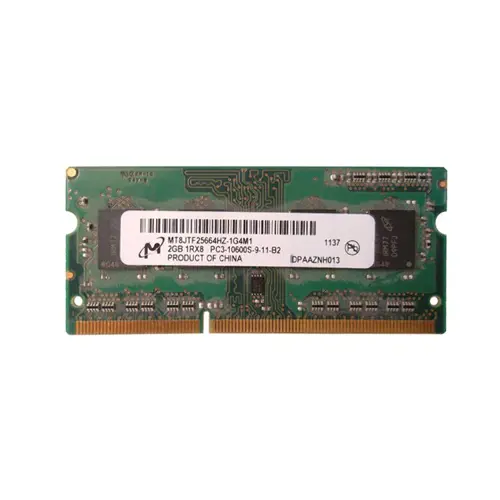
The Micron MT8JTF25664HZ-1G4M1 is a 2GB DDR3-1333 Non-ECC Unbuffered SoDIMM designed specifically for notebook and mobile workstation upgrades, offering a plug-and-play path to improve system responsiveness. Its single-rank x8 organization and CL9 latency ensure stable, low-power operation and broad compatibility with a wide range of older laptops that require 204-pin DDR3 memory.
1. The SoDIMM form factor guarantees a direct physical fit for space-constrained laptop slots, erasing uncertainty during hands-on memory upgrades for ultraportables and all-in-one systems.
2. A modest capacity breathes new life into lightweight operating system environments, keeping secondary ultrabooks productive for browsing, streaming, and basic document workflows rather than retiring them early.
3. DDR3 technology protects long-term signal integrity on aging mobile platforms, allowing the memory controller to operate stably within the narrow thermal headroom of a sealed laptop chassis.
4. The mainstream speed tier lowers the active power envelope just enough to extend unplugged work sessions, reducing fan spin-ups in passively cooled netbook designs.
5. Standard CAS latency shortens the wait for frequently accessed instructions, making the waking-from-idle and tab-switching experience snappy even on minimal-spec portable builds.
The MT8JTF25664HZ-1G4M1 is a 204-pin DDR3-1333 SoDIMM, immediately identifying it as notebook-class memory built for the physical and power constraints of laptops. Its unbuffered, non-ECC architecture and single-rank x8 design are not mere specifications; they are practical enablers. When upgrading an aging ultrabook or a mobile workstation, this module’s single-rank construction imposes a lighter electrical load on the memory controller. That means you avoid the boot failures and stability hiccups that often plague dual-rank sticks in older chipsets, making it a safe, drop-in refresh for a Dell Latitude or a ThinkPad X220. The CL9 latency keeps everyday multitasking responsive: switching between a dozen browser tabs and a video call feels fluid rather than bogged down by hesitation. For a field engineer running lightweight CAD or data analysis on a platform with limited slots, adding this 2 GB module extends the usable life of the machine without reworking the OS or drivers. The compact SoDIMM form factor fits exactly where it should, letting you reclaim productivity in seconds without wrestling with compatibility risks. It is straightforward, dependable memory that respects the tight tolerances of portable systems.
Laptop Upgrade
For systems with a single 2 GB module, the most straightforward capacity doubling is to add an identical MT8JTF25664HZ-1G4M1 SoDIMM in the second slot, yielding 4 GB dual-channel operation—sufficient to noticeably improve responsiveness under Windows 10 or Linux with light multitasking. If the notebook has only one slot, a standalone 4 GB or 8 GB DDR3-1333 SoDIMM (where chipset support allows) can replace the existing module, though you lose the dual-channel benefit. Always verify maximum capacity per slot before purchasing higher-density parts.
Mobile Workstation
This 2 GB single-rank module alone will not satisfy memory-hungry professional applications like CAD, 3D rendering, or large dataset analysis. To maximize capacity on a typical two-slot mobile workstation that supports DDR3, install two of the largest compatible SoDIMMs—often 8 GB per slot for a 16 GB ceiling—and retire the 2 GB module. Populating both channels with matched high-density kits provides the bandwidth and headroom needed for multitasking and avoids crippling disk swapping.
Ultrabook Power Saving
Ultrabooks and thin notebooks benefit from low-voltage DDR3L (1.35 V) SoDIMMs rather than the 1.5 V DDR3 module listed here. If battery runtime is critical, replace the 2 GB module with a single 4 GB or 8 GB DDR3L-1333 SoDIMM; a single module consumes marginally less power than a pair and leaves one rank idle, while the lower voltage directly reduces DRAM energy draw. Ensure the platform explicitly supports DDR3L before swapping, as mixing voltages can cause instability.
Rigorously tested and compatible with notebooks: Dell Latitude E6410, ThinkPad T420, HP EliteBook 8460p.
Q: Can I mix this MT8JTF25664HZ-1G4M1 with other memory modules of different brands or speeds?
A: Mixing is possible but not recommended. The system will default to the slowest speed and may disable dual-channel mode, potentially causing instability. For best results, use identical modules.
Q: Is this memory compatible with my notebook?
A: This DDR3-1333 SODIMM fits notebooks with 204-pin DDR3 slots. Confirm your laptop supports 1333MHz and 2GB per slot. Check the manufacturer’s specifications or use an online compatibility tool.
Q: What is the recommended DIMM population order for optimal performance?
A: For dual-slot notebooks, install matching pairs in both slots to enable dual-channel operation. In single-slot systems, populate the sole slot. Match capacity and rank when possible.
Q: Does this module support overclocking or XMP profiles?
A: No, this is a standard JEDEC-compliant module. It does not support overclocking or XMP profiles. It runs at fixed DDR3-1333 with CL9 timings for reliable operation in notebooks.
Q: What warranty and typical failure rate can I expect?
A: This module carries a 1-year warranty. The typical annualized failure rate is very low, normally under 0.5%, when operated within specified conditions. We ensure RoHS compliance and reliable performance.