











 Secure payments
Standard refund policy
Trade Assurance
Secure payments
Standard refund policy
Trade Assurance
| Product Type | Memory Module |
|---|---|
| Compliance Standards | RoHS |
| Memory Capacity | 2 GB |
| Memory Technology | DDR3 |
| RAM Speed | 1333 |
| RAM Standard | DDR3-1333/PC3-10600 |
| Error Identifying | Non-ECC |
| Signal Type | Unbuffered |
| Column Access Strobe (CAS) | CL9 |
| Rank | Single Rank x8 |
| Quantity of Pins | 204-pin |
| RAM Genre | SoDIMM |
This unbuffered, Non-ECC DDR3-1333 SO-DIMM in a single-rank x8 configuration and CL9 latency is an ideal plug-and-play upgrade for mainstream laptops and mobile workstations still leveraging the DDR3 ecosystem. Its single-rank design ensures broad compatibility and efficient power consumption, while the low-latency CL9 timing helps maintain responsive system performance in everyday productivity and legacy portable platforms.
1. The SoDIMM form factor slides straight into notebook memory banks, transforming a sluggish ultraportable into a responsive daily driver with a tool-free five-minute installation.
2. Single-rank x8 organization curtails the energy demand on the memory controller, directly lowering core platform thermals and preserving precious battery minutes during untethered work.
3. Unbuffered, non-ECC signaling mirrors the native memory interface of consumer laptop chipsets, eliminating any need for BIOS configuration and delivering genuine seamless plug-and-play assurance.
4. DDR3 technology aligns with a vast installed base of business and education laptops, offering a budget-friendly lifeline that restores usable performance to systems running essential productivity suites.
5. A lean capacity tuned for light workloads keeps power envelope and cost modest, providing enough headroom for smooth word processing, email, and thin-client sessions without compromising battery longevity.
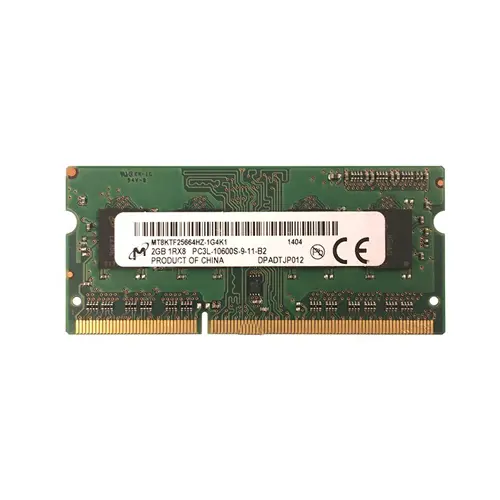
The MT8KTF25664HZ-1G4K1 is clearly a notebook memory module, identified by its 204-pin SODIMM form factor. For professionals upgrading a mobile workstation or breathing new life into an ultrabook, its four defining characteristics translate directly to real-world usability.
First, as an unbuffered DIMM, there is no register chip between the DRAM and the memory controller. This eliminates micro-latency on every command, meaning snappier application launches and more responsive multitasking when you are running a heavy suite of office tools alongside a browser with dozens of tabs. Second, the Non-ECC nature reduces controller overhead and power consumption, preserving precious battery life in a thin-and-light laptop where every watt matters; no background cycles are wasted correcting errors that consumer workloads simply do not encounter. Third, its single-rank x8 organization presents a clean electrical load to the chipset, ensuring broad compatibility with budget and premium notebooks alike, while generating less heat inside a tightly packed chassis. Finally, the native DDR3-1333 speed at CL9 strikes the ideal balance between bandwidth and latency, preventing stuttering during high-definition video conferences or large spreadsheet recalculations. Together, these traits make this module a reliable, drop-in upgrade that instantly restores fluidity to aging portable systems without compromising battery endurance or thermal headroom.
Laptop Upgrade
For a system with a single 2GB DDR3-1333 SO-DIMM, add an identical 2GB module to enable dual-channel mode and double capacity to 4GB. If both slots are filled with 2GB sticks, replace them with a cost‑effective 2×4GB kit of the same speed and unbuffered non‑ECC type for a smooth 8GB upgrade. Always match rank and CL9 timing to avoid compatibility issues.
Mobile Workstation
Maximize capacity by installing the largest supported SO-DIMMs—often 8GB DDR3-1333 non‑ECC modules—in both slots for 16GB total. This configuration handles demanding CAD, 3D rendering, and large datasets, but verify the chipset’s maximum per‑slot limit (many older platforms restrict single modules to 4GB or 8GB). Dual‑channel operation with matched sticks ensures optimal memory bandwidth for professional workloads.
Ultrabook Power Saving
Prioritize DDR3L (1.35V) SO-DIMMs instead of standard 1.5V modules to reduce power draw and extend battery runtime. A 2×4GB low‑voltage kit retains responsive multitasking while leveraging the lower operational voltage to generate less heat in thin chassis. Confirm platform support for DDR3L before upgrading, as some ultra‑low‑voltage designs only accept 1.35V memory.
This unbuffered non-ECC DDR3 SODIMM is rigorously tested and compatible with Dell Latitude E6430, Lenovo ThinkPad X230, and HP EliteBook 8470p.
Q: Can I mix this MT8KTF25664HZ-1G4K1 with other memory modules of different brands or speeds?
A: Mixing is technically possible but not recommended. The system will downclock all modules to the slowest common speed and timings, risking instability. For optimal reliability, install identical modules in your laptop.
Q: Is this memory compatible with my system?
A: It is compatible with laptops that have a DDR3 SoDIMM slot and support 2GB unbuffered, non-ECC modules. It works with many Intel 3rd Gen Core (Ivy Bridge) platforms and AMD A-series APUs using DDR3-1333 memory.
Q: What is the recommended DIMM population order for optimal performance?
A: In laptops with two slots, you can install this single module in either slot. For dual-channel capability, populate both slots with identical modules. As a single-rank module, it operates without specific population ordering constraints.
Q: Does this module support overclocking or XMP profiles?
A: No, this JEDEC-compliant DDR3-1333 SoDIMM does not support overclocking or XMP. It runs at fixed 1333MT/s with CL9 timings to ensure stable, low-power operation in thermally constrained laptop environments.
Q: What warranty and typical failure rate can I expect?
A: This module includes a 1-year limited warranty. Typical failure rates are very low for JEDEC-standard modules under normal use. We provide reliable replacement support if any defect occurs within the warranty period.