











 Secure payments
Standard refund policy
Trade Assurance
Secure payments
Standard refund policy
Trade Assurance
| Product Type | Memory Module |
|---|---|
| Compliance Standards | RoHS |
| Memory Capacity | 2 GB |
| Memory Technology | DDR3 |
| Product Voltage | 1.5V |
| RAM Speed | 1333MHz |
| RAM Standard | DDR3-1333/PC3-10600 |
| Error Identifying | ECC |
| Signal Type | Registered |
| Column Access Strobe (CAS) | CL9 |
| Rank | Single Rank x4 |
| Quantity of Pins | 240-pin |
| RAM Genre | VLP RDIMM |
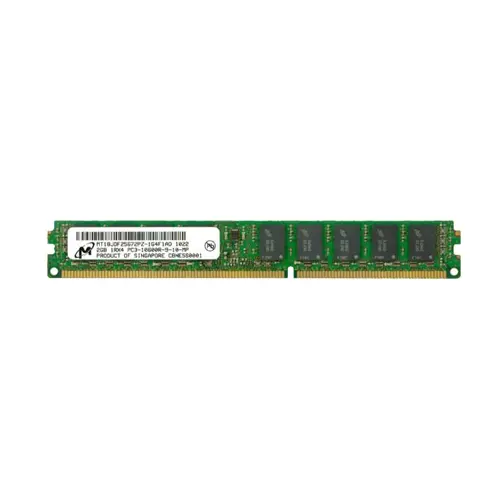
This VLP RDIMM is engineered for dense server environments where physical height clearance is critical, such as 1U rack-mount systems or blade servers, and its registered signal type ensures robust signal integrity across fully populated memory channels. With integrated ECC and single-rank x4 organization, it delivers data reliability and efficient memory controller load balancing ideal for virtualization and light database workloads requiring stable, error-corrected operation.
1. ECC memory detects and corrects single-bit errors in real time, preserving data integrity for financial databases and hypervisor stability in virtualized server environments.
2. Registered signal buffering decouples the memory controller from direct electrical loading, enabling fully populated DIMM slots without compromising signal quality in large-scale server deployments.
3. Very low profile design reduces module height significantly, improving front-to-back cooling and preventing thermal buildup in dense 1U rack servers and blade chassis.
4. Single rank x4 configuration minimizes per-rank power draw, allowing infrastructure architects to pack more memory channels into a power-constrained server node without sacrificing reliability.
5. DDR3-1333 speed class delivers sufficient sustained throughput for entry-level web hosting and lightweight container workloads, balancing operational cost with platform performance.
The Micron MT18JDF25672PZ-1G4F1AD is a DDR3-1333 registered DIMM with ECC and a very low-profile form factor, engineered specifically for servers where uptime and data accuracy are non-negotiable. In a virtualized cluster, memory errors are silent killers: a single bit flip in a hypervisor page table can corrupt a live VM or crash an entire host. The module’s ECC continuously detects and corrects single-bit errors, meaning your multi-tenant environment stays resilient under 24/7 load without unexplained service interruptions. Meanwhile, the registered buffer stabilizes the electrical load on the memory controller, so you can populate all channels without sacrificing signal integrity—critical when you are packing dense nodes for high VM density.
In an in-memory database like Redis or Memcached, responsiveness is everything. The single-rank x4 organization concentrates all DRAM devices on one rank, reducing bus contention and delivering consistently low latency for cache lookups. Paired with the VLP design, this memory slides effortlessly into 1U servers and blade enclosures, improving airflow across adjacent modules and preventing thermal throttling during peak query rates. This is not just memory; it is a guarantee that your virtual infrastructure and real-time data stores perform with the predictability and protection your business demands.
General Virtualization
For virtualized environments hosting multiple VMs, memory capacity and stability are critical. Using this 2 GB ECC Registered DIMM, populate all available channels evenly to maximize bandwidth, but recognize that 2 GB modules will limit total capacity in modern hosts. It is advisable to deploy these modules only in low‑density test clusters or legacy hypervisors; for production, migrate to higher‑density 8 GB or 16 GB RDIMMs to host a reasonable number of guests without excessive swapping.
In‑Memory Database
In‑memory databases such as Redis or SAP HANA demand exceptionally fast access and absolute data integrity, which ECC memory guarantees. However, a 2 GB capacity per stick is severely restrictive for any dataset larger than a few hundred megabytes. If these modules must be used, install the maximum number supported in a balanced configuration to achieve the highest aggregate capacity, but limit the application to development, caching for small datasets, or proof‑of‑concept deployments.
High‑Performance Computing (HPC)
HPC jobs rely on memory bandwidth and the ability to populate large arrays simultaneously. Registered DIMMs allow more modules per channel, but the 2 GB density creates a punishing footprint for node memory. Leverage the ECC error protection for long‑running computational jobs while packing all available memory slots to reach a usable total. This configuration is suitable for lightweight compute nodes running single‑threaded or memory‑light workloads; for memory‑intensive simulations, upgrade to higher‑capacity RDIMMs to avoid node starvation.
Rigorously tested server memory, compatible with Dell PowerEdge R710/R610, HP ProLiant DL380 G7, IBM x3650 M3.
Q: Can I mix this MT18JDF25672PZ-1G4F1AD with other memory modules of different brands or speeds?
A: Mixing registered ECC DDR3 modules from different brands or speeds is not recommended. The system will negotiate to the lowest speed and may face stability issues. For optimal reliability, use identical modules.
Q: Is this memory compatible with my Intel Xeon or AMD Opteron server platform?
A: This 2GB DDR3-1333 VLP RDIMM is designed for servers supporting 1.5V registered ECC memory. Verify your board’s qualified vendor list, but it typically fits dual-processor Intel 5500/5600 series or equivalent AMD platforms with 240-pin slots.
Q: What is the recommended DIMM population order for optimal performance on my server board?
A: Follow your server board’s manual for balanced memory configuration. Typically, populate identical RDIMMs in sets of three per channel (for triple-channel platforms) or according to the memory riser diagram, filling the furthest slot from the CPU first.
Q: Does this module support overclocking or XMP profiles?
A: No. Server-grade registered ECC memory operates at JEDEC standard timings only. Overclocking or XMP is not supported, as data integrity and stability are prioritized over speed in enterprise environments.
Q: What warranty and typical failure rate can I expect for this module?
A: This product carries a one-year warranty. As a rigorously tested enterprise RDIMM, the annualized failure rate is very low (typically <0.5%), ensuring reliable 24/7 operation in compatible servers.