











 Secure payments
Standard refund policy
Trade Assurance
Secure payments
Standard refund policy
Trade Assurance
| Product Type | Memory Module |
|---|---|
| Compliance Standards | RoHS |
| Memory Capacity | 2 GB |
| Memory Technology | DDR3 |
| RAM Speed | 1333MHz |
| RAM Standard | DDR3-1333/PC3-10600 |
| Error Identifying | Non-ECC |
| Signal Type | Unbuffered |
| Column Access Strobe (CAS) | CL9 |
| Rank | Dual Rank x8 |
| Quantity of Pins | 240-pin |
| RAM Genre | UDIMM |
This desktop-class UDIMM, based on DDR3-1333 technology with a low CL9 latency and a dual-rank x8 organization, is ideally suited for mainstream productivity and light content-creation systems where its interleaved dual-rank access improves memory bandwidth efficiency. The unbuffered, non-ECC design ensures broad compatibility with consumer motherboards and delivers the cost-effective stability required for everyday computing and multitasking workloads.
1. Dual Rank x8 interleaved organization boosts memory controller efficiency, enabling smoother multitasking and faster content creation in desktop productivity suites.
2. CL9 low-latency timing accelerates data retrieval, giving competitive gamers reduced input lag and snappier in-game reactions.
3. 1333MHz clock speed delivers a peak transfer rate that keeps everyday desktop applications responsive and eliminates micro-stutters during HD media playback.
4. 2GB capacity breathes new life into older desktop systems, handling multiple browser tabs and office documents without heavy swapping.
5. UDIMM format with unbuffered signaling ensures plug-and-play simplicity for cost-effective DIY desktop upgrades and broad chipset compatibility.
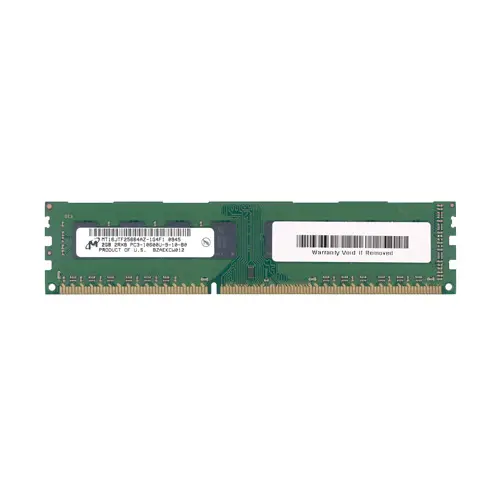
Designed for desktop platforms, the Micron MT16JTF25664AZ-1G4F1 is a 2GB DDR3-1333 UDIMM whose architectural decisions directly translate into tangible performance benefits in gaming and content creation. Its non‑ECC, unbuffered signal path eliminates the additional controller cycles and clock penalties found in registered server memory. For a gamer, that means every CAS‑9 column access resolves without the slightest overhead, producing crisper hit registration in fast‑paced shooters and snappier texture streaming across expansive open worlds. At the same time, the dual‑rank x8 organization interleaves two independent sets of DRAM pages on the module. While the system is chewing through a video rendering pass, this rank interleaving allows the memory controller to prefetch and pipe the next data block while the current one is still being written, effectively raising sustained bandwidth without increasing clock speed. Coupled with a true CAS latency of 9 cycles at 1333MHz, the module keeps frame times fluid under heavy After Effects compositions and maintains seamless multitasking when you are jumping between a 3D viewport, a browser loaded with references, and a real‑time preview. Instead of raw overclocking headroom, you get deterministic, low‑latency response that desktop enthusiasts and creative professionals can rely on for stability‑critical work. All of this arrives on the ubiquitous 240‑pin DDR3 footprint with full RoHS compliance, making it a straightforward, responsible upgrade for older Intel and AMD systems that need consistent performance, not server‑grade error correction.
The module’s Non-ECC, unbuffered, 240‑pin UDIMM form factor identifies it as standard desktop memory.
Gaming Build
These 2 GB modules only suit ultra‑budget or retro gaming. For dual‑channel operation, fit two matched DIMMs for 4 GB total; populating all four slots yields 8 GB, which handles older titles. Modern 16 GB or 32 GB gaming kits demand higher‑density sticks—mixing these low‑capacity DIMMs is not advised.
Content Creation
Video editing and 3D rendering workloads that need 64 GB cannot be served by 2 GB DIMMs. Even with four slots the maximum is 8 GB, causing excessive paging and slowdowns. Creators should replace them entirely with 8 GB or 16 GB DDR3 modules to reach productive capacities.
General Productivity
For web browsing, office apps, and light multitasking, a pair of these 2 GB modules gives a cost‑effective 4 GB baseline. Adding two more to reach 8 GB noticeably improves responsiveness under Windows 10. Always install identical sticks to preserve stability and get the best value from older hardware.
Rigorously tested DDR3 UDIMM, compatible with desktops like Dell OptiPlex 790/990 and HP Compaq 8200 Elite.
Q: Can I mix this MT16JTF25664AZ-1G4F1 with other memory modules of different brands or speeds?
A: Mixing is possible but not recommended. For optimal stability, use identical modules. Mismatched speeds force all DIMMs to operate at the lowest common frequency.
Q: Is this memory compatible with my system?
A: This DDR3 UDIMM fits desktops with standard 240-pin slots. It works with Intel 5/6/7 Series or AMD 800/900 chipsets that support non‑ECC 1333MHz memory. Verify your board’s specifications.
Q: What is the recommended DIMM population order for optimal performance?
A: For dual‑channel operation, install matched pairs in the same‑colored slots. Typically populate the second and fourth slots (A2 and B2) first; always consult your motherboard manual.
Q: Does this module support overclocking or XMP profiles?
A: No. This is a JEDEC‑compliant standard module without XMP support. It runs exclusively at a fixed 1333MHz CL9 and does not accept overclocking or timing adjustments.
Q: What warranty and typical failure rate can I expect?
A: It includes a 1‑year warranty. The module’s typical annualized failure rate is extremely low, generally under 0.5%, reflecting mature DDR3 technology and rigorous testing.