











 Secure payments
Standard refund policy
Trade Assurance
Secure payments
Standard refund policy
Trade Assurance
| Product Type | Memory Module |
|---|---|
| Compliance Standards | RoHS |
| Memory Capacity | 2 GB |
| Memory Technology | DDR3 |
| RAM Speed | 1333MHz |
| RAM Standard | DDR3-1333/PC3-10600 |
| Error Identifying | Non-ECC |
| Signal Type | Unbuffered |
| Column Access Strobe (CAS) | CL9 |
| Rank | Single Rank x8 |
| Quantity of Pins | 240-pin |
| RAM Genre | UDIMM |
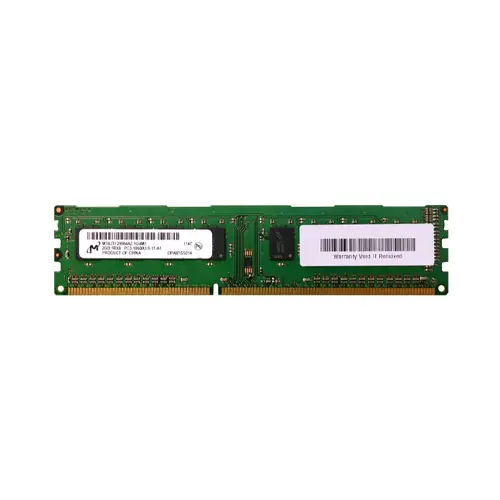
This unbuffered, non-ECC UDIMM is built for mainstream desktop platforms, providing reliable DDR3-1333 performance for everyday productivity, light content creation, and legacy gaming systems. Its single-rank x8 organization and CL9 latency ensure stable signaling and low controller loading, making it an ideal drop-in upgrade for older Intel or AMD builds that require 2GB capacity without excessive power draw.
1. Tight CAS timings reduce memory access latency, giving content creation tools and competitive games the instant responsiveness needed for seamless real-time editing and precise reaction inputs.
2. Single Rank x8 organization lightens the load on the processor’s memory controller, unlocking extra overclocking headroom and greater tuning stability for budget-minded enthusiast builds.
3. Unbuffered signal architecture keeps the electrical path straightforward and short, slicing off microseconds that translate into faster command execution in fast-paced multiplayer titles.
4. High-bandwidth DDR3 frequency boosts frame pacing consistency and accelerates texture streaming, helping open-world and simulation games maintain immersive visual flow.
5. Entry-level density provides enough workspace for snappy everyday multitasking and legacy gaming, offering a reliable, cost-efficient upgrade path for older desktop platforms.
The MT8JTF25664AZ-1G4M1 is a desktop UDIMM built for performance-driven PCs. Its four defining traits directly tackle real user frustrations. As an unbuffered module, it communicates with the CPU without intervening registers, cutting latency to the bare minimum. For a competitive gamer, this means every click and keystroke translates into near-instant on-screen action, eliminating the micro-stuttering that can cost a match. The CL9 timing at 1333MHz further accelerates data retrieval; video editors scrubbing through 4K footage will notice smoother previews and faster exports because the processor isn’t kept waiting for large asset files. The Non-ECC design skips error correction overhead, concentrating pure throughput for creative and entertainment workloads that value speed over server-grade data integrity. Finally, the single-rank x8 layout and 240-pin UDIMM interface ensure effortless compatibility with mainstream desktop boards, making it a risk-free upgrade that extends an older machine’s useful life—allowing you to multitask across demanding applications without the dreaded disk thrashing.
Gaming Build
For dual‑channel operation, install a matched pair of these 2 GB UDIMMs to get 4 GB of interleaved memory, which raises bandwidth for older or less demanding titles. Most consumer boards have four slots, so populating all four yields 8 GB—a practical ceiling with these modules. If a 16 GB or 32 GB kit is required, replace them with higher‑density DDR3 sticks; the 2 GB parts are best suited to entry‑level legacy gaming rigs.
Content Creation
Video editing and 3D rendering typically demand 64 GB or more, but a four‑slot desktop board filled with these 2 GB DIMMs only reaches 8 GB. That is insufficient for professional timelines or complex scenes, causing heavy swapping. Use the 2 GB modules solely for system diagnostics or a lightweight scratch disk, and install 8 GB or 16 GB modules to achieve the large capacities creative applications require.
General Productivity
A single 2 GB module covers basic office tasks, while a pair (4 GB total) in dual‑channel mode provides snappier responsiveness for multitasking and integrated graphics. Filling all four DIMM slots delivers 8 GB, a cost‑effective sweet spot for smooth web browsing, email, and office suites. This configuration leverages an existing stock of these 2 GB modules without any additional investment.
Rigorously tested, this non-ECC DDR3-1333 UDIMM fits desktops like Dell OptiPlex 780/790, HP Compaq 6005 Pro.
Q: Can I mix this MT8JTF25664AZ-1G4M1 with other memory modules of different brands or speeds?
A: Mixing different brands or speeds is not recommended. For stability, use identical DDR3 UDIMMs. The system will downclock all modules to the slowest common speed and may experience compatibility issues.
Q: Is this memory compatible with my system?
A: It fits desktop motherboards with 240-pin DDR3 slots supporting non-ECC unbuffered memory. Verify your chipset supports DDR3-1333/PC3-10600 (e.g., Intel 6/7/8 Series, AMD 800/900 Series). Check your board’s memory QVL.
Q: What is the recommended DIMM population order for optimal performance?
A: As a single 2GB module, it can be installed in any DDR3 slot. For dual-channel configurations, install a second identical module in the corresponding slot as per your motherboard manual.
Q: Does this module support overclocking or XMP profiles?
A: No. This is a standard JEDEC DDR3-1333 CL9 UDIMM. It does not support XMP profiles or overclocking; it operates exclusively at its rated 1333MHz with fixed timings.
Q: What warranty and typical failure rate can I expect?
A: This Micron memory module carries a 1-year warranty. It is built to exacting standards with a typical annualized failure rate well below 0.5% under normal operating conditions.