











 Secure payments
Standard refund policy
Trade Assurance
Secure payments
Standard refund policy
Trade Assurance
| Product Type | Memory Module |
|---|---|
| Compliance Standards | RoHS |
| Memory Capacity | 2 GB |
| Memory Technology | DDR3 |
| RAM Speed | 1333MHz |
| RAM Standard | DDR3-1333/PC3-10600 |
| Error Identifying | Non-ECC |
| Signal Type | Unbuffered |
| Column Access Strobe (CAS) | CL9 |
| Rank | Single Rank x8 |
| Quantity of Pins | 240-pin |
| RAM Genre | UDIMM |
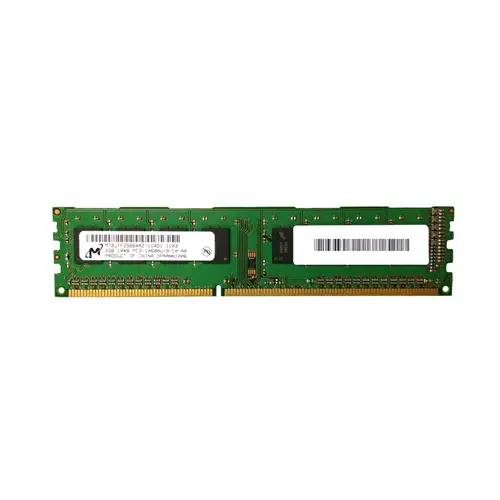
This UDIMM DDR3-1333 module is clearly a desktop memory kit, ideal for entry-level productivity or legacy system upgrades, with its single-rank x8 configuration reducing electrical loading for better signal integrity on older platforms. Operating at CL9 with a low 9-cycle CAS latency, it also leverages unbuffered signaling to minimize access delays in single-threaded tasks and lightweight content creation.
1. The PC3-10600 peak bandwidth keeps background apps and browser tabs responsive, supporting a seamless multitasking experience on mainstream desktops.
2. A nine-cycle CAS latency reduces the time the CPU waits for data, contributing to higher frame rates and smoother gameplay in graphics-intensive titles.
3. Unbuffered signaling eliminates additional latency, allowing the memory controller to access DRAM directly for snappy day-to-day operations and faster load times.
4. The UDIMM form factor fits standard desktop sockets, making it an effortless drop-in upgrade for aging office PCs or entry-level gaming rigs.
5. Single Rank configuration places less strain on the memory controller, improving overclocking headroom and stability for enthusiasts pushing modest frequency gains.
The MT8JTF25664AZ-1G4D1 is a desktop UDIMM engineered for consumer platforms, and its four defining characteristics directly address the real-world demands of legacy system users. Its Non-ECC nature eliminates the overhead of error correction, meaning every clock cycle is dedicated purely to moving data. For a gamer deep in a twitch-sensitive title like Counter-Strike 2, this translates into the lowest possible latency between an action and its on-screen response, avoiding the micro-stutter that parity checks can introduce on unsupported chipsets. The Unbuffered signal type reinforces this by letting the memory controller talk directly to the DRAM chips without a register delay, sharpening command execution during intense firefights.
The DDR3-1333 speed with a tight CAS latency of 9 balances respectable bandwidth with quick access times. When you are rendering a 1080p timeline in DaVinci Resolve or running multiple browser tabs alongside a legacy CAD tool, that CL9 rating ensures the CPU is fed data rapidly, preventing the application lag that plagues higher-latency budget modules. Finally, the Single Rank x8 architecture places a lighter electrical load on older motherboards’ memory controllers. This maximizes compatibility with vintage AM3 or LGA1155 boards and leaves room for a more stable multi-module configuration, giving a second life to a system without chasing the latest standards.
This is a standard desktop DDR3 UDIMM, non-ECC and unbuffered, suited for older consumer platforms.
Gaming Build
Dual‑channel memory is essential for gaming performance. These 2 GB modules are too small to reach modern 16 GB or 32 GB targets—a 16 GB configuration would require eight modules, exceeding typical four‑slot motherboards. If you must use them, populate four slots for an 8 GB dual‑channel kit, which handles older titles but bottlenecks current games. For a balanced build, replace with two 8 GB or four 4 GB DDR3 DIMMs instead.
Content Creation
Video editing and 3D rendering demand large capacities, ideally 64 GB across four slots. Four of these 2 GB modules yield only 8 GB, causing frequent disk swapping. For light content work, maximize capacity by installing four 2 GB sticks in dual‑channel mode, but this is a stopgap. A true workstation should adopt 8 GB or 16 GB modules to fill all slots with 32‑64 GB total, dramatically improving render times.
General Productivity
Cost‑effective multitasking benefits from at least 4 GB. A pair of these 2 GB modules delivers 4 GB of dual‑channel memory, sufficient for basic office tasks and web browsing. For snappier performance, fill all four slots to reach 8 GB, which comfortably runs modern productivity suites and many browser tabs without overspending.
Rigorously tested DDR3 UDIMM, compatible with desktops: Dell OptiPlex 790, HP Compaq 8200 Elite, Lenovo ThinkCentre M91p.
Q: Can I mix this MT8JTF25664AZ-1G4D1 with other memory modules of different brands or speeds?
A: Mixing brands or speeds may cause instability. For best results, use identical modules. If mixed, the system defaults to the slowest speed and loosest timings, which can degrade performance.
Q: Is this memory compatible with my desktop system using an Intel H61 or AMD 900-series chipset?
A: Yes, this 240-pin DDR3 UDIMM is compatible with most desktop boards supporting 2nd/3rd Gen Intel Core or equivalent AMD platforms. Verify your motherboard supports non-ECC, unbuffered DDR3-1333.
Q: What is the recommended DIMM population order for optimal performance?
A: Consult your motherboard manual. Typically, populate slots furthest from the CPU first. For dual-channel, install matched pairs in the same colored slots to enable symmetric memory access.
Q: Does this module support overclocking or XMP profiles?
A: No. This is a JEDEC-standard DDR3-1333 module with no XMP support. It is designed to run reliably at 1333MHz CL9 without manual tuning or voltage adjustments.
Q: What warranty and typical failure rate can I expect?
A: This module carries a one-year warranty. Built to RoHS standards, its typical annualized failure rate is below 0.5%, ensuring long-term reliability for standard desktop deployments.