











 Secure payments
Standard refund policy
Trade Assurance
Secure payments
Standard refund policy
Trade Assurance
| Model | MT9JSF25672AZ-1G4K1 |
|---|---|
| Product Type | Memory Module |
| Compliance Standards | RoHS |
| Memory Capacity | 2 GB |
| Memory Technology | DDR3 |
| Product Voltage | 1.5V |
| RAM Speed | 1333MHz |
| RAM Standard | DDR3-1333/PC3-10600 |
| Error Identifying | ECC |
| Signal Type | Unbuffered |
| Column Access Strobe (CAS) | CL9 |
| Rank | Single Rank x8 |
| Quantity of Pins | 240-pin |
| RAM Genre | UDIMM |
This 2GB DDR3-1333 UDIMM with ECC is designed for entry-level servers and workstations where data integrity is critical, utilizing unbuffered ECC technology to detect and correct single-bit memory errors without compromising system stability. Its single-rank x8 organization and CL9 latency ensure reliable operation and broad compatibility with platforms that require low-density, standard 1.5V DDR3 memory for light virtualization or legacy NAS appliances.
1. ECC protection detects and corrects single-bit errors in real time, safeguarding financial transactions and database integrity on entry-level servers that cannot afford silent data corruption.
2. Unbuffered signal topology minimizes access latency, giving lightweight virtualization hosts and edge appliances a responsiveness boost under frequent small-query workloads.
3. A two-gigabyte capacity per module strikes the right balance for dedicated appliance OS instances or lightweight container hosts without wasting memory resources.
4. The data rate of thirteen hundred and thirty-three mega transfers per second supplies enough throughput to keep a microservice stack responsive when simultaneous client requests spike.
5. Single Rank x8 organization draws less current per DIMM and eases the load on the memory controller, enabling stable multi-slot population in compact servers that prioritize uptime over raw capacity.
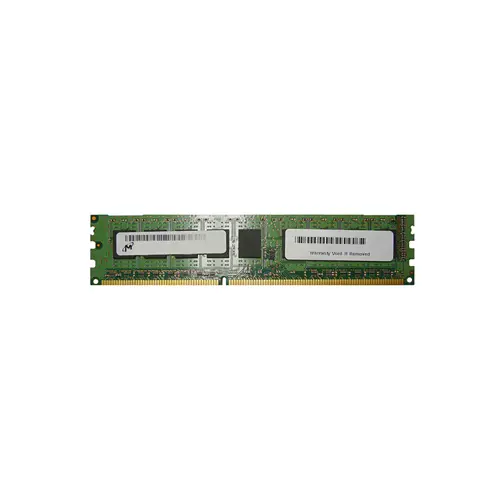
The MT9JSF25672AZ-1G4K1 is a DDR3 Unbuffered ECC memory module purpose-built for entry-level servers and always-on systems where data dependability outweighs raw capacity. Its ECC capability translates directly to tangible data integrity. In a 24/7 network video recorder, it silently corrects single-bit memory errors before they can corrupt critical surveillance footage, eliminating the risk of lost evidence from cosmic-ray-induced bit flips. Because it is unbuffered, the module shuns the register latency of RDIMMs, delivering snappier response times for lightweight virtualized firewalls or inventory databases that must process transactional queries without delay. The 1333MHz speed delivers a steady 10.6GB/s of bandwidth, effortlessly handling concurrent access from multiple POS terminals. Meanwhile, the single-rank x8 configuration minimizes electrical loading on the memory bus. When you breathe new life into a legacy single-socket file server, this refined signal integrity translates into flawless POST sequences and rock-steady uptime, eliminating the random reboots that typically sabotage aging platforms. For operators who simply cannot afford silent data corruption or unexplained downtime, this module wraps vital error protection in a responsive, compatibility-friendly design.
This is server-class memory — a DDR3-1333 ECC Unbuffered DIMM designed for entry-level servers and workstations that require data integrity. Effective capacity planning with these 2 GB modules depends on populating channels symmetrically.
General Virtualization
Install at least four identical modules (8 GB total) in a dual-channel configuration to support a handful of light VMs. Populate both memory channels equally to enable interleaving and maximize throughput. ECC protection guards guest operating systems against silent memory errors.
In-Memory Database
Fill every available DIMM slot with these 2 GB ECC UDIMMs to reach the highest possible capacity, because in-memory datasets demand large RAM. ECC is non-negotiable for data accuracy. Although 2 GB per module is small today, a fully populated 6‑slot or 12‑slot board can still host caching nodes or small Redis instances.
High-Performance Computing (HPC)
Install one identical module per memory channel (e.g., populate all blue slots on a quad-channel board) to achieve balanced interleaving and peak bandwidth. Use the exact same part number across all slots to maintain timing consistency. Even at modest total capacity, error-free throughput and low latency are critical for parallel scientific workloads.
Rigorously tested, compatible with Dell PowerEdge R210 II, HP ML110 G7, Lenovo TS140.
Q: Can I mix this MT9JSF25672AZ-1G4K1 with other memory modules of different brands or speeds?
A: Mixing modules is not recommended, especially in servers. It may force all DIMMs to the lowest common speed and disable ECC functionality, risking data integrity and system stability.
Q: Is this memory compatible with my system? (Intel or AMD server platform)
A: This DDR3-1333 ECC UDIMM works with Intel Xeon E3 series (Socket LGA1155/1150) and select AMD Opteron platforms that explicitly support unbuffered ECC memory. Verify your motherboard's qualified vendor list.
Q: What is the recommended DIMM population order for optimal performance?
A: Install identical modules in DIMM slots per your server board's manual. For single-rank x8 UDIMMs, populate one DIMM per channel first (usually blue slots) to enable independent channel mode and maximize memory bandwidth.
Q: Does this module support overclocking or XMP profiles?
A: No. This is a server-grade ECC UDIMM operating at JEDEC standard DDR3-1333 CL9. It does not support overclocking or Intel XMP. Reliability and data integrity take precedence over performance tuning.
Q: What warranty and typical failure rate can I expect?
A: This module includes a 1-year warranty. Enterprise DDR3 ECC UDIMMs exhibit an annualized failure rate (AFR) typically below 0.5% under proper cooling and specified voltage, ensuring stable long-term server operation.