











 Secure payments
Standard refund policy
Trade Assurance
Secure payments
Standard refund policy
Trade Assurance
| Product Type | Memory Module |
|---|---|
| Compliance Standards | RoHS |
| Memory Capacity | 2 GB |
| Memory Technology | DDR3 |
| RAM Speed | 1333MHz |
| RAM Standard | DDR3-1333/PC3-10600 |
| Error Identifying | Non-ECC |
| Signal Type | Unbuffered |
| Column Access Strobe (CAS) | CL9 |
| Rank | Dual Rank x8 |
| Quantity of Pins | 240-pin |
| RAM Genre | UDIMM |
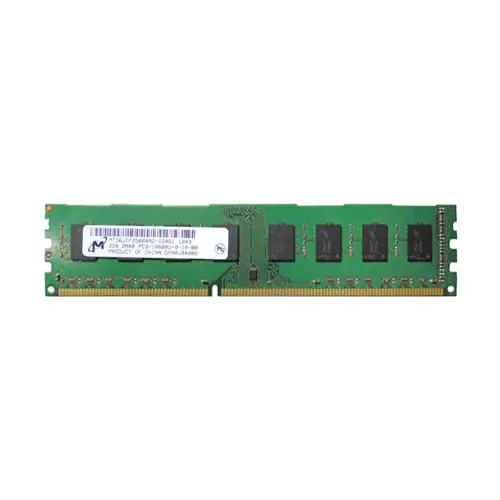
This UDIMM module is a standard desktop DDR3-1333 memory kit, designed for mainstream productivity and light content-creation systems where non-ECC, unbuffered operation is typical. Its dual-rank x8 organization improves interleaving efficiency for better bandwidth utilization, while the CL9 latency and 1333 MT/s speed deliver a responsive experience in legacy upgrades.
1. A modest 2 GB density handles legacy productivity suites and light web browsing with ease, preventing slowdowns in everyday office desktops.
2. 1333 MHz operation provides the steady bandwidth needed for smooth HD media playback and responsive application launches on mainstream consumer rigs.
3. CL9 latency tightens the gap between data requests and delivery, giving desktop users a snappier feel when switching tasks or opening files.
4. Dual Rank x8 architecture interleaves memory banks to accelerate parallel workloads, keeping multitasking fluid when juggling spreadsheets, browsers, and communication apps.
5. Unbuffered signal topology guarantees broad motherboard compatibility and stable operation, making drop-in upgrades effortless for budget-conscious desktop builders.
When you upgrade an aging desktop that still runs essential productivity tools or revisit a classic 3A title at comfortable settings, every microsecond of memory latency shapes the experience. The Micron MT16JTF25664AZ-1G4G1 is a 2 GB DDR3-1333 UDIMM purpose‑built for standard desktop platforms, and its four defining characteristics directly address the real frustrations of users who refuse to compromise on system responsiveness.
Its Non‑ECC, unbuffered architecture eliminates the extra cycle of error‑correction and register chips found in server memory, so command‑to‑response latency stays tight. For a gamer, that means an enemy strafe in a fast shooter registers without a perceptible hitch; for a video editor scrubbing through a 1080p timeline, the interface feels snappier because the CPU is not idly waiting on memory handshakes. The DDR3‑1333 speed rating paired with a CL9 CAS delivers a predictable 13.5‑nanosecond first‑word access, translating background anti‑virus scans or multiple browser tabs into smooth, interruption‑free multitasking instead of momentary freezes.
The dual‑rank x8 organization keeps the memory bank interleaved, sustaining higher bandwidth under concurrent loads. When you render a complex scene while a spreadsheet and a dozen chrome tabs remain open, this internal parallelism prevents the stuttering that single‑rank modules often cause. Thanks to the standard 240‑pin UDIMM form factor, the module fits instantly into a wide range of desktop Intel and AMD platforms from the DDR3 era, making it a plug‑and‑play rescue for a sluggish office PC or a home media center that stumbles after years of service. For a modest investment, you restore fluent daily computing and unlock respectable multimedia handling without chasing costly platform swaps.
Based on the specifications — Non-ECC, Unbuffered, DDR3-1333 UDIMM with 240 pins — this is a desktop memory module. Below is the capacity planning guidance for typical desktop usage scenarios.
Gaming Build
For a dual-channel gaming rig, a single 2 GB stick is outdated. Aim for at least 16 GB using a matched kit of two 8 GB modules, or configure 32 GB via two 16 GB modules for newer AAA titles and streaming. Always install identical pairs to enable dual-channel bandwidth, which noticeably improves frame rates and responsiveness.
Content Creation
Video editing and 3D rendering thrive on capacity. Populate all four DIMM slots with 16 GB modules to reach 64 GB. This minimizes disk swapping during timeline scrubbing and reduces render times. Prioritize matched quad-channel sets where supported, but for most consumer platforms paired dual-channel kits provide sufficient throughput for 4K workflows.
General Productivity
Office multitasking, web browsing, and light productivity require far less investment. A single 8 GB stick offers smooth everyday performance and leaves room for a future 8 GB upgrade. For the strictest budgets, 4 GB (via two 2 GB modules in dual-channel) keeps costs minimal while preserving acceptable responsiveness in lightweight tasks.
Rigorously tested for desktops, compatible with Dell OptiPlex 790, HP Compaq 8200 Elite, Lenovo ThinkCentre M81.
Q: Can I mix this MT16JTF25664AZ-1G4G1 with other memory modules of different brands or speeds?
A: Mixing is possible but not guaranteed. For optimal stability, use identical modules with matching speed, timings, and voltage. The system will operate at the lowest common specification.
Q: Is this memory compatible with my system?
A: This 240-pin DDR3-1333 UDIMM is designed for desktop motherboards with compatible chipsets. Verify your board supports unbuffered, non-ECC DDR3 memory and has available DIMM slots.
Q: What is the recommended DIMM population order for optimal performance?
A: For dual-channel operation, install identical modules in the same-colored slots, typically DIMM 1 and DIMM 2. Refer to your motherboard manual for the exact configuration to enable full bandwidth.
Q: Does this module support overclocking or XMP profiles?
A: No, this is a JEDEC-compliant module without XMP. It operates at fixed DDR3-1333 CL9 specifications and does not support overclocking. Its primary design goal is stable, standard-speed operation.
Q: What warranty and typical failure rate can I expect?
A: This module includes a 1-year warranty covering manufacturing defects. The typical annualized failure rate (AFR) is below 0.2%, ensuring reliable long-term performance in desktop environments.