











 Secure payments
Standard refund policy
Trade Assurance
Secure payments
Standard refund policy
Trade Assurance
| Product Type | Memory Module |
|---|---|
| Compliance Standards | RoHS |
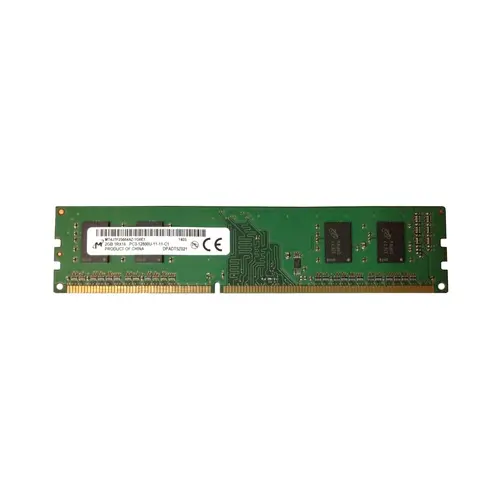
| Memory Capacity | 2 GB |
| Memory Technology | DDR3 |
| RAM Speed | 1600MHz |
| RAM Standard | DDR3-1600/PC3-12800 |
| Error Identifying | Non-ECC |
| Signal Type | Unbuffered |
| Column Access Strobe (CAS) | CL11 |
| Rank | Single Rank x16 |
| Quantity of Pins | 240-pin |
| RAM Genre | UDIMM |
1
1. UDIMM form factor fits effortlessly into standard desktop motherboards, ensuring a hassle-free upgrade path for everyday users.
2. Sufficient memory footprint supports essential business applications and media playback, breathing new life into older systems without extra investment.
3. Elevated data rate accelerates multitasking, allowing seamless transitions between office tools, web browsing, and background services.
4. Low column access latency delivers crisp system response, which casual gamers and content consumers feel as quicker load times and smoother interactions.
5. Single-rank layout with optimized chip architecture reduces memory controller demand, promoting stability and enabling modest tuning headroom for enthusiasts.
For aging desktop platforms, the MT4JTF25664AZ-1G6E1 2GB DDR3-1600 UDIMM proves that meticulous design directly shapes your daily experience. Its non-ECC, unbuffered architecture eliminates the overhead of error correction and buffer registers, allowing the memory controller to issue commands straight to the DRAM. In a competitive AAA game, this translates into snappier hit registration and fewer micro-stutters when every millisecond counts. The 1600MHz clock and 12.8 GB/s bandwidth then take over during professional workloads. While rendering a complex 4K video timeline, the sustained throughput keeps the CPU saturated with high-bitrate frames, preventing the dreaded preview freeze. The single-rank x16 organization further refines that stability by lowering the electrical load on older chipsets, which means you can drop the module into a vintage workstation and still enjoy consistent peak performance. With a CL11 latency that pairs lean responsiveness with compatibility, you are not just adding capacity; you are recovering the fluid, uninterrupted workflow and gaming immersion that a sluggish system gradually steals away.
Gaming Build
For a dual-channel DDR3 gaming setup, a pair of these 2 GB UDIMMs provides 4 GB total, which is barely enough for older titles. To reach a functional 8 GB, populate all four motherboard slots with identical 2 GB modules—this sustains dual-channel interleaving but still falls short of modern 16 GB recommendations. Given the low density, these DIMMs are best reserved for budget retro builds; a modern gaming rig demands higher-capacity DDR3 kits.
Content Creation
Video editing and 3D rendering thrive on large memory pools, often 32–64 GB. A single 2 GB module is impractical here: even a fully populated four-slot board yields only 8 GB, causing excessive disk swapping under demanding timelines or high-resolution renders. Creators should bypass these 2 GB sticks and instead install 8 GB or 16 GB UDIMMs per channel to reach productive capacities while maintaining acceptable performance.
General Productivity
For web browsing, office suites, and light multitasking, two 2 GB modules in dual-channel mode (4 GB total) offer a cost-effective baseline on an older DDR3 desktop. Bumping up to four matching 2 GB sticks (8 GB) noticeably smooths multi-tab browser sessions and concurrent applications. This approach maximizes the value of these low-cost DIMMs for email, document editing, and video conferencing, provided the operating system is a lightweight 64-bit edition.
Rigorously tested, compatible with desktop PCs like Dell OptiPlex 7010, HP Elite 8300, Lenovo M92p.
Q: Can I mix this MT4JTF25664AZ-1G6E1 with other memory modules of different brands or speeds?
A: Yes, you can mix it with other DDR3 modules, but the system will operate at the slowest module's speed. For best stability, use identical modules in matched pairs.
Q: Is this memory compatible with my system?
A: This 240-pin DDR3 UDIMM is compatible with desktop motherboards supporting PC3-12800, including Intel 6/7-series and AMD AM3+ chipsets. Please verify your board's QVL list for guaranteed compatibility.
Q: What is the recommended DIMM population order for optimal performance?
A: Install identical modules in pairs into same-colored slots to enable dual-channel mode. Single-module operation reduces memory bandwidth; populate symmetrical slots first for best throughput.
Q: Does this module support overclocking or XMP profiles?
A: This standard JEDEC DDR3-1600 module does not support XMP. Manual overclocking may be attempted in BIOS, but operation beyond rated specifications is not guaranteed for stability.
Q: What warranty and typical failure rate can I expect?
A: This module includes a one-year limited warranty. Typical annualized failure rate is below 0.5%, backed by rigorous production testing to ensure reliable long-term operation.