











 Secure payments
Standard refund policy
Trade Assurance
Secure payments
Standard refund policy
Trade Assurance
| Product Type | Memory Module |
|---|---|
| Compliance Standards | RoHS |
| Memory Capacity | 2 GB |
| Memory Technology | DDR3 |
| RAM Speed | 1600MHz |
| RAM Standard | DDR3-1600/PC3-12800 |
| Error Identifying | Non-ECC |
| Signal Type | Unbuffered |
| Column Access Strobe (CAS) | CL11 |
| Rank | Single Rank x8 |
| Quantity of Pins | 240-pin |
| RAM Genre | UDIMM |
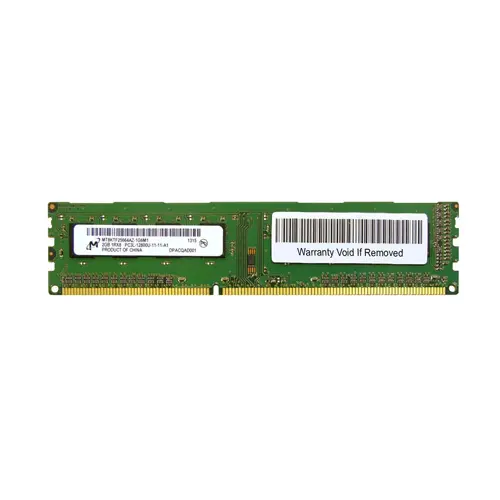
This is a standard desktop memory module, as indicated by its 240-pin DDR3 UDIMM form factor and Non-ECC, unbuffered signal type, making it ideally suited for entry-level productivity PCs and light content creation workloads. Its single-rank x8 organization minimizes electrical loading on the memory controller, which enhances compatibility and signal integrity in older dual-channel platforms while maintaining responsive CL11 latency at 1600MHz.
1. Modest capacity keeps legacy desktops running lightweight operating systems and productivity suites smoothly, preventing swap-file slowdowns during everyday browser-based tasks.
2. Elevated DDR3 transfer rate supplies data quickly to the processor, reducing frame-time jitter in budget triple-A titles and ensuring crisp multimedia streaming without dropped frames.
3. Relaxed column-access latency promotes unwavering compatibility across mainstream consumer chipsets, eliminating cold-boot surprises when refreshing an older family PC.
4. Single-rank organization lowers electrical loading on the memory controller, enabling painless dual-channel pairing for casual users craving a snappier multi-window workflow.
5. Unbuffered, non-ECC UDIMM architecture mirrors typical desktop-platform expectations, delivering effortless tool-free upgrades and immediate system recognition for mainstream gaming and home-office builds.
When you slot this 2 GB DDR3‑1600 UDIMM (MT8KTF25664AZ‑1G6M1) into a desktop, the unbuffered, non‑ECC architecture isn’t a missing feature—it’s your direct path to snappier, interruption‑free computing. In AAA gaming, every nanosecond counts. Unbuffered signal routing eliminates the intermediary register chip found in server memory, cutting latency and letting the memory controller talk straight to the DRAM cells. That minimal command path, paired with CL11 timings, reduces input lag and stutter in fast‑paced shooters or open‑world titles where a split‑second delay means mission failure. For a content creator rendering 4K timelines or compiling complex 3D scenes, the single‑rank x8 layout and pure unbuffered design maintain signal integrity under continuous heavy load, avoiding the subtle data hangs that can crash a 12‑hour encode. RoHS compliance guarantees lead‑free construction, so you’re adding reliability without hazardous materials to your home or office workspace. This memory module revives legacy desktop platforms with a straightforward, plug‑and‑play upgrade that instantly lightens the everyday grind.
Gaming Build
To enable dual‑channel mode, install a matched pair of these 2 GB modules for a 4 GB base. For modern titles, populate all four DIMM slots with identical sticks to reach 8 GB. Building a 16 GB or 32 GB kit with 2 GB modules is impractical due to limited motherboard slots; move to 4 GB or 8 GB DDR3 DIMMs for higher capacities.
Content Creation
Video editing and 3D rendering thrive on high capacity. Use four 2 GB modules (8 GB total) for entry‑level projects, but 64 GB workloads demand a switch to 8 GB or 16 GB UDIMMs. A 4×16 GB setup maximizes an older quad‑slot board for professional software.
General Productivity
A 2×2 GB (4 GB) dual‑channel configuration handles office suites, web browsing, and light multitasking at minimal cost. For a more responsive experience with numerous open applications, install four 2 GB modules (8 GB) – the sweet spot for budget‑conscious DDR3 productivity builds.
This rigorously tested DDR3 desktop UDIMM is compatible with Dell OptiPlex 7020, HP EliteDesk 800 G1, and Lenovo ThinkCentre M93p.
Q: Can I mix this MT8KTF25664AZ-1G6M1 with other memory modules of different brands or speeds?
A: Mixing is possible but not recommended. The system will match the slowest module’s speed and may experience instability. For optimal reliability, use identical modules from the same manufacturer.
Q: Is this memory compatible with my system?
A: This 2GB DDR3 UDIMM suits desktops with Intel 6/7/8 series or AMD 900 series chipsets. Confirm your motherboard’s QVL lists support for 2GB single-rank, 1600MHz non-ECC modules.
Q: What is the recommended DIMM population order for optimal performance?
A: Install this single-rank module in the slot furthest from the CPU, often slot 2 on four-slot boards. For dual-channel, populate identical modules in the same-colored slots per your motherboard manual.
Q: Does this module support overclocking or XMP profiles?
A: No, this is a standard JEDEC-compliant DDR3-1600 CL11 module without XMP or overclocking support. It runs at fixed 1600MHz timings for reliable plug-and-play operation.
Q: What warranty and typical failure rate can I expect?
A: The module includes a 1-year warranty. Under normal operating conditions, the annualized failure rate is generally below 1%. Proper handling and voltage compliance further minimize risk.