











 Secure payments
Standard refund policy
Trade Assurance
Secure payments
Standard refund policy
Trade Assurance
| Product Type | Memory Module |
|---|---|
| Compliance Standards | RoHS |
| Memory Capacity | 2 GB |
| Memory Technology | DDR3 |
| Product Voltage | 1.5V |
| RAM Speed | 1600MHz |
| RAM Standard | DDR3-1600/PC3-12800 |
| Error Identifying | ECC |
| Signal Type | Registered |
| Column Access Strobe (CAS) | CL11 |
| Rank | Single Rank x8 |
| Quantity of Pins | 240-pin |
| RAM Genre | RDIMM |
This 2GB DDR3-1600 RDIMM with registered ECC and single-rank x8 organization is ideally suited for entry-level servers and virtualization hosts where data integrity and stable operation under moderate memory loads are critical. Its 1.5V registered signaling ensures reliable signal integrity in multi-DIMM configurations, while ECC protection actively corrects single-bit errors, making it a sound choice for memory-resident databases and light virtualized workloads.
1. ECC provides proactive single-bit error correction that prevents silent data corruption, preserving the integrity of transactional databases in always-on enterprise servers.
2. Registered signal buffering decouples the memory chips from the memory controller’s electrical load, enabling fully populated multi-DIMM configurations without sacrificing command stability in dense virtualization hosts.
3. 1600MT/s data rate translates to a peak channel bandwidth of 12.8 GB/s, accelerating in-memory caching and real-time analytics workloads that depend on fast data retrieval.
4. Single Rank x8 architecture reduces bus contention per module, allowing the server to maintain lower command latency and higher sustained throughput when multiple RDIMMs are installed.
5. 1.5V standard voltage keeps power draw predictable across large-scale rack deployments, helping blade and 1U server designs stay within tight thermal and energy budgets.
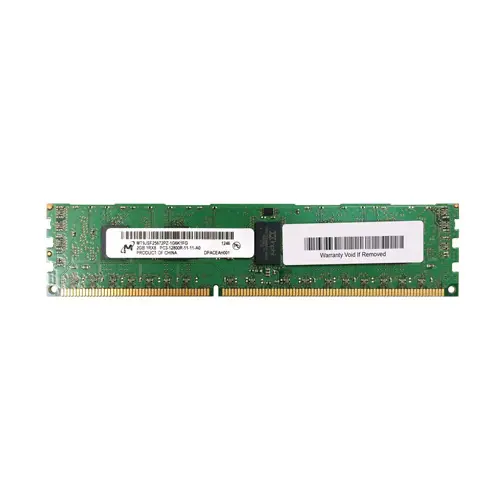
Designed for demanding server environments, the Micron MT9JSF25672PZ-1G6K1FG is a 2 GB DDR3-1600 Registered DIMM that directly addresses the cost of unplanned downtime and data inconsistency. Its ECC technology continuously scans and corrects single-bit errors, a critical defense in virtualization clusters where a cosmic-ray-induced bit-flip inside a hypervisor can silently corrupt guest memory and crash dozens of business-critical VMs. The registered architecture buffers command and address signals, keeping the memory bus electrically clean when multiple modules are populated. This stability becomes a true enabler when scaling up an in-memory database such as Redis or Memcached, where even intermittent signal noise could result in transaction errors or a failed caching layer that degrades the entire application stack. Operating at 1600 MHz with a CAS latency of 11 and a single-rank x8 configuration, the module ensures predictable, low-latency data access that sustains high-concurrency query throughput without saturating the memory channel. For IT operators, it translates into consistent virtualized workload performance, fewer silent data corruptions, and a reliable memory foundation that keeps real-time analytics and transactional databases running smoothly when every millisecond counts.
The memory module specified is a server-class 2GB DDR3-1600 Registered ECC DIMM (RDIMM). Below are capacity planning recommendations for typical server workloads using this module.
General Virtualization
For light to medium virtualization hosts, populate at least 16 identical modules (32 GB) evenly across all memory channels. This configuration balances cost and VM density, supporting roughly 10–15 general-purpose VMs. Always install modules in matched groups of 8 or 16 to enable memory interleaving and maintain ECC protection.
In-Memory Database
In-memory databases require low latency and a large, stable RAM footprint. Deploy 32 modules (64 GB) spread symmetrically across channels — for example, 8 modules per channel on a 4-channel platform. This provides sufficient capacity for a moderate Redis or Memcached instance while preserving full 1600 MT/s speed and error correction, avoiding bandwidth bottlenecks during high-throughput access.
High-Performance Computing (HPC)
HPC applications demand maximum memory bandwidth. Fill all available DIMM slots with these 2 GB RDIMMs, achieving the highest possible channel utilization. In a dual-socket server with 24 slots, 48 GB (24 modules) can handle small- to medium-scale simulations. Balance population evenly across both CPU sockets to maintain NUMA symmetry and ensure consistent per-core performance.
Rigorously tested server memory, compatible with Dell PowerEdge R720, HP ProLiant DL380p Gen8, IBM System x3650 M4, and more.
Q: Can I mix this MT9JSF25672PZ-1G6K1FG with other memory modules of different brands or speeds?
A: Mixing RDIMMs with different brands or speeds is not recommended. It may cause instability, timing conflicts, or force all modules to run at the lowest common speed, undermining server reliability.
Q: Is this memory compatible with my Intel Xeon E5 or AMD Opteron server platform?
A: This DDR3-1600 registered ECC module is compatible with servers using Intel Xeon 5500/5600/E5 series or AMD Opteron 4100/6100/6200 platforms. Verify your board supports 2GB, 240-pin RDIMMs.
Q: What is the recommended DIMM population order for optimal performance?
A: For optimal performance, populate identical DIMMs in matched channels per your server manual. Typically, install in slots 1A, 1B, 1C first, balancing memory evenly across all processor memory channels.
Q: Does this module support overclocking or XMP profiles?
A: No. This is a server-grade registered ECC module built for stability at JEDEC standard DDR3-1600 CL11. It does not support overclocking or XMP profiles, as server platforms prioritize data integrity.
Q: What warranty and typical failure rate can I expect?
A: This module comes with a 1-year warranty. Dell-qualified Micron memory exhibits an extremely low annualized failure rate (AFR), typically below 0.5%, ensuring high reliability for mission-critical server workloads.