











 Secure payments
Standard refund policy
Trade Assurance
Secure payments
Standard refund policy
Trade Assurance
| Product Type | Memory Module |
|---|---|
| Compliance Standards | RoHS |
| Memory Capacity | 2 GB |
| Memory Technology | DDR3 |
| Product Voltage | 1.35V |
| RAM Speed | 1600MHz |
| RAM Standard | DDR3-1600/PC3-12800 |
| Error Identifying | ECC |
| Signal Type | Registered |
| Column Access Strobe (CAS) | CL11 |
| Rank | Single Rank x8 |
| Quantity of Pins | 240-pin |
| RAM Genre | RDIMM |
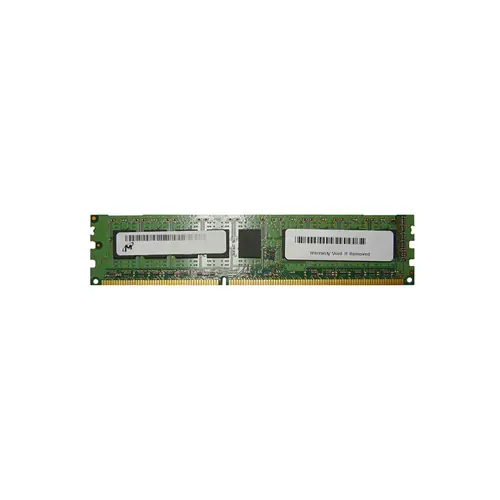
This Micron 2GB DDR3-1600 Registered ECC RDIMM, operating at a low 1.35V, is purpose-built for entry-level servers and small-scale virtualization hosts where data integrity and system stability are paramount. Its single-rank x8 configuration and registered signal path minimize electrical loading on the memory bus, enabling reliable operation in 24/7 environments with memory-intensive workloads such as light database caching or virtualized network appliances, while hardware ECC proactively corrects single-bit errors to prevent data corruption.
1. Registered buffering re-drives command and address signals, allowing stable population of multiple DIMMs per channel to sustain memory-intensive virtualization and large-scale database operations.
2. ECC protection silently corrects single-bit errors in real time, preventing silent data corruption that would compromise the integrity of financial transactions and critical server logs.
3. Low-voltage operation at 1.35V reduces overall rack power consumption and thermal output, directly lowering energy bills and cooling demands in dense data center environments.
4. A 2 GB module acts as a cost-efficient building block for assembling reliable, right-sized memory pools in lightweight servers or edge computing nodes that run containerized microservices.
5. Single Rank x8 organization presents a lighter electrical load on the memory controller, which helps preserve signal integrity and stable latency when multiple modules are fully populated.
The Micron MT9KSF25672PZ-1G6M1 is a server-grade DDR3 RDIMM whose ECC, registered buffering, 1.35V operation, and 1600MHz single-rank design directly solve critical data center challenges. In a virtualized cluster, ECC memory neutralizes single-bit errors that would otherwise silently corrupt hypervisor data or crash multiple guest VMs, safeguarding business continuity. The registered clock driver reduces loading on the memory controller, so you can populate all DIMM slots with confidence—a prerequisite for large in-memory databases like SAP HANA or dense virtualization hosts. Operating at just 1.35V, this module cuts energy consumption and heat, helping you contain cooling costs across a server farm. Meanwhile, the single-rank x8 configuration at 1600MHz delivers predictable, low-latency bandwidth, minimizing command bus contention in latency-sensitive workloads such as Redis caching. For your infrastructure, this means uncompromising data integrity, linear scalability, and energy-efficient performance that keeps critical services accurate and online.
General Virtualization
For small-scale hypervisor hosts, populate all available memory channels with identical 2 GB RDIMMs to achieve balanced capacity while leveraging ECC reliability. Given the module’s single-rank 2 GB density, use two or four DIMMs per channel if supported, aiming for at least 16 GB total to run a handful of lightweight VMs. Avoid mixing registered and unbuffered modules to maintain signal integrity.
In-Memory Database
In-memory workloads demand low latency and high availability, so deploy multiple 2 GB ECC RDIMMs symmetrically across all memory channels to enable rank interleaving. Although single-rank modules are present, installing them in matched sets for each channel helps maximize read/write throughput on platforms that support DDR3-1600 registered memory. Target a minimum of 32 GB by populating all DIMM slots to hold working sets entirely in memory.
High-Performance Computing
HPC applications benefit from maximum bandwidth, so configure the server with balanced DIMM populations per memory channel. Using the provided low-voltage 1.35V RDIMMs reduces power draw in dense node deployments. Fill each channel with two 2 GB modules (if the board allows) to exploit interleaved access, and scale node count horizontally for aggregate capacity while maintaining uniform memory performance.
This rigorously tested server memory is compatible with Dell PowerEdge R710, HP ProLiant DL380 G7, and Lenovo ThinkServer RD630.
Q: Can I mix this MT9KSF25672PZ-1G6M1 with other memory modules of different brands or speeds?
A: Mixing is not recommended. For reliable server operation, use identical RDIMMs with the same part number, speed, voltage, and rank. Mismatched modules may cause instability or fail POST.
Q: Is this memory compatible with my system?
A: It is compatible with servers supporting DDR3-1600 Registered ECC DIMMs at 1.35V. Requires a platform such as Intel Xeon E5-2600 v2 or AMD Opteron 6300 series. Verify your board's support for low-voltage RDIMMs.
Q: What is the recommended DIMM population order for optimal performance?
A: Populate identical modules per channel, starting with the slots farthest from the CPU. Follow your server's manual for balanced memory configurations across all memory channels to maximize bandwidth and interleaving.
Q: Does this module support overclocking or XMP profiles?
A: No. This is a JEDEC-compliant server RDIMM designed for stability. It does not support overclocking or XMP profiles, as enterprise servers prioritize data integrity over memory speed tuning.
Q: What warranty and typical failure rate can I expect?
A: This module carries a 1-year warranty. Typical annualized failure rate (AFR) for enterprise RDIMMs is well below 1% under specified conditions, reflecting high reliability for 24/7 operation.