











 Secure payments
Standard refund policy
Trade Assurance
Secure payments
Standard refund policy
Trade Assurance
| Product Type | Memory Module |
|---|---|
| Compliance Standards | RoHS |
| Memory Capacity | 2 GB |
| Memory Technology | DDR3 |
| Product Voltage | 1.35V |
| RAM Speed | 1600MHz |
| RAM Standard | DDR3-1600/PC3-12800 |
| Error Identifying | ECC |
| Signal Type | Registered |
| Column Access Strobe (CAS) | CL11 |
| Rank | Single Rank x8 |
| Quantity of Pins | 240-pin |
| RAM Genre | RDIMM |
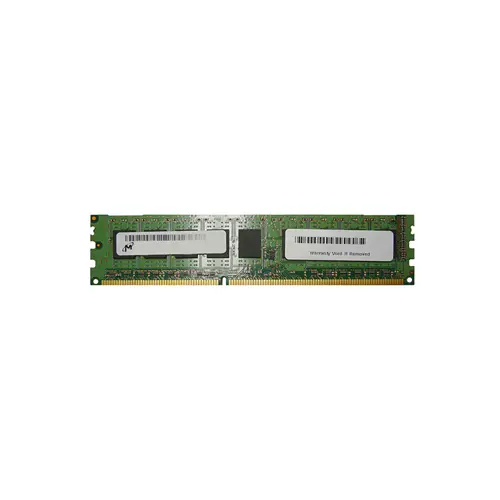
This DDR3-1600 Registered ECC RDIMM, with its single-rank x8 configuration and low 1.35V operating voltage, is purpose-built for entry-level servers and embedded systems where data integrity and power efficiency are critical. The combination of ECC error correction and registered signal buffering ensures stable operation in virtualized environments and light memory-database workloads, while the single-rank design helps maintain lower thermal output and improved signal integrity compared to dual-rank alternatives.
1. ECC protection detects and corrects single-bit memory errors in real time, safeguarding transactional data integrity essential for financial and database workloads.
2. Registered signal buffering stabilizes command and address lines across fully loaded memory channels, enabling consistent operation in high‑capacity virtualization hosts.
3. Low 1.35V operation cuts overall rack power consumption and cooling demands, maximizing power utilization efficiency in dense data center deployments.
4. Single‑rank x8 organization minimizes electrical loading per channel, allowing faster command response and higher bandwidth reliability for latency‑sensitive enterprise applications.
5. CL11 latency strikes a proven balance between access speed and stability, sustaining predictable throughput under sustained multi‑tenant processing loads.
Judging by the registered ECC specification, the Micron MT9KSF25672PZ-1G6K1 is unequivocally server memory, and its four defining traits directly answer the nightmares of IT administrators. ECC becomes non-negotiable the moment you run a virtualized cluster. In a multi-tenant hypervisor environment, a single undetected bit flip caused by background radiation can silently corrupt a virtual machine’s kernel, cascade into data loss, or trigger an unplanned failover that wakes you at 3 a.m. On-die error correction catches and scrubs these single-bit errors in real time, turning a silent data corruption threat into a non-event. The registered buffer then solves a different headache: signal integrity at scale. When you fully populate a server’s memory channels to support dense VM sprawl, the driver count per rank overwhelms the memory controller; the register re-drives the command and address signals, stabilizing the bus and letting you deploy far more memory without random lock-ups. For an in-memory database like Redis or SAP HANA, where microseconds matter, the 1600 MHz clock combined with single-rank x8 organization delivers low-latency access and efficient command scheduling under heavy concurrent reads. Finally, the 1.35V operating voltage cuts thermal dissipation per DIMM, reducing cooling costs inside a packed 1U rack while extending component life—meaning your real-time analytics platform stays both fast and financially predictable across its entire lifecycle.
General Virtualization
For a light to medium virtualization host, populate all available channels symmetrically. Using multiple 2 GB RDIMMs—such as six or eight modules for triple or quad-channel architectures—ensures balanced memory interleaving and stable performance for a modest number of virtual machines, while keeping power draw low with 1.35V operation.
In-Memory Database
Capacity is the primary constraint here; a single 2 GB DIMM is insufficient for most in-memory datasets. To reach minimal viable capacity, install the maximum supported quantity of these registered DIMMs across all memory channels, but plan to replace them with higher-density modules as soon as the workload grows, since low capacity per stick wastes valuable server slots.
High-Performance Computing (HPC)
HPC benefits from memory bandwidth more than raw capacity for many workloads. Populate one DIMM per channel to maximize bandwidth and avoid rank contention, using identical 2 GB RDIMMs across all channels. This configuration delivers consistent 1600 MT/s throughput with the ECC integrity required for long-running scientific computations.
Proven compatible with servers like Dell PowerEdge R720, HP DL380p Gen8, and IBM x3650 M4.
Q: Can I mix this MT9KSF25672PZ-1G6K1 with other memory modules of different brands or speeds?
A: Mixing RDIMMs of different brands or speeds is not recommended. It may cause system instability, boot failures, or performance issues. In server environments, always use identical, validated modules.
Q: Is this memory compatible with my system? Which Intel or AMD platforms support this DDR3 Registered ECC module?
A: This DDR3-1600 Registered ECC module works with servers using Intel Xeon E5-2600 v1/v2 or AMD Opteron 6300 series processors and C602/C204 chipsets supporting 240-pin DDR3 RDIMMs.
Q: What is the recommended DIMM population order for optimal performance with this registered memory?
A: Follow your server board manual. Typically, populate identical RDIMMs first in the blue slots per channel, balancing across memory channels (e.g., A1, B1, C1, D1) for multi-channel performance.
Q: Does this module support overclocking or XMP profiles?
A: No. This is an enterprise-grade Registered DIMM adhering to JEDEC standards. It does not support XMP or overclocking, as operational stability and data integrity are prioritized over tuning.
Q: What warranty and typical failure rate can I expect for this MT9KSF25672PZ-1G6K1 module?
A: It includes a 1-year warranty. The expected annualized failure rate (AFR) for Micron server memory is typically under 0.5%, reflecting high enterprise reliability.