











 Secure payments
Standard refund policy
Trade Assurance
Secure payments
Standard refund policy
Trade Assurance
| Product Type | Memory Module |
|---|---|
| Compliance Standards | RoHS |
| Memory Capacity | 2 GB |
| Memory Technology | DDR3 |
| Product Voltage | 1.5V |
| RAM Speed | 1600MHz |
| RAM Standard | DDR3-1600/PC3-12800 |
| Error Identifying | ECC |
| Signal Type | Registered |
| Column Access Strobe (CAS) | CL11 |
| Rank | Single Rank x8 |
| Quantity of Pins | 240-pin |
| RAM Genre | RDIMM |
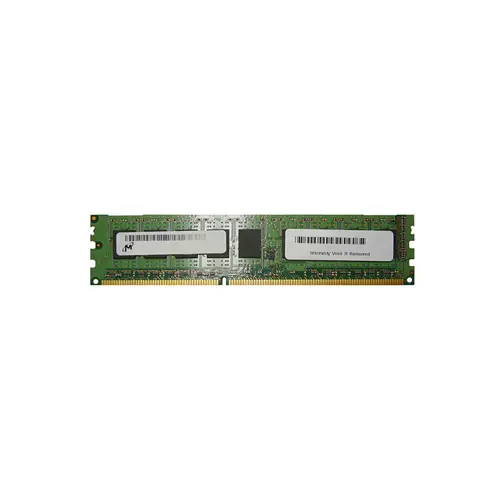
This Micron 2GB DDR3-1600 Registered ECC DIMM (PC3-12800, CL11, single-rank x8) is purpose-built for entry-level servers and legacy virtualization platforms where data integrity and signal stability under concurrent access are critical. Its registered architecture buffers command and address lines to maintain reliable operation in multi-DIMM configurations, while ECC actively corrects single-bit errors, making it suitable for light memory-resident databases or resilient hypervisor installations.
1. ECC protection detects and corrects single-bit memory errors automatically, guarding transactional databases and long-running virtualization hosts against silent data corruption.
2. Registered signal type buffers address and command lines, enabling large-scale memory configurations without compromising signal integrity across fully loaded server boards.
3. 1600 MHz bandwidth accelerates in-memory caching and reduces latency for frequently accessed datasets, improving application throughput under heavy concurrent user loads.
4. Single Rank x8 organization reduces electrical loading per channel, allowing dense DIMM population to maintain rated speed and boosting consistent performance in high-capacity rack deployments.
5. Two gigabyte capacity serves as a cost-efficient building block for lightweight container hosts or small virtualized appliances, keeping overhead low while preserving essential ECC safeguards.
At the heart of reliable enterprise computing, the MT9JSF25672PZ-1G6K1 is not simply a memory module—it is a purpose-built Registered DIMM (RDIMM) engineered for servers where data integrity and uptime directly define business outcomes. In a dense virtualization cluster, every hypervisor host must juggle dozens of VMs without memory-induced instability. The registered signal buffer decouples electrical loading from the CPU’s memory controller, allowing a rack full of these modules to coexist without the command-timing collapses that plague unbuffered alternatives—your VM fleet stays responsive, and live migrations complete without silent corruption. That corruption is precisely what ECC eliminates: in an in-memory database like Redis or a financial trading cache, a single bit flip can corrupt transactional records or pricing logic with zero traceability. The MT9JSF25672PZ-1G6K1’s hardware error correction traps and repairs such events on the fly, turning invisible protons into non-events. Its single-rank x8 organization and DDR3-1600 speed slash access latency for read-heavy workloads, while the CL11 timing keeps response times predictably tight when sub-millisecond queries hit terabytes of hot data. For the DevOps engineer plagued by mysterious nightly crashes or the DBA who trusts indexing consistency, this module means peace of mind is finally a standard form factor—one 2GB 240-pin stick at a time.
General Virtualization
Populate at least six identical 2GB single-rank RDIMMs evenly across memory channels (12GB total) for lightweight VM hosts. On triple-channel platforms, install three modules per CPU to enable channel interleaving and maximize bandwidth. Registered ECC ensures stability when running multiple guest operating systems concurrently.
In-Memory Database
The 2GB capacity severely limits in-memory databases. As a stopgap, fully populate all available slots—24 modules for 48GB in a dual-socket server—with matching CL11 RDIMMs. Configure symmetric DIMM population per processor to maintain NUMA balance and memory interleaving. Plan a migration to higher-density DDR3 RDIMMs for production workloads.
High-Performance Computing
Maximize total node capacity by installing a complete set of 2GB RDIMMs, e.g., 24 modules yielding 48GB. Fill all memory channels identically across both sockets to achieve uniform memory access and consistent latency. This configuration only suits small-scale test clusters; modern HPC jobs require substantially larger memory, making these modules a temporary, budget-constrained solution.
Rigorously tested server memory, compatible with Dell PowerEdge R720, HP DL380p Gen8, IBM x3650 M4.
Q: Can I mix this MT9JSF25672PZ-1G6K1 with other memory modules of different brands or speeds?
A: Mixing Registered ECC RDIMMs of different brands, speeds, or ranks is not recommended. It may cause POST failures or stability issues. For guaranteed compatibility, populate with identical Micron modules having the same speed, rank, and CAS latency.
Q: Is this memory compatible with my Intel Xeon or AMD Opteron server?
A: This DDR3-1600 ECC Registered RDIMM is compatible with platforms supporting dual-rank x8 RDIMMs, such as Intel Xeon E5-2600 v1/v2 or AMD Opteron 6300 series. Verify 240-pin DDR3 RDIMM support in your motherboard or system manual.
Q: What is the recommended DIMM population order for optimal performance?
A: Follow your server board’s population guide. Typically, install identical DIMMs in corresponding slots of each memory channel (e.g., blue slots first) and balance capacity across CPU sockets to enable multi-channel interleaving and maximum throughput.
Q: Does this module support overclocking or XMP profiles?
A: No. This RDIMM adheres to JEDEC DDR3-1600/PC3-12800 specifications with fixed CL11 timing. It does not support XMP or overclocking, ensuring the stable, error-free operation required in server environments.
Q: What warranty and typical failure rate can I expect?
A: This module includes a 1-year warranty. Enterprise-grade RDIMMs like this Micron part exhibit a very low annualized failure rate (AFR), typically below 0.5%, delivering the high reliability needed for mission-critical workloads.