











 Secure payments
Standard refund policy
Trade Assurance
Secure payments
Standard refund policy
Trade Assurance
| Model | MT9JSF25672AZ-1G6M1ZG |
|---|---|
| Product Type | Memory Module |
| Compliance Standards | RoHS |
| Memory Capacity | 2 GB |
| Memory Technology | DDR3 |
| Product Voltage | 1.5V |
| RAM Speed | 1600MHz |
| RAM Standard | DDR3-1600/PC3-12800 |
| Error Identifying | ECC |
| Signal Type | Unbuffered |
| Column Access Strobe (CAS) | CL11 |
| Rank | Single Rank x8 |
| Quantity of Pins | 240-pin |
| RAM Genre | UDIMM |
This ECC unbuffered DDR3 module is best suited for entry-level servers and single-socket workstations running data-sensitive workloads such as light virtualization or file services, where data integrity is essential. Its single-rank x8 configuration reduces electrical loading on the memory controller, enabling more stable operation while the ECC actively corrects single-bit errors to maintain system uptime.
1. ECC protection corrects single-bit memory errors in real time, preserving data integrity for always-on microservices and entry-level server workloads that cannot tolerate silent corruption.
2. Unbuffered design eliminates the register chip delay, offering the lower latency needed to keep single-socket server response times tight under moderate query loads.
3. DDR3-1600 provides a peak transfer rate of 12.8 GB/s per channel, delivering sufficient throughput for lightweight virtualization hosts and dedicated storage appliances.
4. Single Rank x8 configuration reduces electrical loading on the memory controller, improving signal stability and enabling reliable operation in compact, thermally constrained server chassis.
5. A 2 GB capacity targets appliance-like deployments and minimal-footprint hypervisors, ensuring streamlined boot-times and consistent performance for fixed-function server roles.
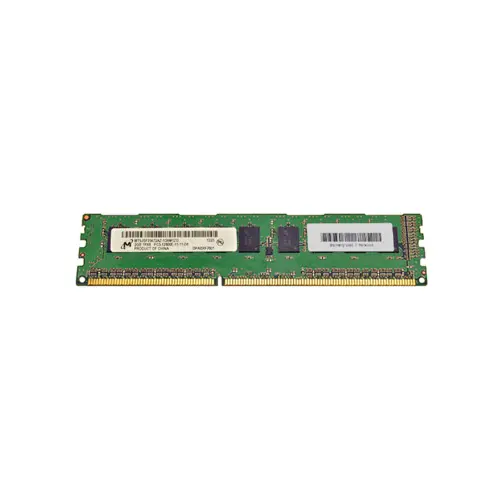
The Micron MT9JSF25672AZ-1G6M1ZG is a 2GB DDR3-1600 ECC Unbuffered DIMM engineered for entry-level servers and workstations where data integrity must never be an afterthought. Its ECC capability actively corrects single-bit errors, a critical safeguard when you are running a virtualization cluster. A spontaneous bit-flip in unsecured memory can silently corrupt a hypervisor or a customer-facing virtual machine, leading to unexplained downtime. ECC eliminates that risk, ensuring your multi-tenant environments remain stable around the clock. The module’s 1600MHz speed paired with a Single Rank x8 organization supplies steady, predictable bandwidth while minimizing electrical load on the memory controller. In an in-memory database scenario like a busy Redis cache, this translates to snappier query responses and consistent low-latency throughput, even under sustained pressure. Because it is unbuffered, the DIMM avoids the additional clock-cycle delay of registered memory, giving you faster command-to-data handoffs for latency-sensitive operations. For the IT manager, that means you can build affordable, power-efficient nodes without compromising the fault tolerance your critical applications demand. It is a straightforward upgrade that protects your data, accelerates your transactions, and preserves budget.
Server Memory Type Identified
This is a DDR3-1600 ECC Unbuffered DIMM (UDIMM) designed for single-socket servers and workstations. With ECC error correction and 2 GB capacity per module, it suits platforms prioritizing data integrity over maximum density, though the 2 GB size limits total memory in modern virtualization or database hosts.
General Virtualization
For lightweight hypervisors (e.g., a small ESXi or Proxmox host running 3–5 VMs), install four modules for 8 GB total, filling all channels on a typical single-socket board. This provides just enough headroom for a domain controller, a web server, and a test VM while maintaining ECC protection. If the CPU supports it, run at 1600 MHz for best latency.
In-Memory Database
An in-memory database like Redis on a 2 GB DIMM is severely constrained. Use two sticks (4 GB) for the OS and a tiny dataset, but this is only viable for development or caching layers where the working set fits within 1–2 GB. For any production use, these modules are undersized; plan to replace them with higher-capacity ECC UDIMMs.
High-Performance Computing
In a small HPC test cluster or a single-node compute server, populate all available slots (often four or six) to maximize memory bandwidth, yielding 8–12 GB. The ECC feature reliably sustains multi-day simulation runs, but memory capacity per core will be very low. Reserve this configuration for lightweight benchmarks or teaching environments only.
Rigorously tested 2GB DDR3 ECC UDIMM, verified compatible with Dell T20, T110 II, HP MicroServer Gen8, Lenovo TS140.
Q: Can I mix this MT9JSF25672AZ-1G6M1ZG with other memory modules of different brands or speeds?
A: Mixing is not recommended. Unmatched DIMMs may cause ECC errors, instability, or downgrade to non-ECC mode. For reliable server operation, install identical modules with the same speed, rank, and timings.
Q: Is this memory compatible with my system? (Intel/AMD server platform)
A: This 2GB DDR3-1600 ECC UDIMM fits server boards with 240-pin slots supporting Unbuffered ECC memory. Verify your Intel Xeon E3 or AMD equivalent platform explicitly supports 1.5V, Single Rank x8 UDIMMs.
Q: What is the recommended DIMM population order for optimal performance?
A: Populate identical DIMMs per memory channel following the server board manual. Typically, install one DIMM per channel first, filling blue slots before black, to maintain balanced interleaving and full ECC bandwidth.
Q: Does this module support overclocking or XMP profiles?
A: No. This is a server-grade ECC UDIMM complying with JEDEC DDR3-1600 CL11 standards. It does not include XMP profiles and is not designed for overclocking; stability and data integrity are prioritized.
Q: What warranty and typical failure rate can I expect?
A: This Micron module is covered by a 1-year warranty. Typical annualized failure rate (AFR) for server UDIMMs is very low, around 0.2–0.5%, assuming proper handling and environmental conditions.