











 Secure payments
Standard refund policy
Trade Assurance
Secure payments
Standard refund policy
Trade Assurance
| Product Type | Memory Module |
|---|---|
| Compliance Standards | RoHS |
| Memory Capacity | 2 GB |
| Memory Technology | DDR3 |
| Product Voltage | 1.5V |
| RAM Speed | 1600MHz |
| RAM Standard | DDR3-1600/PC3-12800 |
| Error Identifying | ECC |
| Signal Type | Unbuffered |
| Column Access Strobe (CAS) | CL11 |
| Rank | Single Rank x8 |
| Quantity of Pins | 240-pin |
| RAM Genre | UDIMM |
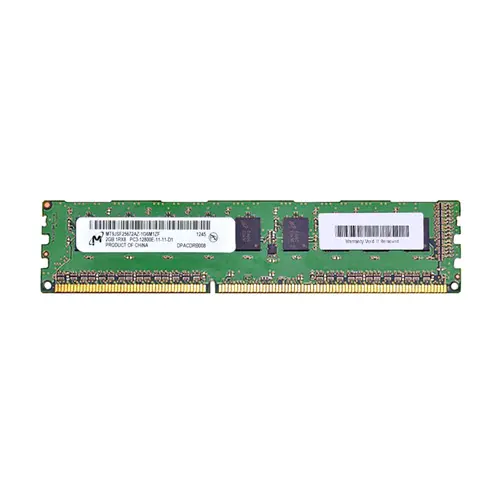
This 2GB DDR3-1600 UDIMM with ECC is purpose-built for entry-level servers and workstations where rigorous data integrity is critical for workloads such as virtualization or small-scale in-memory databases. Its single-rank x8 design and unbuffered signal path reduce bus loading and electrical noise, ensuring stable CL11 operation and reliable single-bit error correction without the cost and overhead of registered memory.
1. End-to-end ECC protection catches and corrects single-bit errors in real time, preserving transaction integrity for always-on microservers and eliminating silent data corruption in critical logging or authentication services.
2. The unbuffered UDIMM design strips out register latency, giving lightweight server roles like DNS resolvers or embedded virtualization hosts faster memory access and deterministic response under constant query loads.
3. Lean capacity dedicated to firmware booting or single‑purpose network appliances avoids resource waste, reduces power draw per node, and simplifies replacement cycles in dense rack‑deployed environments.
4. A single-rank x8 organization puts minimal electrical load on the memory bus, keeping signal margins wide and error rates low during sustained 24/7 operation in hot‑aisle containment.
5. The low CL11 CAS latency shortens wait‑state delays for cache‑sensitive server tasks, so small OLTP databases receive requested rows with less idle cycles on legacy DDR3 platforms.
When you are managing a single‑socket server or a professional workstation, every bit of data matters. The Micron MT9JSF25672AZ-1G6M1ZF UDIMM with ECC directly addresses the silent threat of memory bit‑flips. In a virtualized environment running multiple lightweight guests on a small business hypervisor, a single undetected error can corrupt a virtual disk or crash an entire guest without warning. The Error Correction Code hardware scrubs single‑bit errors in real time, preserving uptime for critical applications like a customer database or an on‑premises file server.
The unbuffered design eliminates the register chip, reducing electrical latency compared to registered alternatives. For an engineering workstation performing real‑time 3D rendering or a ZFS‑based NAS undergoing constant scrub calculations, that lower command‑to‑response delay translates into snappier project timeline scrubbing and faster file integrity verification. Its single‑rank x8 organization further minimizes the electrical load on the memory bus, guaranteeing rock‑solid compatibility with mainstream platforms where populating all four DIMM slots would otherwise force you to downclock dual‑rank modules. Paired with a 1600MHz clock that delivers up to 12.8GB/s of bandwidth, this module prevents the memory subsystem from becoming a bottleneck during simultaneous database queries and nightly backup jobs. This means your investment directly secures data integrity and delivers system responsiveness exactly where you need it most—without hidden compromises.
General Virtualization
For general virtualization, distribute these 2 GB ECC UDIMMs evenly across all memory channels. A balanced configuration of six to twelve modules (12–24 GB) on a dual‑ or triple‑channel server provides sufficient headroom for a handful of lightweight VMs while maintaining interleaved throughput. Always use identical single‑rank modules in each channel to preserve ECC reliability.
In‑Memory Database
In‑memory databases thrive on capacity; populate every available DIMM slot with these 2 GB sticks. A 24‑slot server yields 48 GB, suitable for modest Redis or Memcached instances. Always fill channels symmetrically to uphold ECC protection and uniform latency. Because 2 GB per module limits scale, plan a migration to higher‑density ECC DIMMs if the working set grows beyond this ceiling.
High‑Performance Computing (HPC)
HPC workloads prioritize bandwidth. Install one module per channel to enable full interleaving—for example, eight 2 GB modules (16 GB) in an eight‑channel platform deliver maximum throughput for memory‑bound simulations. The 1600 MHz speed at CL11 provides predictable access patterns, while ECC guards against silent data corruption during long‑running parallel jobs.
Rigorously validated ECC UDIMM for servers. Compatible with Dell PowerEdge T110 II, T20, HP MicroServer Gen8, Lenovo TS140.
Q: Can I mix this MT9JSF25672AZ-1G6M1ZF with other memory modules of different brands or speeds?
A: Mixing is not recommended for server environments. Different brands or speeds can cause signal integrity issues and instability. For optimal reliability, always use identical modules across all channels.
Q: Is this memory compatible with my system?
A: It is compatible with Intel Xeon E3-1200 series or single-socket AMD platforms using DDR3 ECC UDIMM support. Please verify your server motherboard supports 2GB DDR3-1600 ECC Unbuffered 240-pin modules.
Q: What is the recommended DIMM population order for optimal performance?
A: Populate channel A (slots A1, A2) first, then channel B. Always follow your server board’s manual, but generally, identical modules ensure balanced channel interleaving and peak memory throughput.
Q: Does this module support overclocking or XMP profiles?
A: No, it is a server-class ECC UDIMM built to JEDEC standards. It operates strictly at 1600MHz with fixed CL11 timings for 24/7 stability, not designed for overclocking or XMP profiles.
Q: What warranty and typical failure rate can I expect?
A: This module includes a one-year warranty. In server deployments, the typical annualized failure rate (AFR) is very low, well under 0.5%, ensuring high reliability over its operational life.