











 Secure payments
Standard refund policy
Trade Assurance
Secure payments
Standard refund policy
Trade Assurance
| Model | MT9JSF25672AZ-1G6M1 |
|---|---|
| Product Type | Memory Module |
| Compliance Standards | RoHS |
| Memory Capacity | 2 GB |
| Memory Technology | DDR3 |
| Product Voltage | 1.5V |
| RAM Speed | 1600MHz |
| RAM Standard | DDR3-1600/PC3-12800 |
| Error Identifying | ECC |
| Signal Type | Unbuffered |
| Column Access Strobe (CAS) | CL11 |
| Rank | Single Rank x8 |
| Quantity of Pins | 240-pin |
| RAM Genre | UDIMM |
This unbuffered ECC DDR3-1600 module is designed for entry-level servers and workstations where data integrity is mandatory, making it ideal for light virtualization, file servers, and critical always-on systems. Its single-rank x8 organization reduces electrical loading on the memory controller, while ECC detects and corrects single-bit errors to prevent silent data corruption in memory-intensive tasks.
1. ECC protection corrects single-bit errors in real time, safeguarding transactional data integrity for entry-level server workloads.
2. Unbuffered design minimizes memory access latency, which benefits latency-sensitive applications like small-scale database queries.
3. 2 GB capacity per module allows cost-effective memory provisioning for lightweight virtualization hosts running a handful of containers or VMs.
4. 1600 MT/s data rate delivers sufficient memory bandwidth to keep dual-core server processors fed during moderate multi-threaded tasks.
5. Single Rank x8 organization improves signal integrity and operational stability, reducing the risk of memory-related system crashes in always-on microservers.
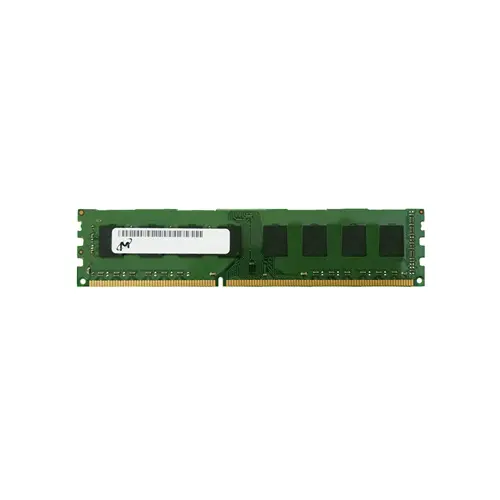
The Micron MT9JSF25672AZ-1G6M1 is a server-grade DDR3 UDIMM built for reliability in critical computing environments. Its ECC capability is the most vital safeguard you can have: it continuously detects and corrects single-bit memory errors, preventing silent data corruption in a virtualized cluster where a flipped bit could crash multiple guest machines or corrupt a financial transaction log. As an unbuffered module, it eliminates the additional clock cycle latency introduced by registered chips, giving your in-memory database like Redis a subtle but measurable latency advantage—every nanosecond counts when serving millions of key-value lookups. The DDR3-1600 speed ensures 12.8 GB/s of peak bandwidth per channel, which helps maintain consistent performance for small-scale virtualization hosts or NAS appliances under concurrent access loads. Finally, its single-rank x8 organization minimizes electrical loading on the memory bus, improving signal integrity and simplifying compatibility across a wide range of server motherboards—this means less troubleshooting and a smoother lifespan upgrade cycle for your existing infrastructure.
General Virtualization
For modest virtualization hosts using ECC UDIMMs, populate all available channels with identical 2GB modules to maximize memory interleaving while staying within budget. A typical dual‑socket platform might deploy six or eight modules per CPU, yielding 12–16GB total, which is sufficient for a handful of light VMs. Always use identical part numbers to maintain stable ECC operation and avoid mixed‑rank penalties.
In‑Memory Database
Capacity is critical, so choose a board that supports the maximum number of 240‑pin slots and fill every slot with 2GB UDIMMs, reaching up to 32–48GB in a four‑channel configuration. Single‑rank x8 modules like the MT9JSF25672AZ‑1G6M1 reduce electrical loading, improving signal integrity at full population. Even then, this DDR3‑1600 ECC kit is best suited for small dataset caching or development instances rather than production in‑memory engines.
High‑Performance Computing
HPC nodes that require ECC protection but cannot use RDIMMs benefit from unbuffered modules in balanced configurations. Install one DIMM per channel (e.g., four 2GB sticks on a quad‑channel board) to achieve peak bandwidth and lower latency for memory‑bound scientific workloads. If the application scales well with memory capacity, double‑rank alternatives would be preferable, but these single‑rank UDIMMs keep power and heat to a minimum in dense clusters.
Validated server memory: rigorously tested DDR3 ECC UDIMM. Compatible with Dell PowerEdge R310, HP MicroServer Gen8, Lenovo ThinkServer TS140.
Q: Can I mix this MT9JSF25672AZ-1G6M1 with other memory modules of different brands or speeds?
A: Mixing modules is not recommended. For ECC UDIMMs, match identical part numbers, ranks, and timings to maintain signal integrity and prevent errors. Inconsistent specs may cause system instability or unbootable states.
Q: Is this memory compatible with my system? (Intel/AMD platforms)
A: This DDR3 ECC Unbuffered DIMM works with select Intel Xeon E3/E5 and AMD Opteron platforms supporting UDIMM ECC. Verify your server board's QVL and support for 1.5V UDIMMs before purchase.
Q: What is the recommended DIMM population order for optimal performance?
A: Install in balanced configurations, starting with the slots furthest from the CPU per channel. For single rank x8, populate identical blue or black slots first. Always consult your server's manual for dual-channel mapping.
Q: Does this module support overclocking or XMP profiles?
A: No, this is a JEDEC-compliant server memory module without XMP. It operates at fixed DDR3-1600 CL11, 1.5V. Overclocking is neither supported nor advised for ECC memory in production environments.
Q: What warranty and typical failure rate can I expect?
A: Backed by a 1-year warranty, this Micron module has a typical annualized failure rate (AFR) below 0.4% under normal operating conditions, ensuring reliable long-term server uptime.