











 Secure payments
Standard refund policy
Trade Assurance
Secure payments
Standard refund policy
Trade Assurance
| Model | MT9JSF25672AZ-1G9K1ZG |
|---|---|
| Product Type | Memory Module |
| Compliance Standards | RoHS |
| Memory Capacity | 2 GB |
| Memory Technology | DDR3 |
| Product Voltage | 1.5V |
| RAM Speed | 1866MHz |
| RAM Standard | DDR3-1866/PC3-14900 |
| Error Identifying | ECC |
| Signal Type | Unbuffered |
| Column Access Strobe (CAS) | CL13 |
| Rank | Single Rank x8 |
| Quantity of Pins | 240-pin |
| RAM Genre | UDIMM |
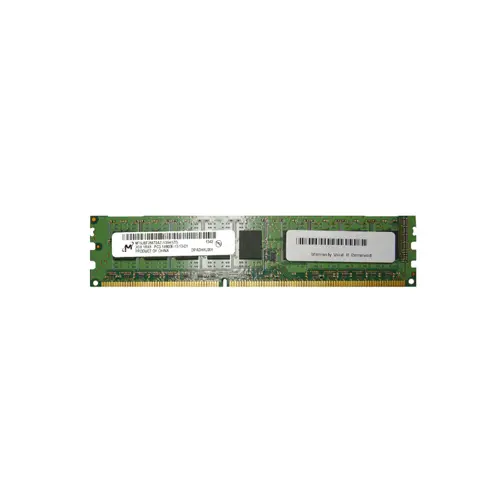
This unbuffered ECC DDR3-1866 module, organized as single‑rank x8 with CL13 latency, is purpose‑built for entry‑level servers and small NAS or virtualization hosts where data integrity is critical. Its error‑correcting code safeguards against single‑bit memory errors in always‑on environments, while the standard 1.5 V UDIMM form factor ensures consistent signal stability and broad compatibility with legacy server platforms.
1. Unbuffered signal architecture minimizes controller latency, giving lightweight server workloads a responsiveness edge crucial for real-time decision-making pipelines.
2. Error-correcting code protection silently corrects single-bit faults, preserving data accuracy in long-running virtualization hosts where memory integrity is non-negotiable.
3. Single Rank x8 organization lowers electrical loading per channel, enabling stable signal integrity when populating multiple DIMMs in dense storage or edge server chassis.
4. High-speed DDR3 frequency elevates memory bandwidth, directly improving throughput for in-memory databases and caching layers that feed concurrent user requests.
5. Tight column access latency shrinks the gap between data request and delivery, reducing CPU idle cycles during burst microservice transactions under heavy container density.
In enterprise environments where data integrity underpins every transaction, the Micron MT9JSF25672AZ-1G9K1ZG UDIMM proves indispensable. As an unbuffered ECC DDR3 module clocked at 1866MHz, it is engineered for single‑socket servers and small‑scale virtualization hosts, not for typical desktops. True ECC error correction is the non‑negotiable feature here: in a lightweight virtualization cluster hosting several VMs on cost‑sensitive hardware, a single‑bit parity error in unprotected memory can silently corrupt a hypervisor commit, leading to guest crashes or data inconsistency. Over time, those bit flips compound, undermining the very stability a virtualized environment demands. Equally critical is the single‑rank x8 organization, which imposes a lighter electrical load on the memory controller—essential when populating multiple DIMM slots in a compact micro‑server. This ensures reduced signal noise and reliable simultaneous access. In a memory‑caching scenario like a Redis instance, the 1866MHz bandwidth and tight CAS latency of CL13 deliver near‑line‑speed response under high read‑write loads, keeping query latency predictable. The 1.5V standard voltage further guarantees broad motherboard compatibility and thermal consistency inside cramped 1U chassis, eliminating surprise shutdowns. Pairing these attributes means the operator gains a stable, self‑correcting memory foundation where uptime, data fidelity, and smooth concurrent workloads are not just hoped for, but built in.
General Virtualization
For lightweight virtualization hosts, deploying four 2 GB ECC UDIMMs provides 8 GB of error‑correcting capacity, sufficient for a handful of low‑memory VMs. Scale to 16 GB using eight identical modules to support moderate consolidation, and always populate identical DIMMs per channel for stable multi‑tenancy.
In‑Memory Database
Because ECC guards against data corruption, these modules suit small in‑memory datasets. Pair six to eight sticks for 12–16 GB in a single‑socket server, enough to host Redis or memcached instances under 10 GB. Monitor memory pressure closely; at this density, datasets requiring more than 12 GB will exceed capacity and demand a platform shift.
High‑Performance Computing
HPC nodes benefit from the low‑latency CL13 and 1866 MT/s speed when running tightly‑coupled MPI tasks. Install four or eight matched DIMMs to populate all memory channels for maximum bandwidth. A 16 GB configuration (eight modules) offers headroom for medium‑scale simulations, but memory‑bound HPC workloads will quickly outgrow 2 GB DIMMs, making this a stopgap until a DDR4‑based upgrade.
Rigorously tested server ECC UDIMM, compatible with Dell PowerEdge R210 II, T20, HP MicroServer Gen8, Lenovo TS140.
Q: Can I mix this MT9JSF25672AZ-1G9K1ZG with other memory modules of different brands or speeds?
A: Mixing ECC UDIMMs from different brands or speeds is not recommended. The system will clock all modules at the slowest common speed, potentially causing stability issues or ECC error handling inconsistencies.
Q: Is this memory compatible with my system? For example, Intel Xeon or AMD server platforms.
A: This DDR3-1866 ECC Unbuffered UDIMM is compatible with server platforms supporting 240-pin DDR3 ECC UDIMMs, such as Intel Xeon E3-1200 series or AMD AM3+ Opteron configurations. Verify your motherboard’s ECC support.
Q: What is the recommended DIMM population order for optimal performance?
A: Consult your server motherboard manual. Generally, populate identical modules per channel, filling slots starting with channel A (often blue slots) to enable dual-channel interleaving and maximize memory bandwidth.
Q: Does this module support overclocking or XMP profiles?
A: No. This is a JEDEC-compliant ECC server memory module running at standard 1866MHz. It does not support overclocking, XMP profiles, or voltage adjustments beyond the specified 1.5V.
Q: What warranty and typical failure rate can I expect?
A: This Micron module is covered by a 1-year warranty. With JEDEC-compliant design and rigorous screening, expected annualized failure rate (AFR) is well below industry average, typically under 0.5%.