











 Secure payments
Standard refund policy
Trade Assurance
Secure payments
Standard refund policy
Trade Assurance
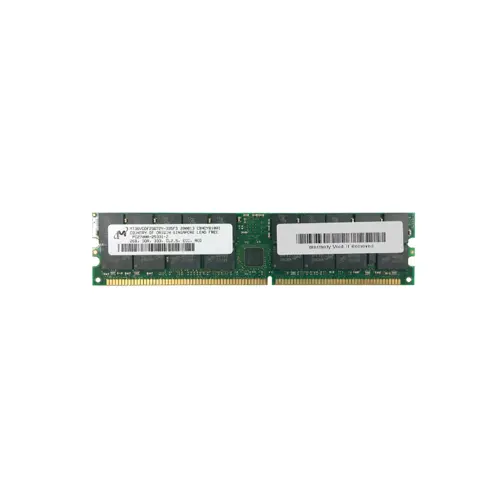
| Model | MT36VDDF25672Y-335F3 |
|---|---|
| Product Type | Memory Module |
| Memory Capacity | 2 GB |
| Memory Technology | DDR |
| Product Voltage | 2.5V |
| RAM Speed | 333MHz |
| RAM Standard | DDR-333/PC-2700 |
| Error Identifying | ECC |
| Signal Type | Registered |
| Column Access Strobe (CAS) | CL2.5 |
| Rank | Dual Rank x4 |
| Quantity of Pins | 184-pin |
| RAM Genre | RDIMM |
This Micron MT36VDDF25672Y-335F3 is a 2GB DDR-333 Registered ECC DIMM engineered for legacy server platforms that demand uncompromising data integrity. Its registered signal topology and dual-rank x4 organization enable stable operation in multi-slot systems, making it ideal for virtualization hosts and memory-intensive database applications where error correction and reliable command signaling are critical.
1. ECC protection detects and corrects single-bit memory errors, preventing silent data corruption in mission-critical server workloads.
2. Registered signal buffering stabilizes high-capacity memory configurations, essential for maintaining uptime in dense virtualization clusters.
3. RDIMM architecture ensures reliable operation with server-grade chipsets, enabling seamless scaling in multi-socket enterprise platforms.
4. Dual Rank x4 interleaving maximizes memory bandwidth saturation, driving consistent database transaction throughput under heavy loads.
5. CL2.5 low latency accelerates memory access cycles, reducing response times for latency-sensitive financial trading applications.
The Micron MT36VDDF25672Y-335F3 is a server-grade DDR-333 Registered DIMM with ECC, purpose-built for mission-critical enterprise environments. In a virtualization cluster running dozens of VMs on a single host, registered memory is non-negotiable. Its on-DIMM buffering isolates the command and address bus from the memory controller, allowing you to populate all available slots with stable signal integrity. Without this, high-density configurations would suffer from electrical loading, leading to boot failures or silent crashes under load. The integrated ECC silently corrects single-bit errors, a critical safeguard when a flipped bit in an in-memory database like Redis or SAP HANA could corrupt a financial transaction or inventory record. Dual-rank x4 organization further amplifies performance through rank interleaving: while one rank is refreshing or busy, the controller can read from the other, effectively hiding access latency and boosting sustained throughput. Finally, the CL2.5 low latency directly translates to faster response times in latency-sensitive workloads, ensuring your data analytics queries return results sooner, not later. In a server, these four attributes together mean uncompromised uptime, data accuracy, and the consistency required for 24/7 operations.
General Virtualization
For a light consolidation host running several idle or low-load VMs, a balanced configuration of four to eight modules (8–16 GB) in matched pairs provides sufficient headroom while preserving interleaving benefits. Deploy modules as identical dual-rank x4 RDIMMs across all populated channels to sustain memory bandwidth under moderate overcommit. Favor populating all memory channels symmetrically before scaling capacity to avoid performance cliffs.
In-Memory Database
In-memory workloads crave low latency and high reliability; therefore, fully populate each memory channel with these registered ECC DIMMs to maximize chip-kill protection and bandwidth. A practical starting point is twelve to sixteen modules (24–32 GB) per server, keeping the dataset entirely in main memory, with identical DIMMs to maintain CL2.5 timing consistency. Scale further by adding more identical DIMMs rather than mixing densities, preserving dual-rank signaling across all slots.
High-Performance Computing
For bandwidth-sensitive HPC jobs, aim to fill every available memory channel with one dual-rank RDIMM to sustain peak stream throughput—six or eight modules (12–16 GB) often balance cost and performance. Uniformity is critical: install only these PC-2700 ECC modules across the board to avoid clock jitter and maintain registered bus stability. If the workload’s memory footprint exceeds 16 GB, scale to a fully populated cost-optimized configuration of 16 modules (32 GB) while keeping all DIMMs identical in rank and speed.
Trusted compatibility: Rigorously tested for Dell PowerEdge 2850, HP ProLiant DL380 G4, IBM xSeries 346, and more.
Q: Can I mix this MT36VDDF25672Y-335F3 with other memory modules of different brands or speeds?
A: Mixing is not recommended for server environments. It may compromise signal integrity and ECC functionality, potentially leading to system instability or data errors.
Q: Is this memory compatible with my system?
A: This module is designed for server platforms supporting DDR-333 Registered ECC memory, typically found in systems with Intel E750x or AMD 8000 series chipsets. Verify your motherboard’s qualified vendor list.
Q: What is the recommended DIMM population order for optimal performance?
A: Follow your server motherboard manual. Generally, populate DIMMs in matched pairs, filling slot 1 of each channel first across all memory banks for balanced interleaving.
Q: Does this module support overclocking or XMP profiles?
A: No. As a server-grade Registered ECC module, it operates strictly at JEDEC standard timings. Overclocking and XMP are unsupported to ensure mission-critical data integrity.
Q: What warranty and typical failure rate can I expect?
A: This module includes a 1-year warranty. It undergoes rigorous testing and exhibits a very low annualized failure rate, typical of enterprise-class DRAM components.