











 Secure payments
Standard refund policy
Trade Assurance
Secure payments
Standard refund policy
Trade Assurance
| Product Type | Memory Module |
|---|---|
| Compliance Standards | RoHS |
| Memory Capacity | 2 GB |
| Memory Technology | DDR |
| Product Voltage | 2.5V |
| RAM Speed | 400MHz |
| RAM Standard | DDR-400/PC-3200 |
| Error Identifying | ECC |
| Signal Type | Registered |
| Column Access Strobe (CAS) | CL3 |
| Rank | Dual Rank x4 |
| Quantity of Pins | 184-pin |
| RAM Genre | RDIMM |
This RDIMM is engineered for legacy server platforms requiring stringent data integrity, leveraging registered signal buffering to maintain signal stability across densely populated memory channels and ECC to correct single-bit errors for virtualization and modest in-memory database workloads. Its dual-rank x4 organization with CL3 latency maximizes bank-level parallelism on aging DDR-400 chipsets, ensuring consistent throughput in always-on mission-critical environments.
1. ECC memory corrects single-bit errors on the fly, safeguarding data integrity in always-on server environments where even silent corruption is unacceptable.
2. Registered signal buffering stabilizes high-capacity memory configurations, allowing the server to support dense memory populations without compromising signal quality under continuous load.
3. Dual Rank x4 organization keeps memory banks optimally interleaved, boosting sustained throughput for virtualized workloads that demand consistent low-latency access.
4. CL3 low column access latency accelerates cache-line fetches, directly benefiting database transaction processing and reducing query response times in enterprise applications.
5. DDR-400 compliant bandwidth supplies a steady 3.2 GB/s per channel, reliably feeding network-attached storage operations and light-duty hosting tasks without overprovisioning.
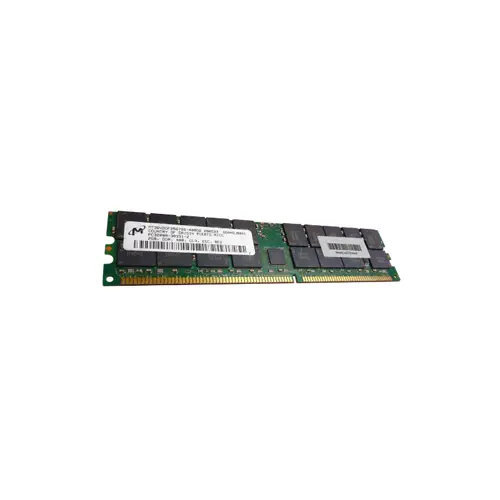
When managing a virtualized cluster, silent data corruption isn’t an abstract risk—it’s a revenue killer. This Micron MT36VDDF25672G-40BD2 module brings ECC to every 2 GB DDR-400 footprint, catching single-bit errors before a flipped bit in a hypervisor page table cascades into application failure or database inconsistency. In a dense ESXi host running dozens of VMs, that integrity directly protects uptime and data trust.
The registered logic on this RDIMM means your aging but reliable dual-socket server can populate all banks without signal degradation. For a memory database like Redis or an in-memory analytics workload, the registered buffer stabilizes electrical loads across 184-pin interfaces, letting you push capacity without mysterious boot failures or intermittent parity faults.
Dual-rank architecture adds another layer of real-world benefit: while one rank executes a CAS 3 read burst, the other precharges, effectively interleaving transactions inside a single DIMM. In a virtualized SAP HANA testbed, that translates to lower average latency under concurrent OLTP pressure, where every microsecond of stalled memory access ripples into transaction queues. The old PC-3200 speed doesn’t headline benchmarks, but for specialized legacy industrial controllers or secure financial settlement systems that demand deterministic, error-free operation, this module turns a platform refresh into a calculated, low-risk uptime investment—no new validation required.
General Virtualization
This legacy DDR-400 RDIMM is suited for older virtualization hosts. With only 2 GB per module, you must populate as many DIMM slots as possible to reach a viable memory pool. Aim for a fully balanced configuration across all memory channels—typically 8 or 16 identical modules—to avoid NUMA penalties and ensure stable VM density.
In-Memory Database
In-memory databases demand both capacity and reliability, which makes ECC and registered buffering critical. However, 2 GB DIMMs severely limit dataset size; you will need a fully populated server board, often 16 or more modules, to achieve even 16–32 GB total. Prioritize dual-rank x4 modules in matched sets to maintain signal integrity and minimize memory latency.
High-Performance Computing (HPC)
HPC workloads on this DDR-400 platform require maximum bandwidth aggregation. Install identical RDIMMs in multiples of the channel count (e.g., 4 or 8 per CPU) to enable interleaving. While these modules offer error correction, their low 400 MHz speed and 2 GB capacity restrict them to lightweight, scale-out nodes or legacy cluster maintenance rather than modern compute-intensive tasks.
Rigorously tested for servers: compatible with Dell PowerEdge 2850, HP ProLiant DL380 G4, and IBM xSeries 346.
Q: Can I mix this MT36VDDF25672G-40BD2 with other memory modules of different brands or speeds?
A: Mixing is strongly discouraged. Registered ECC DDR modules require identical ranks, timing, and organization. Mismatched DIMMs can cause boot failures or silent data corruption in server platforms.
Q: Is this memory compatible with my system?
A: It's compatible with server boards supporting 184-pin DDR Registered ECC memory, such as those based on Intel E7520/E7320 chipsets or AMD Opteron 2xx/8xx series. Verify your platform's support list.
Q: What is the recommended DIMM population order for optimal performance?
A: Install identical modules in pairs, filling same-color memory slots first per your server board's manual. For dual-rank RDIMMs, populate the farthest slot from the processor in each channel initially.
Q: Does this module support overclocking or XMP profiles?
A: No, this is a server-grade Registered ECC DDR module. It adheres strictly to JEDEC DDR-400 standards for maximum reliability and does not support overclocking or XMP profiles.
Q: What warranty and typical failure rate can I expect?
A: This module carries a 1-year warranty. Enterprise-class Registered ECC memory exhibits very low annualized failure rates, typically under 0.3%, ensuring stable, long-term operation in 24/7 server environments.