











 Secure payments
Standard refund policy
Trade Assurance
Secure payments
Standard refund policy
Trade Assurance
| Model | MT9KSF25672AZ-1G4D1 |
|---|---|
| Product Type | Memory Module |
| Compliance Standards | RoHS |
| Memory Capacity | 2 GB |
| Memory Technology | DDR3 |
| Product Voltage | 1.35V |
| RAM Speed | 1333MHz |
| RAM Standard | DDR3-1333/PC3-10600 |
| Error Identifying | ECC |
| Signal Type | Unbuffered |
| Column Access Strobe (CAS) | CL9 |
| Rank | Single Rank x8 |
| Quantity of Pins | 240-pin |
| RAM Genre | UDIMM |
This 2GB DDR3L-1333 ECC Unbuffered DIMM is purpose-built for entry-level servers and small-office workstations where data integrity is critical. Its low 1.35V operating voltage, error-correcting code (ECC) protection, and single-rank x8 architecture with CL9 latency deliver stable, power-efficient memory performance for light virtualization, file-serving, and embedded applications.
1. ECC protection continuously corrects single-bit memory errors in the background, safeguarding transactional integrity for always-on server workloads without interrupting service.
2. Low-voltage operation substantially reduces the module's power footprint, helping dense data center deployments lower cooling expenses and improve overall energy efficiency.
3. The unbuffered architecture provides a direct electrical path between the memory controller and DRAM, ensuring plug-and-play compatibility and signal stability in entry-level single-socket server platforms.
4. A short column-access latency minimizes the wait state between a data request and delivery, making database queries and lightweight virtualization noticeably more responsive.
5. Single-rank loading keeps the electrical load on the memory bus minimal, preserving signal margin and enabling reliable operation when every bit of uptime matters.
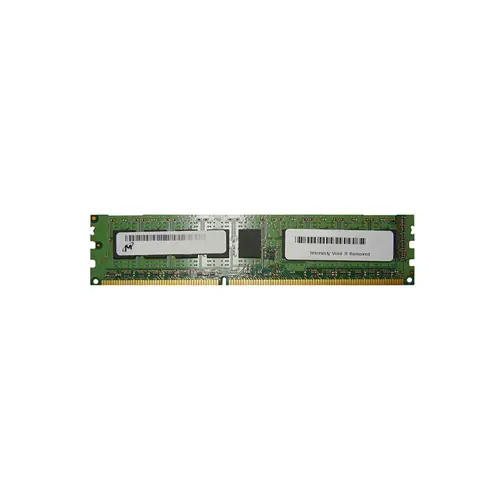
The Micron MT9KSF25672AZ-1G4D1 is a server-oriented DDR3 UDIMM built for micro-servers and entry-level workstations. In virtualized clusters, its ECC engine automatically corrects single-bit errors, preventing silent data corruption that could otherwise cascade into host failures and service interruptions. The 1.35V low-voltage design directly curbs power draw and heat, which trims energy and cooling costs in 24/7 operations—a meaningful saving at scale. Because it is unbuffered, there is no extra register delay; this lower latency is vital for in-memory databases like Redis or SAP HANA, where every nanosecond saved per query accelerates real-time analytics. The single-rank x8 layout additionally lightens the electrical load on the memory controller, ensuring stable 1333MHz signaling even in compact dual-inline configurations. When you run a hardened ZFS storage server or orchestrate containerized microservices, this module guards your data, reduces operating expenses, and delivers the predictable responsiveness that keeps your services running smoothly.
General Virtualization
This 2GB DDR3 ECC UDIMM is only suitable for very small-scale or legacy virtualization hosts. Populate the server with at least four to six identical modules (8–12 GB total) to support a handful of light virtual machines. Because modern hypervisors demand much larger footprints, consider this module only for test labs—production deployments require higher-capacity DIMMs, and mixing sizes may disable interleaving benefits.
In-Memory Database
In-memory databases demand both capacity and reliability, but a single 2 GB DIMM is wholly inadequate for productive workloads. To even prototype, install the maximum number of identical 2 GB UDIMMs across all channels (e.g., six modules for 12 GB). Recognize that this severely limits dataset size; real-world deployments typically start at 64 GB or more. Use ECC as a minimum safeguard, but plan an immediate migration to higher-density registered memory.
HPC
For lightweight HPC nodes processing small, partitioned jobs, install matching pairs or trios of this UDIMM (2 GB per channel) to maintain balanced memory bandwidth. Total capacity might reach 8–12 GB on a single-socket board, which fits embarrassingly parallel tasks with modest memory per core. However, any modern compute-bound simulation or model quickly exhausts 2 GB DIMMs, so treat this configuration as a stopgap; scale-out with many nodes rather than scaling up capacity per node.
Rigorously tested and compatible with Dell PowerEdge T110, R210, and HP ProLiant ML110 G7 servers.
Q: Can I mix this MT9KSF25672AZ-1G4D1 with other memory modules of different brands or speeds?
A: Mixing ECC UDIMMs is not recommended. Different brands or speeds may cause signal integrity issues and disable ECC functionality. For maximum server stability, use identical modules in matched capacity, rank, and timings.
Q: Is this memory compatible with my system? This is a server module, which Intel or AMD platforms support it?
A: It fits single-socket servers using Intel Xeon E3/E5 or AMD Opteron platforms that require 1.35V DDR3 ECC Unbuffered UDIMMs. Always verify motherboard QVL lists for 2GB 2Rx8 PC3-10600E support.
Q: What is the recommended DIMM population order for optimal performance?
A: Populate identical DIMMs starting with slot 0 (or 1) per channel, typically blue slots first. For dual-channel operation, install pairs of equal capacity and rank. Consult your server board's manual for exact slot numbering sequences.
Q: Does this module support overclocking or XMP profiles?
A: No. This server-grade ECC UDIMM adheres strictly to JEDEC DDR3-1333 CL9 specifications. XMP and overclocking are disabled to ensure data integrity and 24/7 operational reliability in mission-critical environments.
Q: What warranty and typical failure rate can I expect?
A: This module carries a one-year warranty. Server UDIMMs have a very low annualized failure rate, typically under 0.2%, when operated within specified voltage and temperature ranges in validated server platforms.