











 Secure payments
Standard refund policy
Trade Assurance
Secure payments
Standard refund policy
Trade Assurance
| Product Type | Memory Module |
|---|---|
| Memory Capacity | 2 GB |
| Memory Technology | DDR3 |
| Product Voltage | 1.5V |
| RAM Speed | 1333MHz |
| RAM Standard | DDR3-1333/PC3-10600 |
| Error Identifying | ECC |
| Signal Type | Registered |
| Column Access Strobe (CAS) | CL9 |
| Rank | Single Rank x4 |
| Quantity of Pins | 240-pin |
| RAM Genre | RDIMM |
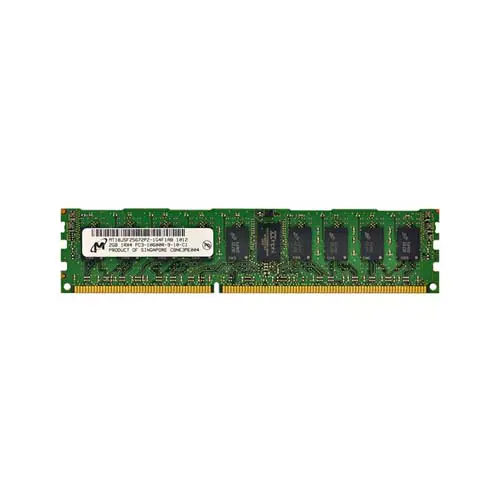
This 2GB DDR3-1333 registered ECC RDIMM is purpose-built for server platforms demanding high data integrity, making it well-suited for virtualization, memory caching, and light database workloads. Its single-rank x4 organization minimizes electrical loading on the memory bus, enabling more stable operation in dense multi-DIMM configurations while the registered signal type reinforces command/address reliability across populated channels.
1. End-to-end error correction safeguards mission-critical data, eliminating silent data corruption in always-on enterprise servers and financial transaction systems.
2. The registered clock driver buffers command and address lines, enabling stable population of all DIMM slots to maximize total memory capacity for dense virtualization farms.
3. Narrow-DRAM organization strengthens advanced ECC schemes by confining hard faults to a single nibble, dramatically improving system uptime and service continuity.
4. High-speed DDR3 transfer rates sustain consistent throughput across concurrent VMs and heavy I/O workloads, preventing memory-induced bottlenecks in database and analytics platforms.
5. A low column access latency accelerates memory read cycles, directly improving transaction processing speeds and application responsiveness under steep user loads.
As a server-grade DDR3-1333 Registered DIMM, the Micron MT18JSF25672PZ-1G4F1AB equips your infrastructure with four decisive advantages that translate directly into uptime and responsiveness. In a virtualized cluster, a single undetected bit-flip can silently corrupt guest filesystems or in-memory states across dozens of VMs; the module’s integrated ECC engine intercepts such errors in real time, preserving transactional integrity and preventing catastrophic failovers. Its Registered signal buffer decouples the memory bus from the CPU’s electrical load, letting you fully populate 18 DIMM slots per host without signal degradation—an indispensable capability when hypervisors demand hundreds of gigabytes of stable, bankable memory. The single-rank x4 organization works in tandem with advanced ECC to achieve Chipkill-class resilience: even if an entire DRAM chip fails, the data stays whole, so an in-memory database like Redis continues serving queries without a hint of corruption. At CAS 9 latency, the module sharpens access times, accelerating virtual memory paging and cutting response latencies under heavy multi-tenant workloads. Together, these four traits deliver a fault-tolerant, low-latency memory foundation where business continuity and database performance are inseparable.
This DDR3-1333 ECC Registered RDIMM (2GB, 1.5V) serves legacy server platforms. Given the 2GB density, capacity planning requires maximizing module count and balancing channels.
General Virtualization
Equip each memory channel with at least two modules to reach 16GB total, the minimum for running two or three light VMs. For example, in a server with four channels, install eight RDIMMs (two per channel). The ECC feature safeguards hypervisor stability, and populating all channels enables memory interleaving for smoother multi-VM workloads.
In-Memory Database
Fill every available DIMM slot to achieve the highest possible capacity. A fully populated 24-slot dual-socket server provides 48GB, which is suitable only for small in-memory caches or test databases. Always mirror the module layout across both processor sockets to preserve NUMA locality and minimize remote access latency.
High-Performance Computing
HPC applications depend on bandwidth, so deploy at least one 2GB module per channel (e.g., 8 or 12 RDIMMs). Use a single DIMM per channel at the rated 1333MHz for optimal latency and power. If more memory is needed, populate a second module per channel only after ensuring the platform can sustain full speed.
Rigorously tested for Dell PowerEdge R720, HP DL380p Gen8, IBM x3650 M4.
Q: Can I mix this MT18JSF25672PZ-1G4F1AB with other memory modules of different brands or speeds?
A: Mixing this 2GB DDR3-1333 RDIMM with modules of different speeds or brands is possible but not recommended. The memory controller will downclock all modules to the slowest common speed, and mixed brands may cause signal integrity issues.
Q: Is this memory compatible with my system?
A: This is a 240-pin DDR3-1333 Registered ECC RDIMM designed for servers. It is compatible with Intel Xeon 5500/5600 series or AMD Opteron 6100 series platforms that require 1.5V registered memory. Verify your server board's qualified vendor list.
Q: What is the recommended DIMM population order for optimal performance?
A: Populate identical DIMMs in matched sets across memory channels, typically filling blue slots first on Intel platforms. Always follow your server motherboard manual for specific slot numbering to enable multi-channel interleaving and best throughput.
Q: Does this module support overclocking or XMP profiles?
A: No. This server-grade registered ECC module does not support overclocking or XMP profiles. It operates strictly at JEDEC-standard DDR3-1333 CL9 timings to ensure 24/7 data integrity and system stability in mission-critical environments.
Q: What warranty and typical failure rate can I expect?
A: This module includes a 1-year warranty. Server RDIMMs like this Micron-built unit typically demonstrate an annualized failure rate (AFR) below 0.5% under normal operating conditions, ensuring high reliability for enterprise workloads.