











 Secure payments
Standard refund policy
Trade Assurance
Secure payments
Standard refund policy
Trade Assurance
| Product Type | Memory Module |
|---|---|
| Compliance Standards | RoHS |
| Memory Capacity | 2 GB |
| Memory Technology | DDR3 |
| Product Voltage | 1.35V |
| RAM Speed | 1333MHz |
| RAM Standard | DDR3-1333/PC3-10600 |
| Error Identifying | ECC |
| Signal Type | Registered |
| Column Access Strobe (CAS) | CL9 |
| Rank | Single Rank x8 |
| Quantity of Pins | 240-pin |
| RAM Genre | RDIMM |
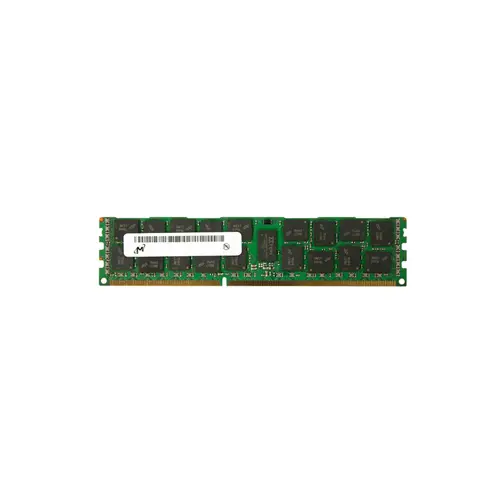
Designed as a DDR3-1333 registered ECC module, this 2 GB RDIMM is optimally targeted at entry-level server platforms running virtualization or small-scale in-memory database workloads where data integrity and multi-DIMM stability are essential. Its single-rank x8 organization and low 1.35 V operating voltage minimize bus loading and power draw, while registered signal buffering combined with CL9 latency ensures reliable, responsive performance in dense memory configurations.
1. ECC integrity guards against silent data corruption, preserving transaction accuracy in financial databases and mission-critical services.
2. Registered buffering stabilizes command and address lines across heavily populated server boards, ensuring reliable operation with multiple DIMMs per channel.
3. Low-voltage operation curbs power consumption and thermal stress in dense data center racks, directly lowering cooling overhead for always-on infrastructure.
4. Single-rank architecture reduces electrical load on the memory controller, enabling higher clock margins and stable performance in large-scale virtualization deployments.
5. Modest capacity footprint targets embedded server roles such as IPMI management modules and lightweight hypervisor appliances, where deterministic low-power operation outweighs total memory expansion.
When you are managing a virtualization cluster or running an in‑memory database, every bit of data matters — and the MT9KSF25672PZ-1G4M1FF RDIMM is engineered to protect it. This DDR3‑1333 registered module integrates ECC, which continuously corrects single‑bit memory errors caused by background radiation. In a hypervisor hosting multiple virtual machines, an uncorrected error can silently corrupt a guest operating system or customer transaction; ECC prevents that silent corruption, keeping your critical workloads reliable.
The registered buffer stabilizes the command and address lines when multiple DIMMs populate a server, solving the signal integrity challenges that arise in dense, multi‑slot configurations. For your Redis or memcached instance where latency is measured in microseconds, a stable electrical interface eliminates intermittent retries and timeouts. With a 1.35 V operating voltage, this module draws significantly less power than standard 1.5 V DDR3, reducing datacenter thermal load and electricity costs across hundreds of nodes. The single‑rank x8 organization also presents a lighter load to the memory controller, which improves compatibility and allows the system to sustain higher bandwidth in read‑heavy in‑memory database operations — so your queries return faster, without hardware hang‑ups.
General Virtualization
To support multiple VMs, capacity is king. Using these 2 GB RDIMMs, populate every available slot in a dual‑socket server (e.g., 24 modules across 12 DIMM slots per CPU) to reach 48 GB total, and install at least one DIMM per memory channel to preserve balanced bandwidth. Given the limited 2 GB density, this configuration only suits lightweight testbeds; production environments demand larger modules, but the low 1.35 V operation helps keep overall power draw modest.
In‑Memory Database
In‑memory databases demand symmetrical, fully‑populated memory layouts for consistent low latency. Install one or two identical RDIMMs in every channel across both sockets (e.g., 12 modules for 24 GB or 24 modules for 48 GB) with Rank‑Interleaving enabled to maximize throughput. Be aware that a 48 GB ceiling restricts dataset size drastically—evaluate whether this fits your working set, and always use ECC Registered memory to safeguard data integrity during high‑speed operations.
High‑Performance Computing (HPC)
HPC workloads prize bandwidth over raw capacity. Configure the server with only one RDIMM per channel (4 or 3 channels per CPU, yielding 8 or 6 modules for 16‑12 GB) to run at the full 1333 MHz speed without the command‑rate slowdowns of 2 DIMMs per channel. This delivers the highest memory throughput while the 1.35 V Registered ECC design ensures stability during extended compute runs, making it ideal for memory‑bandwidth‑bound scientific kernels.
Rigorously tested server memory, compatible with Dell PowerEdge R720, HP DL380p Gen8, Lenovo ThinkServer RD630.
Q: Can I mix this MT9KSF25672PZ-1G4M1FF with other memory modules of different brands or speeds?
A: Mixing RDIMMs of different brands or speeds is not recommended. Registered ECC modules require matched ranks, timings and voltage to ensure signal integrity and prevent system instability.
Q: Is this memory compatible with my system? Which server platforms are supported?
A: This module is designed for servers with Intel Xeon 5500/5600 series or AMD Opteron 6100 series platforms that support DDR3-1333 Registered ECC memory at 1.35V. Please consult your motherboard's qualified vendor list.
Q: What is the recommended DIMM population order for optimal performance?
A: For optimal performance, populate identical RDIMMs per memory channel following the server board's manual. Typically, install in sets of three for triple-channel or two for dual-channel, starting with the farthest slot from the CPU.
Q: Does this module support overclocking or XMP profiles?
A: No. This is a server-grade Registered ECC DIMM adhering to JEDEC standards. It does not support overclocking or XMP profiles; stability and data integrity are prioritized over variable clock speeds.
Q: What warranty and typical failure rate can I expect for this memory?
A: This memory carries a 1-year warranty. As an enterprise RDIMM built with RoHS-compliant components and ECC technology, its typical annualized failure rate (AFR) is very low under specified operating conditions.