











 Secure payments
Standard refund policy
Trade Assurance
Secure payments
Standard refund policy
Trade Assurance
| Product Type | Memory Module |
|---|---|
| Memory Capacity | 32 GB |
| Memory Technology | DDR4 |
| Product Voltage | 1.2V |
| RAM Speed | 2666MHz |
| RAM Standard | DDR4-2666/PC4-21300 |
| Error Identifying | ECC |
| Signal Type | Registered |
| Column Access Strobe (CAS) | CL19 |
| Rank | Dual Rank x4 |
| Quantity of Pins | 288-pin |
| RAM Genre | RDIMM |
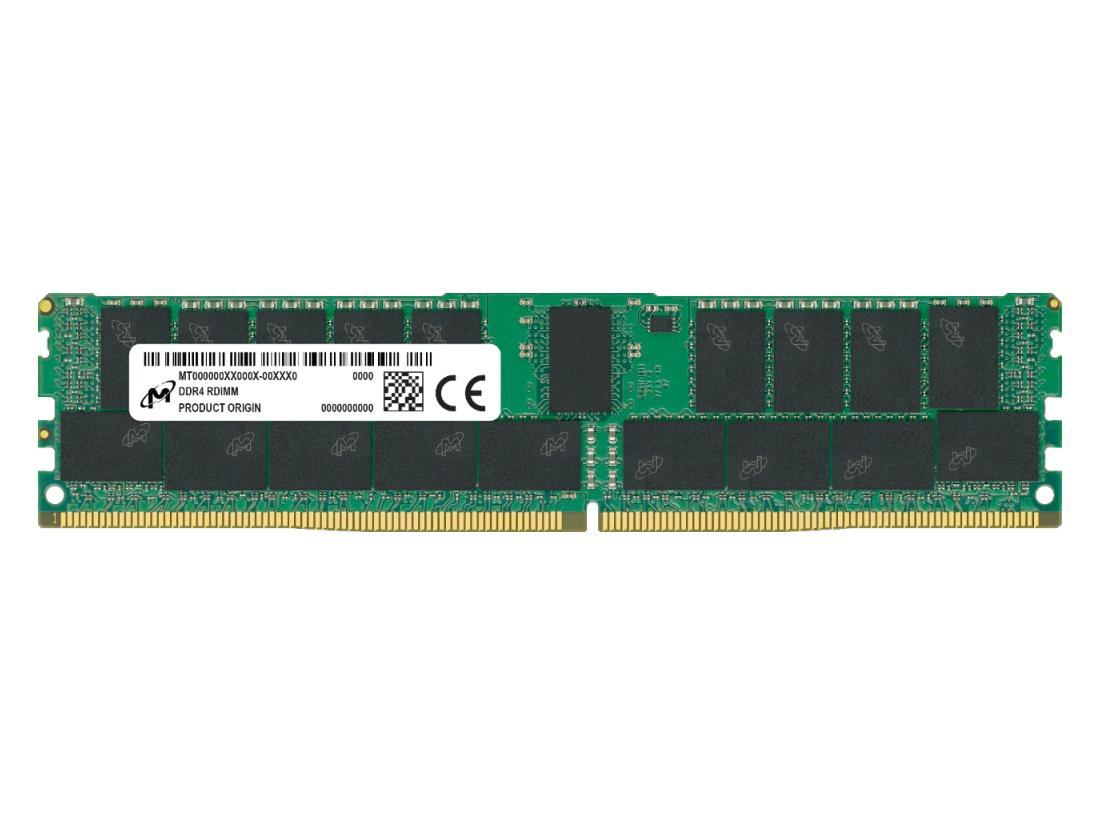
This 32GB DDR4-2666 RDIMM is engineered for server environments, where its ECC and registered signal type deliver the data integrity and reliability required for virtualization and in-memory databases. The dual-rank x4 configuration optimizes memory bandwidth and enables higher capacity per channel, while the CL19 latency at 1.2V strikes a balance between responsive performance and power efficiency in enterprise-class platforms.
1. 32 GB capacity per module enables higher VM density per server node, reducing hardware footprint and licensing costs in virtualized environments.
2. ECC single-bit error correction actively prevents data corruption in memory, ensuring transactional integrity for critical enterprise databases and in-memory analytics.
3. Registered signaling stabilizes high-capacity memory configurations by reducing electrical load on the memory controller, enabling deployments with dozens of DIMMs without signal degradation.
4. 2666 MHz memory bandwidth accelerates large dataset throughput for content delivery, scientific simulation, and real-time big data processing workloads.
5. Dual rank x4 organization interleaves memory accesses across two internal ranks, saturating the channel and delivering consistent low-latency performance under multi-tenant heavy load.
Judging by the RDIMM form factor, registered signal type, and ECC support, this is unequivocally a server-grade memory module built for mission-critical enterprise environments. In a dense virtualization cluster running dozens of VMs, a single undetected bit flip in system memory can silently corrupt transactional data or crash an entire hypervisor. The module’s ECC engine actively detects and corrects single-bit errors and flags multi-bit faults, giving you a hardened layer of data integrity that prevents costly downtime and forensic headaches. Meanwhile, the registered design places a clock driver on each DIMM, stabilizing command and address signals so you can populate all memory channels with 32GB modules without sacrificing the 2666MHz speed. That reliability becomes tangible in an in-memory database such as Redis or SAP HANA, where the dual-rank x4 organization leverages rank interleaving to overlap row activations and keep read/write latency consistently low even under sustained 100% load. What this means for your data center is straightforward: fewer memory-related service interruptions, predictable low-latency performance for latency-sensitive workloads, and the density headroom to scale virtual machines or database caches seamlessly.
General Virtualization
For general virtualization, install at least four of these 32 GB RDIMMs (128 GB total) in a dual-socket server to comfortably run dozens of mixed-workload VMs. The ECC and registered architecture provides the uptime stability essential for virtualized environments. Populate all memory channels symmetrically to achieve optimal throughput and retain expansion capacity for future growth.
In-Memory Database
Begin with eight modules (256 GB) for an in-memory database such as Redis or SAP HANA, keeping the entire hot dataset in RAM. The dual-rank x4 configuration provides solid bandwidth, while ECC eliminates silent data corruption risks. Scale to 512 GB or 1 TB by fully populating DIMM slots, ensuring all queries are served directly from memory.
High-Performance Computing
Equip each HPC node with six or eight of these 32 GB RDIMMs (192–256 GB) across all memory channels for interleaved access. This arrangement maximizes the 2666 MHz bandwidth and supports memory-bandwidth-bound scientific simulations. The registered DIMM design enables large, reliable memory footprints, and dual-rank modules offer an ideal balance between capacity and latency.
Rigorously tested, compatible with servers: Dell PowerEdge R740, HPE ProLiant DL380 Gen10, Lenovo ThinkSystem SR650.
Q: Can I mix this MTA36ASF4G72PZ-2G6E1SG with other memory modules of different brands or speeds?
A: Mixing ECC Registered DIMMs is strongly discouraged. Identical specs and rank are critical to maintain signal integrity and memory RAS. Even minor variations can cause POST failures or silent data corruption in server workloads.
Q: Is this memory compatible with my server system (Intel or AMD platform)?
A: This DDR4-2666 RDIMM is compatible with Intel Xeon Scalable (1st/2nd Gen) and AMD EPYC 7001 series platforms. Verify the specific server board’s qualified vendor list for this Micron part number to ensure proper ECC functionality.
Q: What is the recommended DIMM population order for optimal performance?
A: Follow your server board manual; typical order for dual-socket systems populates far blue slots first to balance memory channels per CPU. This dual-rank x4 RDIMM should be installed in identical sets for correct NUMA interleaving.
Q: Does this module support overclocking or XMP profiles?
A: No. This is a JEDEC-compliant registered server DIMM, prioritizing stability and data integrity. Overclocking and XMP are not supported, as ECC and strict signal timing govern all operations.
Q: What warranty and typical failure rate can I expect?
A: The module includes a one-year warranty. Enterprise RDIMMs typically exhibit an annualized failure rate below 0.5% under rated conditions, backed by rigorous screening and Micron’s quality assurance.