











 Secure payments
Standard refund policy
Trade Assurance
Secure payments
Standard refund policy
Trade Assurance
| Product Type | Memory Module |
|---|---|
| Compliance Standards | RoHS |
| Memory Capacity | 32 GB |
| Memory Technology | DDR3 |
| Product Voltage | 1.35V |
| RAM Speed | 1066MHz |
| RAM Standard | DDR3-1066/PC3-8500 |
| Error Identifying | ECC |
| Signal Type | Registered |
| Column Access Strobe (CAS) | CL7 |
| Rank | Quad Rank x4 |
| Quantity of Pins | 240-pin |
| RAM Genre | RDIMM |
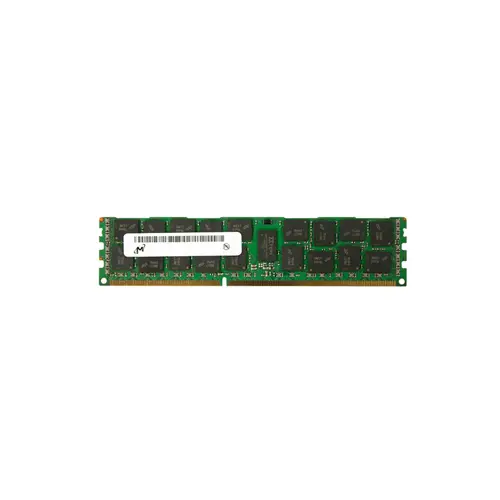
This 32GB DDR3-1066 Registered ECC RDIMM is engineered for legacy server platforms where data integrity and sustained uptime are critical, excelling in memory-bound workloads such as virtualization and in-memory databases. Its quad-rank x4 organization maximizes DIMM capacity while the 1.35V low-voltage operation and registered signal type reduce electrical loading on the memory bus, ensuring stable 240-pin operation at CL7 latencies in dense, multi-DIMM configurations.
1. High-density module capacity allows IT architects to pack more virtual machines onto a single physical server, reducing hardware sprawl and boosting consolidation ratios.
2. ECC protection continuously corrects memory errors in-flight, guarding against silent data corruption that could otherwise compromise database integrity or financial ledgers.
3. Registered signal buffering maintains clean command and address integrity under fully loaded memory channels, a must-have for 24/7 server reliability in enterprise environments.
4. Low-voltage operation trims overall rack power draw and thermal stress, directly lowering cooling costs and extending component lifespan in dense data centers.
5. Quad-rank architecture with x4 device width pushes per-slot density to its practical limit, while the registered interface absorbs electrical loading to keep data pathways stable during peak workload bursts.
The Micron MT72KSZS4G72PZ-1G1D1FE is unmistakably a server-class memory module: a 32GB DDR3-1066 RDIMM with ECC, registered signaling, quad-rank organization, and a low 1.35V operating voltage. In the data center, these specifications translate directly into reliability and performance that commodity desktop DRAM simply cannot deliver.
Consider a dense virtualization cluster running dozens of virtual machines on a single host. A single bit flip in unprotected memory can corrupt a hypervisor page table, silently cascading into guest kernel panics and unplanned downtime. The module’s ECC engine detects and corrects single-bit errors in real time, preserving data integrity for every VM instance without performance penalties. Meanwhile, the registered buffer isolates the memory controller from the electrical load of the quad-rank DRAM packages. This means you can fully populate all 24 DIMM slots across a server’s memory channels with 32GB modules, achieving 768GB or more of total capacity, without signal degradation or boot failures that plagues unbuffered designs.
Shift that capacity to an in-memory database or caching tier such as Redis or SAP HANA. The quad-rank x4 construction enables this high 32GB density on a single stick, letting you keep massive working sets entirely in DRAM. Combined with the tight CL7 latency, the module serves real-time analytics queries with sub-microsecond consistency, eliminating the IO latency spikes that degrade customer-facing dashboards. The 1.35V low-voltage operation further reduces thermal output per DIMM, cutting cooling costs in a fully loaded chassis while maintaining the 1066MHz bandwidth needed to saturate legacy DDR3 platforms still widely deployed in scale-out infrastructure. This is not just a memory upgrade; it is an investment in uptime, data fidelity, and predictable peak-load performance for the workloads that keep your business running.
General Virtualization
For virtualized environments hosting multiple VMs, capacity and reliability are critical. Populate memory channels symmetrically: two 32 GB RDIMMs per CPU offer 64 GB of balanced capacity, while four modules reach 128 GB for larger farms. Uniform configuration avoids mixed ranks and ensures predictable performance, and ECC with registered buffering provides enterprise-grade stability.
In-Memory Database
In-memory databases require maximum capacity to keep entire datasets in RAM. Fill all DIMM slots with these 32 GB quad-rank RDIMMs, accepting the 1066 MT/s speed when capacity takes priority. Although quad-rank loading limits maximum frequency, the benefit of large in-memory datasets is clear, and reserving some headroom for mirroring or sparing adds resilience for mission-critical systems.
High-Performance Computing (HPC)
HPC workloads need balanced bandwidth and capacity. Install one DIMM per memory channel to maintain signal integrity and sustained 1066 MT/s operation. A dual-socket platform with three channels per CPU can utilize six 32 GB modules (192 GB total) to feed compute cores efficiently without bandwidth bottlenecks, while the 1.35 V low-voltage design helps control power in dense clusters.
Rigorously tested and verified for servers: Dell R720/R620, HP DL380p Gen8, IBM x3650 M4.
Q: Can I mix this MT72KSZS4G72PZ-1G1D1FE with other memory modules of different brands or speeds?
A: Mixing RDIMM modules of differing brands, speeds, or ranks is not recommended. This can cause signal integrity issues and system instability. For reliable enterprise operation, always populate identical part numbers.
Q: Is this memory compatible with my server? Which Intel or AMD platforms are supported?
A: This 32GB DDR3-1066 registered ECC RDIMM is designed for dual-processor servers using Intel Xeon E5-2600 v1/v2 or AMD Opteron 6300 series platforms. Verify your board supports 1.35V quad-rank RDIMMs.
Q: What is the recommended DIMM population order for optimal performance with this module?
A: Populate identical DIMMs in matched sets per memory channel, starting with the slots farthest from the CPU. Always follow the slot color coding in your server’s manual to maximize interleaving and channel balancing.
Q: Does this 32GB RDIMM support overclocking or XMP profiles?
A: No. This is a JEDEC-standard registered memory module for enterprise servers. It operates strictly at DDR3-1066 with CL7 timings and does not support overclocking or XMP. Stability and data integrity are the priorities.
Q: What warranty and typical failure rate can I expect for this memory?
A: This module includes a 1-year warranty. As an enterprise-grade Micron RDIMM, it exhibits an extremely low annualized failure rate (AFR) under normal operating conditions, ensuring mission-critical reliability.