











 Secure payments
Standard refund policy
Trade Assurance
Secure payments
Standard refund policy
Trade Assurance
| Product Type | Memory Module |
|---|---|
| Compliance Standards | RoHS |
| Memory Capacity | 32 GB |
| Memory Technology | DDR3 |
| Product Voltage | 1.35V |
| RAM Speed | 1066MHz |
| RAM Standard | DDR3-1066/PC3-8500 |
| Error Identifying | ECC |
| Signal Type | Registered |
| Column Access Strobe (CAS) | CL7 |
| Rank | Quad Rank x4 |
| Quantity of Pins | 240-pin |
| RAM Genre | RDIMM |
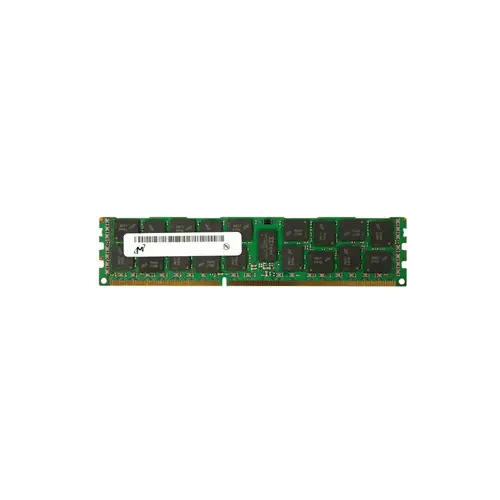
This 32GB DDR3-1066 registered ECC RDIMM is engineered for legacy server platforms that demand uncompromising data integrity, making it ideal for virtualized environments and memory-resident databases where a single-bit error is unacceptable. Its quad-rank x4 organization and CL7 latency maximize memory density per channel while the 1.35V low-voltage operation and registered signal buffering deliver exceptional power efficiency and signal stability under heavy, sustained workloads.
1. Registered signal type buffers command and address signals, enabling the server to scale to massive memory capacities without compromising signal integrity across a sea of DIMMs.
2. ECC error identification silently detects and corrects single-bit memory errors, preserving data integrity in financial transactions or virtualization hosts where even a silent bit flip is unacceptable.
3. Quad Rank x4 configuration packs more DRAM chips per module, maximizing total node memory density for in-memory databases and hyperconverged infrastructure despite a limited number of DIMM slots.
4. Low-voltage operation at 1.35V trims overall server power draw and heat output, directly lowering cooling overhead and energy bills in racks running thousands of modules around the clock.
5. A capacity of 32 GB per RDIMM maintains a generous memory footprint per socket, comfortably supporting dense virtual machine consolidation and large-scale container orchestration without immediate hardware refresh.
The Micron 32GB DDR3-1066 RDIMM (MT72KSZS4G72PZ-1G1D1FF) is purpose-built for virtualized data centers and in-memory database servers where reliability directly impacts revenue. Its ECC error correction is your safeguard against silent data corruption. In hypervisor clusters running dozens of VMs, a single uncorrected bit flip can crash critical workloads or corrupt transactional records — this module catches and fixes those errors in real time, ensuring service continuity. The registered buffer ensures electrical integrity when you populate all channels for high density; you can confidently install multiple quad-rank DIMMs to support memory-hungry applications like SAP HANA without signal instability. The quad-rank x4 design maximizes capacity per channel, keeping large datasets in memory for faster analytics, while CL7 latency accelerates cache access. Operating at just 1.35V, it lowers power draw and cooling demands across populated racks, meaning lower OPEX. Ultimately, this means uncompromised uptime, data accuracy, and energy efficiency under the heaviest workloads.
General Virtualization
For a hypervisor hosting mixed workloads, populate at least six of these 32 GB RDIMMs per dual-socket server to achieve 192 GB total. This capacity comfortably supports 20–30 typical virtual machines while leaving headroom for memory overcommitment. Distribute modules evenly across memory channels to maintain balanced memory access and maximize throughput.
In-Memory Database
Applications like Redis or SAP HANA demand both capacity and data integrity. A minimum configuration of eight 32 GB modules (256 GB) is recommended for mid-sized datasets, scaling to sixteen or more for larger instances. ECC and registered buffering are essential here to prevent silent data corruption under sustained write loads.
High-Performance Computing (HPC)
For compute-bound simulations, install one module per channel (typically 8 or 12 DIMMs for a dual-socket system) to maximize memory bandwidth. With 32 GB per slot, this yields 256–384 GB of memory, enough for large numerical models while keeping memory latency low. Quad-rank x4 modules ensure high rank density, but verify platform compatibility and limit to two DIMMs per channel if clock speed throttling occurs under full population.
Rigorously tested server memory compatible with Dell PowerEdge R720, HP ProLiant DL380p Gen8, and Lenovo System x3650 M4.
Q: Can I mix this MT72KSZS4G72PZ-1G1D1FF with other memory modules of different brands or speeds?
A: Mixing registered server DIMMs with different brands, speeds, or ranks often causes stability issues. We strongly advise using identical part numbers to guarantee signal integrity and system reliability.
Q: Is this memory compatible with my system?
A: This module is compatible with servers supporting DDR3 Registered ECC DIMMs, such as Intel Xeon E5-2600 v2 or AMD Opteron 6300 series platforms. Please check your motherboard's qualified vendor list.
Q: What is the recommended DIMM population order for optimal performance?
A: Follow your server manual's population rules. For quad-rank RDIMMs, populate the first slot of each memory channel (commonly blue slots) first to maintain balanced interleaving and consistent performance.
Q: Does this module support overclocking or XMP profiles?
A: No. As an enterprise-grade registered DIMM, this module runs strictly at JEDEC-standard DDR3-1066 CL7 for maximum stability. Overclocking and XMP are neither supported nor recommended.
Q: What warranty and typical failure rate can I expect?
A: We provide a one-year warranty. This module’s enterprise build quality yields a typical annualized failure rate (AFR) below 0.5%, ensuring durable 24/7 operation in mission-critical environments.