











 Secure payments
Standard refund policy
Trade Assurance
Secure payments
Standard refund policy
Trade Assurance
| Product Type | Memory Module |
|---|---|
| Compliance Standards | RoHS |
| Memory Capacity | 32 GB |
| Memory Technology | DDR3 |
| Product Voltage | 1.35V |
| RAM Speed | 1066MHz |
| RAM Standard | DDR3-1066/PC3-8500 |
| Error Identifying | ECC |
| Signal Type | Registered |
| Column Access Strobe (CAS) | CL7 |
| Rank | Quad Rank x4 |
| Quantity of Pins | 240-pin |
| RAM Genre | RDIMM |
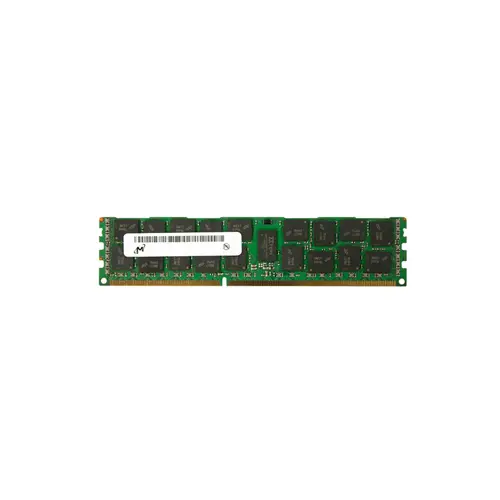
This 32GB DDR3-1066 registered ECC memory module (PC3-8500, CL7) is purpose-built for legacy server platforms running memory-intensive workloads such as virtualization, in-memory databases, and enterprise applications requiring uncompromising data integrity. Its quad-rank x4 organization maximizes capacity density per channel while the 1.35V low-voltage operation reduces power consumption, and the combination of ECC with registered signal buffering ensures rock-solid stability in multi-DIMM configurations.
1. The substantial per-module capacity allows dense memory configurations, letting a single server host more virtual machines and larger in-memory databases without expanding physical footprint.
2. Hardware-level error correction traps and repairs single-bit faults in real time, preserving data integrity for always-on enterprise applications where silent corruption is unacceptable.
3. The registered buffer re-drives address and command signals, enabling fully populated memory channels across multiple DIMMs while preserving electrical stability in large-scale deployments.
4. A high rank count combined with x4 DRAM organization deepens bank interleaving, keeping throughput consistent when many CPU cores access memory simultaneously under heavy consolidation.
5. Energy-efficient low-voltage operation trims power consumption per DIMM, directly lowering cooling overhead and operational expenditure in hyperscale data center environments.
When you are running a dense virtualization cluster hosting dozens of mission-critical VMs, or powering an in-memory database where microsecond latency defines revenue, the Micron MT72KSZS4G72PZ-1G1E1HF 32GB DDR3 RDIMM is not just another component—it is your stability anchor. Its ECC engine silently corrects single-bit errors caused by cosmic particles or electrical noise, preventing silent data corruption that could crash a transactional database or silently poison a virtual machine’s state. The registered signal buffer decouples the memory controller from the DRAM loads, letting you fill all channels with these 32GB quad-rank modules without compromising signal integrity; that translates directly to confidently scaling your VMware or KVM farm to hundreds of VMs per host without random boot failures. Speaking of quad-rank x4 construction, it packs enormous density into one slot, maximizing capacity for memory-hungry in-memory analytics like Redis clusters or SAP HANA snapshots while leaving room for future growth. Finally, the 1.35V low-voltage operation cuts power draw meaningfully across a rack of servers, reducing cooling overhead and electricity bills in a 24/7 data center where every watt matters. This module is engineered so your virtual infrastructure and real-time data engines run not just faster, but safer and more efficiently.
General Virtualization
This 32GB DDR3L-1066 RDIMM is ideal for moderately dense virtualization hosts. Its low 1.35V operation and ECC protection ensure stable, power-efficient support for multiple light to medium VMs. Pair modules in balanced channels—deploy six or twelve identical DIMMs across memory channels for consistent performance and maximum available capacity.
In-Memory Database
Registered, quad-rank x4 construction allows high capacity per channel, which is critical for in-memory workloads like Redis or SAP HANA testing environments. However, the 1066MHz speed and CL7 latency mean you should prioritize capacity over raw bandwidth—populate all channels with 32GB DIMMs to reach 384GB or 768GB targets. Always enable spare rank or mirroring if uptime is paramount.
High-Performance Computing
HPC clusters running memory-bandwidth-sensitive tasks may find 1066MHz a bottleneck, but this module suits capacity-bound simulations or large shared-memory nodes. Install multiple DIMMs per channel (e.g., 2DPC) to maximize total RAM, but be aware that quad-rank loading will force memory speed to drop. Balance node design by using these in data-fatigue jobs while pairing compute-heavy tasks with faster, lower-capacity memory.
Rigorously tested server memory, compatible with Dell PowerEdge R720, HP ProLiant DL380p Gen8, Cisco UCS C220 M3, IBM x3650 M4.
Q: Can I mix this MT72KSZS4G72PZ-1G1E1HF with other memory modules of different brands or speeds?
A: Mixing is not recommended for server environments. All RDIMMs should be identical in speed, rank, and voltage to maintain signal integrity and stable ECC operation. Mismatched DIMMs may force the system to downclock and risk memory errors.
Q: Is this memory compatible with my system? Which Intel or AMD platforms are supported?
A: This 32GB DDR3-1066 Registered ECC RDIMM requires a server board with 240-pin slots supporting Quad Rank x4 modules and 1.35V low voltage. It is validated for dual-socket platforms like Intel Xeon E5-2400/2600 v1/v2 and select AMD Opteron 6300 series.
Q: What is the recommended DIMM population order for optimal performance with this Quad Rank RDIMM?
A: Populate identical Quad Rank RDIMMs per channel starting with the farthest slot from the CPU. For dual-socket servers, balance memory equally across all memory channels and CPUs. Consult your server manual for slot numbering to avoid performance degradation.
Q: Does this module support overclocking or XMP profiles?
A: No. Server-class Registered ECC memory adheres strictly to JEDEC standard DDR3-1066 with CAS 7 latency. It does not support XMP profiles, overclocking, or manual timing adjustments. Operating outside the rated 1.35V specification risks ECC failure.
Q: What warranty and typical failure rate can I expect with this module?
A: This module includes a one-year warranty covering manufacturing defects. Enterprise-grade ECC RDIMMs demonstrate an AFR below 1% under normal thermal conditions. Advanced error correction and rigorous testing ensure high reliability in 24/7 operation.