











 Secure payments
Standard refund policy
Trade Assurance
Secure payments
Standard refund policy
Trade Assurance
| Product Type | Memory Module |
|---|---|
| Compliance Standards | RoHS |
| Memory Capacity | 32 GB |
| Memory Technology | DDR3 |
| Product Voltage | 1.5V |
| RAM Speed | 1333MHz |
| RAM Standard | DDR3-1333/PC3-10600 |
| Error Identifying | ECC |
| Signal Type | Registered |
| Column Access Strobe (CAS) | CL9 |
| Rank | Quad Rank x4 |
| Quantity of Pins | 240-pin |
| RAM Genre | RDIMM |
1
1. Error correction code actively detects and corrects single-bit memory errors, preserving data integrity in transactional databases and preventing silent corruption during continuous server operation.
2. Registered signal buffering isolates the memory controller from excessive electrical loads, enabling stable population of high-density memory configurations across multiple channels in virtualized environments.
3. Quad Rank x4 organization packs more logical ranks per module, increasing addressable memory depth per channel and sustaining consistent virtual machine performance under heavy consolidation.
4. 32 gigabyte capacity on a single stick dramatically raises the memory ceiling of a 2-socket server, allowing more active VMs and larger in-memory datasets without expanding physical hardware.
5. DDR3-1333 data rate delivers sufficient throughput for enterprise workloads like web serving and file storage, while maintaining a conservative power envelope suited for dense rack deployments.
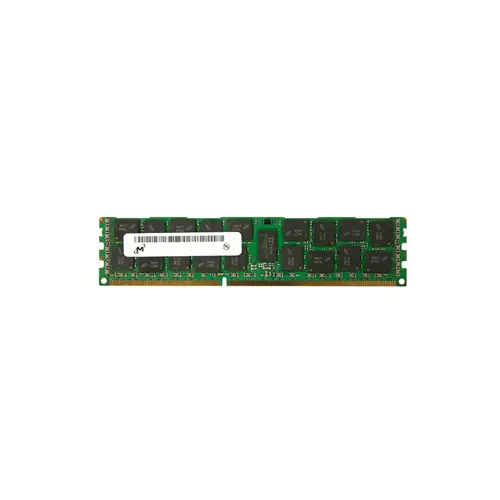
The MT72JSZS4G72PZ-1G4 is a server-specific 32GB DDR3 Registered DIMM with ECC. Its four essential traits — ECC correction, registered buffering, quad-rank architecture, and high capacity — directly address core data center challenges. In a virtualized cluster, memory is the limiting factor; the 32GB density allows generous RAM per host with fewer modules, preserving slot headroom. Registered logic maintains clean signal timing across fully populated channels, eliminating instability seen with unbuffered DIMMs under load. For an in-memory database like Redis or a transactional system, ECC is vital because it continuously corrects single-bit errors from cosmic radiation—a single uncorrected flip could silently corrupt financial records or crash a VM. Quad-rank bank interleaving boosts effective bandwidth and reduces contention when multiple VMs access memory concurrently. This fusion delivers uncompromising data integrity, rugged uptime, and predictable performance for your most demanding workloads.
General Virtualization
This 32GB DDR3-1333 Registered ECC RDIMM is ideal for densely packing virtual machines on legacy servers. For modest virtualization hosts, start with a pair of modules (64GB total) per CPU to maintain balanced memory channels, scaling to six or eight DIMMs for heavier VM density. Always populate identical sticks across memory channels to preserve interleaving and avoid performance penalties from unbalanced configurations.
In-Memory Database
Datasets like Redis or SAP HANA demand both capacity and data integrity, making ECC memory non-negotiable. Deploy this module in matched sets of four or six, targeting 128–192GB per socket, to keep entire working sets in RAM and minimize swap. Avoid mixing quad-rank DIMMs with different ranks or speeds, as this can force the memory controller to downclock and limit throughput.
High-Performance Computing (HPC)
HPC workloads benefit from the registered buffering that allows many DIMMs per node without signal degradation. Populate all memory channels of a dual-socket system with identical 32GB RDIMMs — for example, twelve modules providing 384GB — to maximize bandwidth under massively parallel MPI or CFD jobs. Given the 1333MHz speed, prioritize channel count over raw frequency to sustain aggregate throughput on compute-bound clusters.
Proven after exhaustive testing to work with Dell R720, HP DL380p Gen8, Lenovo RD630, and IBM x3550 M4 servers.
Q: Can I mix this MT72JSZS4G72PZ-1G4 with other memory modules of different brands or speeds?
A: Mixing RDIMMs of different brands, speeds, or ranks is not recommended. It may cause signal integrity issues or prevent the memory from running at the rated 1333MHz, leading to system instability in server environments.
Q: Is this memory compatible with my Intel Xeon server?
A: This 32GB DDR3-1333 ECC Registered DIMM is compatible with Intel Xeon E5-2400/2600 v2 and AMD Opteron 6300 series platforms. Verify your board supports quad-rank x4 modules and 1.5V RDIMMs before purchase.
Q: What is the recommended DIMM population order for optimal performance?
A: Always follow your server motherboard’s population guide. Typically, populate identical quad-rank DIMMs starting with the first slot of each memory channel (e.g., A1, B1, C1, D1) to maintain balanced interleaving and maximize throughput.
Q: Does this module support overclocking or XMP profiles?
A: No. This is a JEDEC-compliant server RDIMM designed for stability at 1333MHz CL9. It does not support XMP or overclocking, as reliable operation in mission-critical environments is prioritized.
Q: What warranty and typical failure rate can I expect?
A: This module includes a 1-year warranty. Enterprise-grade DDR3 RDIMMs exhibit very low annualized failure rates (AFR), typically under 0.5%, ensuring dependable long-term operation in server deployments.