











 Secure payments
Standard refund policy
Trade Assurance
Secure payments
Standard refund policy
Trade Assurance
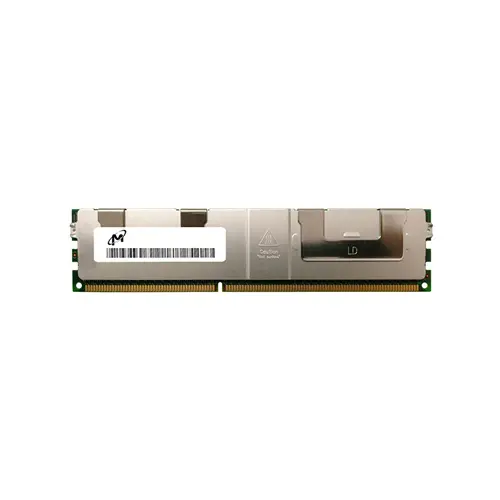
| Model | MT72KSZS4G72LZ-1G4 |
|---|---|
| Product Type | Memory Module |
| Compliance Standards | RoHS |
| Memory Capacity | 32 GB |
| Memory Technology | DDR3 |
| Product Voltage | 1.35V |
| RAM Speed | 1333MHz |
| RAM Standard | DDR3-1333/PC3-10600 |
| Error Identifying | ECC |
| Signal Type | Registered |
| Column Access Strobe (CAS) | CL9 |
| Rank | Quad Rank x4 |
| Quantity of Pins | 240-pin |
| RAM Genre | RDIMM |
This 32GB DDR3L-1333 Registered ECC RDIMM is engineered for enterprise-class server platforms, excelling in memory-intensive workloads such as virtualization, in-memory databases, and data analytics where data integrity is non-negotiable. Its Quad Rank x4 configuration maximizes capacity density per channel, while the 1.35V low-voltage operation and registered signaling enhance signal stability and reduce power consumption in dense, multi-DIMM deployments.
1. ECC protection detects and corrects single-bit errors instantly, safeguarding transactional databases from silent data corruption that could compromise financial accuracy.
2. Registered signal buffering decouples electrical loads from the memory controller, enabling stable operation across fully populated server banks without timing drift.
3. Quad Rank x4 organization maximizes rank interleaving, keeping data pipelines saturated during heavy virtualization bursts and reducing latency under multi-tenant pressure.
4. High-density module capacity lets a single rack scale memory pools efficiently, raising virtual machine density per node and minimizing costly server sprawl.
5. Low-voltage operation trims datacenter power draw and cooling demands per DIMM, accumulating substantial energy savings at hyperscale without sacrificing error-resilient throughput.
When you are managing a dense virtualization cluster or running an in-memory database like Redis, memory errors aren’t just a nuisance—they are downtime and data corruption waiting to happen. The Micron MT72KSZS4G72LZ-1G4 is a 32GB Registered ECC DDR3 module purpose-built for exactly these enterprise scenarios, and its four defining characteristics translate directly into operational integrity. First, the Error Correcting Code (ECC) functionality actively detects and corrects single-bit flips caused by background radiation or electrical noise, preventing silent data corruption that could crash a hypervisor host or flip a financial transaction in your database. Second, the Registered signal buffer allows the memory controller to drive the module’s Quad Rank, x4-organized DRAM chips stably across all four ranks, so you can fully populate a server motherboard with 384GB or more without signal degradation. That high capacity feeds virtual machine density and keeps latency-sensitive datasets entirely in DRAM. Third, the 1.35V operating voltage significantly reduces thermal output inside a 24/7 server rack, lowering cooling costs and extending hardware lifespan—critical when you are running hundreds of modules in a data center. Finally, the CL9 latency and 1333MHz speed strike a deliberately conservative, reliable balance that ensures consistent memory performance under punishing, sustained loads, because in server workloads uptime isn’t negotiable.
General Virtualization
For a typical dual-socket virtualization host, install these 32 GB quad-rank RDIMMs in an identical configuration across all memory channels to maintain balanced bandwidth and NUMA performance. A common starting point is 128 GB (4 × 32 GB) per CPU for moderate consolidation, scaling to 256 GB or 384 GB by adding matched pairs. Always populate channels identically to avoid memory access penalties that degrade virtual machine responsiveness.
In-Memory Database
In-memory databases demand maximum capacity and data integrity, making registered ECC a hard requirement. Fully populate each memory channel with these 32 GB RDIMMs—observe rank-per-channel limits, as installing three quad-rank DIMMs per channel may downclock to 1066 MHz, but the capacity gain for large memory sets is worth the small speed trade-off. Target at least 512 GB per server by using 16 × 32 GB across two sockets to hold entire working sets in DRAM without swapping.
High-Performance Computing
HPC clusters prioritize sustained bandwidth per core and fault tolerance, both satisfied by this ECC registered memory. Populate one 32 GB DIMM per channel initially to run at the full 1333 MHz with minimal rank loading, then scale to two DIMMs per channel if capacity per node must increase, accepting a slight speed reduction. In parallel file system or simulation nodes, equip each socket symmetrically with 4 or 8 identical modules to maximize interleaving and deliver consistent throughput under heavy MPI workloads.
Rigorously tested server memory compatible with Dell PowerEdge R720/R620, HP DL380p Gen8, and similar DDR3 ECC RDIMM systems.
Q: Can I mix this MT72KSZS4G72LZ-1G4 with other memory modules of different brands or speeds?
A: Mixing RDIMMs is not recommended. Unmatched brands, speeds, or ranks can compromise ECC integrity and registered logic, leading to instability in server environments. Always use identical modules per channel for validated reliability.
Q: Is this 32GB DDR3 RDIMM compatible with my server platform?
A: It requires a DDR3 ECC Registered platform, typically Intel Xeon E5-2400/2600 v1/v2 or AMD Opteron 6300 series. Verify your board supports 1.35V, quad-rank x4, 1333MHz RDIMMs and 32GB capacity per slot.
Q: What is the recommended DIMM population order for optimal performance?
A: Populate Channel 1 first (slots 1, 2 per bank). For quad-rank modules, avoid mixing with dual-rank in the same channel. Follow the server’s memory guide to balance load and keep command rates low.
Q: Does this module support overclocking or XMP profiles?
A: No. This registered server memory adheres strictly to JEDEC standards with no XMP support. Overclocking is disabled to ensure 24/7 mission-critical stability and ECC error correction.
Q: What warranty and typical failure rate can I expect?
A: It includes a one-year warranty. Enterprise-grade RDIMMs exhibit very low failure rates under specified conditions, typically <0.2% annually, assuming proper cooling, ESD protection, and workload within limits.