











 Secure payments
Standard refund policy
Trade Assurance
Secure payments
Standard refund policy
Trade Assurance
| Product Type | Memory Module |
|---|---|
| Compliance Standards | RoHS |
| Memory Capacity | 32 GB |
| Memory Technology | DDR3 |
| Product Voltage | 1.35V |
| RAM Speed | 1333MHz |
| RAM Standard | DDR3-1333/PC3-10600 |
| Error Identifying | ECC |
| Signal Type | Registered |
| Column Access Strobe (CAS) | CL9 |
| Rank | Quad Rank x4 |
| Quantity of Pins | 240-pin |
| RAM Genre | RDIMM |
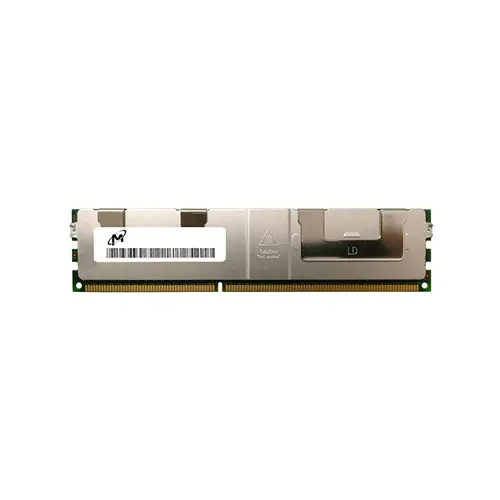
Designed for virtualization and in-memory database workloads, this 32GB DDR3-1333 RDIMM leverages registered signal buffering and ECC to maintain data integrity in high-density server environments. Its quad-rank x4 configuration maximizes capacity per channel, while 1.35V low-voltage operation reduces power consumption without compromising stability.
1. A high-density module footprint allows hosting more virtual machines per physical node, reducing server sprawl and freeing up precious rack space.
2. On-the-fly error correction protects against silent data corruption, ensuring uninterrupted accuracy for mission-critical databases and financial transactions.
3. Registered logic stabilizes command and address lines across multiple DIMMs, sustaining reliable performance as system memory scales to meet enterprise workloads.
4. Multi-rank architecture enables greater capacity per channel and improves memory-level parallelism, which boosts throughput in heavily consolidated virtualization clusters.
5. Low operating voltage curbs overall power draw and thermal output, directly lowering datacenter operational expenses in large-scale deployments.
In enterprise server environments, the Micron MT72KSZS4G72LZ-1G4D1 registered DDR3 memory module directly safeguards mission-critical workloads where downtime is not an option. Its 32 GB quad‑rank x4 organization allows a single server to host dense virtualization clusters—running dozens of virtual machines concurrently—without exhausting DIMM slots, while the registered buffer stabilizes the command and address signals so the system remains rock‑solid even when all banks are populated. The integrated ECC continuously corrects single‑bit errors that cosmic rays or electrical noise can induce, preventing silent data corruption inside an in‑memory database such as SAP HANA or Redis; one undetected bit flip in a financial ledger or a live transaction log could cascade into catastrophic revenue loss. Meanwhile, the 1.35 V low‑voltage operation cuts thermal output in a fully‑populated rack, lowering cooling costs and extending the service life of the memory controller. Together, these four characteristics deliver the predictable data integrity, capacity headroom, and energy efficiency that data centres demand for 24/7 virtualization, large‑scale analytics, and latency‑sensitive online services.
General Virtualization
Populate each memory channel with a single 32 GB quad-rank RDIMM to achieve 256 GB on a typical dual‑socket server while preserving the full 1333 MHz speed. This offers an ideal blend of capacity and performance for hosting dozens of standard VMs. Only install two DIMMs per channel if extreme VM density makes capacity the overriding priority, accepting the resulting clock reduction.
In‑Memory Database
Maximize your dataset footprint by installing two 32 GB quad‑rank DIMMs per channel across all available channels, building up to a 512 GB memory pool. Expect the bus to fall back to 1066 or 800 MHz, but the sheer volume keeps entire tables in RAM and dramatically accelerates real‑time queries. In this scenario, capacity always triumphs over frequency.
High‑Performance Computing (HPC)
Place one 32 GB quad‑rank RDIMM per channel to sustain the full 1333 MHz data rate and avoid downclocking, delivering 128–256 GB of high‑bandwidth memory for simulation and modeling codes. This minimizes latency and maximizes throughput for bandwidth‑bound workloads. Resort to a second DIMM per channel only when the problem size strictly exceeds the available capacity.
Rigorously tested, compatible with DDR3 servers: Dell PowerEdge R720, HP ProLiant DL380p Gen8, Lenovo ThinkServer RD630.
Q: Can I mix this MT72KSZS4G72LZ-1G4D1 with other memory modules of different brands or speeds?
A: Mixing with different brands or speeds is not recommended. Mismatched timings or ranks may cause instability, especially in registered ECC environments. Use identical modules for guaranteed reliability.
Q: Is this memory compatible with my system?
A: This is a DDR3-1333 Registered ECC RDIMM. It requires a server board with an Intel Xeon 5500/5600 series or AMD Opteron 6100/6200 series platform that supports 1.35V quad-rank 240-pin RDIMMs.
Q: What is the recommended DIMM population order for optimal performance?
A: Refer to your server board manual. Typically, populate identical slots per memory channel in ascending order. For quad-rank RDIMMs like this, install one DIMM per channel first to maintain maximum speed.
Q: Does this module support overclocking or XMP profiles?
A: No. This is a server-grade Registered ECC module built to JEDEC DDR3-1333 standards. It does not support overclocking or XMP profiles; stability and data integrity take priority.
Q: What warranty and typical failure rate can I expect?
A: This module carries a 1-year warranty. Typical annualized failure rates for enterprise RDIMMs are extremely low, generally below 0.1%, owing to rigorous testing and error correction.