











 Secure payments
Standard refund policy
Trade Assurance
Secure payments
Standard refund policy
Trade Assurance
| Product Type | Memory Module |
|---|---|
| Compliance Standards | RoHS |
| Memory Capacity | 32 GB |
| Memory Technology | DDR3 |
| Product Voltage | 1.35V |
| RAM Speed | 1333MHz |
| RAM Standard | DDR3-1333/PC3-10600 |
| Error Identifying | ECC |
| Signal Type | Registered |
| Column Access Strobe (CAS) | CL9 |
| Rank | Quad Rank x4 |
| Quantity of Pins | 240-pin |
| RAM Genre | RDIMM |
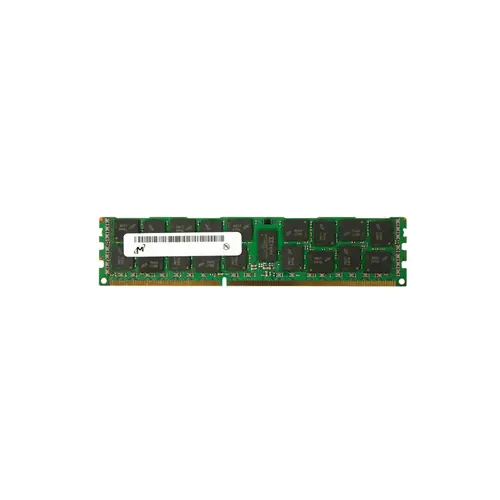
This 32GB DDR3-1333 RDIMM with quad-rank x4 organization and low 1.35V operation is purpose-built for legacy dual-processor servers running memory-intensive workloads such as virtualization and in-memory databases. Its registered signal architecture and ECC reliably maintain data integrity across high-capacity memory channels, while the quad-rank configuration maximizes capacity density per slot in platforms that support it.
1. End-to-end error correction detects and corrects single-bit memory faults in real time, safeguarding transactional integrity for databases and financial workloads that cannot tolerate silent data corruption.
2. The registered buffer isolates the memory controller from excessive electrical loading, allowing fully populated server boards to maintain signal integrity and operational reliability at scale.
3. A dense, high-capacity design per module elevates virtualization density, letting a single hypervisor host more virtual machines before requiring additional physical servers.
4. Quad-rank organization maximizes the addressable memory per channel without sacrificing bus stability, giving in-memory analytics and large-scale caching the headroom they demand.
5. Energy-efficient low-voltage operation substantially reduces power draw and cooling overhead across multi-node racks, directly improving the total cost of ownership in always-on data centers.
In modern data centers, unplanned downtime or silent data corruption is simply not an option. The Micron MT72KSZS4G72PZ-1G4 RDIMM is engineered precisely for environments where reliability and density govern every decision. Its ECC technology actively detects and corrects single-bit errors caused by background radiation or cosmic ray strikes, preserving data integrity in transactional databases and real‑time analytics platforms where even a flipped bit can cascade into financial miscalculation. The registered design buffers command and address signals, stabilizing signal integrity across densely populated memory channels, which becomes critical when scaling virtualization clusters — it enables you to confidently populate all 24 DIMM slots per host without sacrificing boot‑time reliability under heavy VM density. With a 32 GB capacity built on quad‑rank x4 organization, the module delivers the deep memory footprint required for in‑memory databases like SAP HANA, while sustaining bandwidth under concurrent access from dozens of virtual machines. Operating at 1.35 V reduces thermal load and power draw per node, accumulating significant energy savings across a server farm and allowing higher ambient temperatures without throttling — a practical advantage that directly extends hardware lifespan and lowers your total cost of ownership.
General Virtualization
For general virtualization, density and reliability are paramount. Populate each memory channel of a dual-socket server with two of these 32 GB Quad-Rank RDIMMs, typically enabling 384 GB or more to host numerous VMs. The 1.35 V low-voltage operation reduces power draw in dense clusters while Registered ECC ensures data integrity across all workloads.
In-Memory Database
In-memory databases demand the largest possible capacity to hold entire datasets in RAM. Configuring two DIMMs per channel with these modules yields up to 512 GB on a high-memory server, minimizing disk I/O latency. Though quad-rank loading may slightly derate speed, the massive capacity and ECC protection make it an ideal fit for Redis or SAP HANA deployments.
High-Performance Computing (HPC)
HPC codes are often bandwidth-bound. For peak throughput, install only one 32 GB Quad-Rank DIMM per channel to avoid speed downgrades, providing 128–192 GB per node while running all channels at the full 1333 MHz. This balances memory per core for MPI-based simulations and maintains optimal floating-point performance per watt.
Verified for servers: Dell PowerEdge R720, HP DL380p Gen8, Lenovo x3650 M4. Rigorously tested.
Q: Can I mix this MT72KSZS4G72PZ-1G4 with other DDR3 RDIMMs of different brands or speeds?
A: Mixing is not recommended for server environments. Different brands, speeds, or ranks can cause instability. All modules should be identical to ensure reliable ECC and registered operation compliance.
Q: Is this memory compatible with my Intel Xeon E5-2600 v2 series server using the C602 chipset?
A: Yes, this 32GB DDR3-1333 quad-rank RDIMM is validated for Intel Xeon E5 platforms with C602 chipsets. Confirm your board supports registered ECC memory and 1.35V low-voltage operation for full compatibility.
Q: What is the recommended DIMM population order for optimal performance on a dual-socket server?
A: Populate identical DIMMs per channel starting with the farthest slot from each CPU. For quad-rank modules, follow the platform memory population guide, typically filling blue slots first to balance interleaving.
Q: Does this module support overclocking or XMP profiles?
A: No. This is an enterprise-grade RDIMM designed strictly for JEDEC-standard operation at DDR3-1333 with CL9 timing. Overclocking and XMP are not supported to ensure mission-critical data integrity.
Q: What warranty and typical failure rate can I expect for this server memory?
A: It carries a one-year warranty. Annualized failure rate (AFR) for mature DDR3 RDIMMs is industry-typical at around 0.2–0.5%, assuming proper cooling and within rated voltage specifications.