











 Secure payments
Standard refund policy
Trade Assurance
Secure payments
Standard refund policy
Trade Assurance
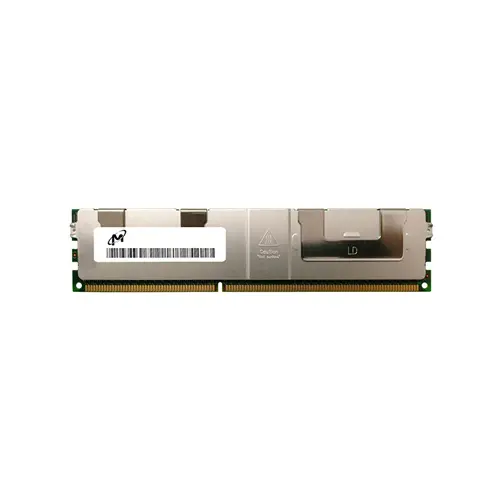
| Model | MT72KSZS4G72LZ-1G4E2B3 |
|---|---|
| Product Type | Memory Module |
| Compliance Standards | RoHS |
| Memory Capacity | 32 GB |
| Memory Technology | DDR3 |
| Product Voltage | 1.35V |
| RAM Speed | 1333MHz |
| RAM Standard | DDR3-1333/PC3-10600 |
| Error Identifying | ECC |
| Signal Type | Registered |
| Column Access Strobe (CAS) | CL9 |
| Rank | Quad Rank x4 |
| Quantity of Pins | 240-pin |
| RAM Genre | RDIMM |
This 32GB DDR3-1333 registered ECC RDIMM is engineered for legacy dual-socket servers and workstations, delivering the data integrity and reliability demanded by virtualization, memory-resident databases, and mission-critical enterprise workloads. Its quad-rank x4 design maximizes memory density per channel while registered signaling stabilizes multi-DIMM configurations, and the low 1.35V operating voltage reduces overall power consumption without compromising the CL9 latency.
1. Memory Capacity: High-density memory footprint accommodates extensive virtualization workloads, allowing more virtual machines per server node without compromising performance.
2. Error Identifying: ECC protection detects and corrects single-bit errors in real time, fortifying data integrity for critical enterprise databases and financial transactions.
3. Signal Type: Registered buffering stabilizes signal integrity across multiple DIMM slots, enabling reliable scaling to large memory configurations in multi-socket servers.
4. Rank: Quad Rank x4 organization maximizes capacity per channel, supporting memory-hungry in-memory analytics and heavy consolidation without sacrificing physical slot count.
5. RAM Speed: Sustained 1333MHz throughput balances bandwidth and latency, delivering consistent data flow for concurrent workloads in virtualized and cloud infrastructure.
The Micron MT72KSZS4G72LZ-1G4E2B3 is unmistakably a server-grade RDIMM, and its engineering speaks directly to the relentless demands of enterprise data centers. Its ECC technology continuously corrects single-bit memory errors caused by background radiation or electrical noise—an absolute necessity when operating in-memory databases like SAP HANA, where an undetected bit flip could silently corrupt financial transactions or analytics results. The registered buffer isolates the memory controller from the electrical load of multiple modules, making it possible to populate all 24 DIMM slots in a virtualization host without signal degradation; this means you can confidently run dozens of virtual machines on a single node and scale memory-intensive workloads without random crashes. The quad-rank 32GB capacity, built on x4 DRAM components, delivers dense, stable memory for massive Redis clusters or VMware ESXi farms, enabling far more active datasets to reside in RAM for sub-millisecond access. Finally, operation at 1.35V instead of the standard 1.5V reduces thermal stress and power draw across your fleet. In a 24/7 deployment, that incremental efficiency compounds into meaningful savings on cooling and energy, helping you meet sustainability targets while maintaining the performance and reliability your critical applications demand.
General Virtualization
For consolidating multiple virtual machines, deploy six or eight of these 32 GB RDIMMs across triple-channel or quad-channel memory controllers to reach 192–256 GB total capacity. Quad-rank DIMMs may limit maximum frequency, so confirm platform support for 1333 MHz at full population—balance DIMMs per channel to avoid performance penalties.
In-Memory Database
Maximize capacity by fully populating all available slots with these 32 GB modules, targeting 256 GB or more depending on server limits. The ECC and registered design is critical for data integrity under constant write-intensive workloads; configure memory interleaving (e.g., node-interleave in BIOS) to improve throughput for large datasets.
High-Performance Computing (HPC)
Aim for high bandwidth and lower latency by populating one or two DIMMs per channel—ideally a symmetrical layout across memory risers to maintain uniform access times. With quad-rank DIMMs, a 64 GB per socket setup using two modules will deliver strong bandwidth, but for scale-out HPC, add additional nodes rather than fully saturating all memory channels to avoid frequency drops.
Rigorously tested 32GB DDR3 server RDIMM for Dell R720, HPE DL380p Gen8, and similar ECC systems.
Q: Can I mix this MT72KSZS4G72LZ-1G4E2B3 with other memory modules of different brands or speeds?
A: Mixing is strongly discouraged in server environments. Identical part numbers ensure consistent signal integrity, timing parameters, and reliability. Mismatched RDIMMs may cause POST failures or silent data corruption.
Q: Is this memory compatible with my Intel Xeon E5-2600 v2 server platform?
A: Yes, this 32GB DDR3-1333 registered ECC RDIMM is validated for Intel Xeon E5/E7 platforms using the C602 chipset. Verify your board supports quad-rank, 1.35V modules before purchase.
Q: What is the recommended DIMM population order for optimal performance?
A: Populate identical DIMMs per channel, starting with the farthest slot from the CPU. For dual-processor systems, balance memory across both processors symmetrically to maximize interleaving and bandwidth.
Q: Does this module support overclocking or XMP profiles?
A: No. This is a server-grade registered ECC DIMM designed for data integrity and stability. It runs strictly at JEDEC-standard DDR3-1333 with fixed timings and does not support overclocking or XMP.
Q: What warranty and typical failure rate can I expect?
A: It carries a one-year limited warranty. Our quality-controlled enterprise modules exhibit an annualized failure rate well below 1%, ensuring long-term deployment reliability in 24/7 data center operation.