











 Secure payments
Standard refund policy
Trade Assurance
Secure payments
Standard refund policy
Trade Assurance
| Product Type | Memory Module |
|---|---|
| Compliance Standards | RoHS |
| Memory Capacity | 32 GB |
| Memory Technology | DDR3 |
| Product Voltage | 1.35V |
| RAM Speed | 1333MHz |
| RAM Standard | DDR3-1333/PC3-10600 |
| Error Identifying | ECC |
| Signal Type | Registered |
| Column Access Strobe (CAS) | CL9 |
| Rank | Quad Rank x4 |
| Quantity of Pins | 240-pin |
| RAM Genre | RDIMM |
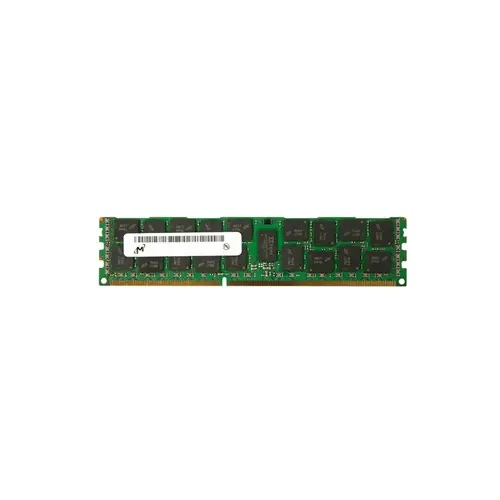
This 32GB DDR3-1333 registered ECC RDIMM with a quad-rank x4 organization is purpose-built for server platforms running memory-intensive, data-critical workloads such as virtualization and in-memory databases. Its hardware error correction guarantees data integrity, while the registered signal type and 1.35V low-voltage design ensure stable, energy-efficient operation in high-density, multi-DIMM configurations.
1. ECC protection detects and corrects single-bit memory errors in real time, preserving data integrity for mission-critical databases and financial transactions.
2. Registered signal buffering stabilizes high-capacity configurations by reducing electrical load on the memory controller, enabling seamless scaling in dense server farms.
3. Quad Rank x4 organization maximizes DRAM density per channel, keeping virtualization hosts fed with ample memory bandwidth under heavy multi-tenant workloads.
4. A generous module capacity supports extensive VM consolidation and large in-memory datasets, boosting throughput in enterprise analytics and caching layers.
5. Low-voltage operation cuts per-DIMM energy consumption without sacrificing clock speed, helping data centers lower cooling overhead and meet green efficiency targets.
Engineered for enterprise servers, this 32GB DDR3L RDIMM (MT72KSZS4G72PZ-1G4E2) turns four critical specifications into real-world dependability. Its registered architecture buffers command and address signals, allowing a single server to populate Quad Rank x4 modules across all channels without signal degradation. In a dense virtualization cluster running dozens of VMs, that means you can confidently scale to 384GB or more per node and maintain smooth live migrations, avoiding the sudden memory errors that unbalance entire host groups. The integrated ECC silently corrects single-bit flips caused by background radiation — an absolute must when an in-memory database like SAP HANA holds transactional hot data where one flipped bit could corrupt financial records without warning. Meanwhile, 1.35V low-voltage operation cuts power draw and thermal stress across the rack, lowering cooling costs in colocation environments while the 1333MHz speed and CL9 latency deliver consistent bandwidth. For database joins and heavy consolidation workloads, this module keeps uptime intact and data accurate under load, not just on a spec sheet.
Based on the specifications — DDR3 Registered ECC RDIMM, 32GB capacity, 1.35V low voltage, and quad-rank x4 organization — this is unequivocally server-class memory. It is designed for stability and data integrity in multi-socket systems. Below is the capacity planning guidance for typical server workloads.
General Virtualization
Virtualized environments are often memory-bound before CPU. For a host running 20–30 light to medium VMs, populate at least six of these 32GB modules per socket (192GB) to avoid ballooning and swapping. Distribute modules evenly across all memory channels to maximize interleaving and bandwidth, and leverage the low 1.35V voltage to reduce aggregate power consumption in dense clusters.
In-Memory Database
In-memory databases like Redis or SAP HANA demand low latency and absolute data correctness — precisely where registered ECC shines. Aim to fill all available DIMM slots with these 32GB quad-rank RDIMMs to reach 256GB–512GB per node, keeping the entire dataset resident. Be mindful that quad-rank DIMMs may force the memory controller to a lower speed step; validate the impact on 1333MHz operation with large populations.
HPC (High-Performance Computing)
For memory-bandwidth-sensitive HPC jobs, a balanced configuration is critical. Install one 32GB module per channel (e.g., eight modules on a dual-socket platform with four channels per CPU) to deliver 256GB while sustaining peak stream bandwidth. Quad-rank DIMMs can stress the command bus, so limit to two per channel unless application capacity requirements strictly dictate otherwise, preserving signal integrity for long-running compute tasks.
Rigorously tested, this 32GB DDR3L RDIMM is compatible with Dell PowerEdge R720, HP DL380p Gen8, and IBM x3650 M4.
Q: Can I mix this MT72KSZS4G72PZ-1G4E2 with other memory modules of different brands or speeds?
A: Mixing is not recommended. Registered DIMMs require identical ranks, timing, and voltage to maintain signal integrity. Dissimilar modules may cause POST failures or stability issues in server environments.
Q: Is this memory compatible with my system? (Intel/AMD server platforms)
A: It is compatible with servers supporting DDR3 Registered ECC RDIMMs, such as Intel Xeon E5-2600 v1/v2 or AMD Opteron 6300 series. Verify your motherboard's QVL and support for 32GB Quad Rank x4 modules.
Q: What is the recommended DIMM population order for optimal performance?
A: Follow your server manual. Typically, populate identical DIMMs per channel starting with the farthest slot from the CPU. Quad Rank modules may limit speed to 1066MHz when all channels are fully populated.
Q: Does this module support overclocking or XMP profiles?
A: No. This is a JEDEC-compliant server memory module operating at fixed DDR3-1333 CL9. XMP and overclocking are not supported, as stability and data integrity are prioritized in server environments.
Q: What warranty and typical failure rate can I expect?
A: This module includes a 1-year warranty. Server-grade RDIMMs have extremely low failure rates, typically less than 0.2% annually under specified conditions, ensuring high reliability for mission-critical workloads.