











 Secure payments
Standard refund policy
Trade Assurance
Secure payments
Standard refund policy
Trade Assurance
| Product Type | Memory Module |
|---|---|
| Compliance Standards | RoHS |
| Memory Capacity | 32 GB |
| Memory Technology | DDR3 |
| Product Voltage | 1.35V |
| RAM Speed | 1333MHz |
| RAM Standard | DDR3-1333/PC3-10600 |
| Error Identifying | ECC |
| Signal Type | Registered |
| Column Access Strobe (CAS) | CL9 |
| Rank | Quad Rank x4 |
| Quantity of Pins | 240-pin |
| RAM Genre | RDIMM |
This 32GB DDR3L-1333 Registered ECC module is purpose-built for server platforms handling memory-intensive workloads such as virtualization and in-memory databases, where its quad-rank x4 organization maximizes per-channel capacity and ECC ensures critical data integrity. The 1.35V low-voltage operation curtails power consumption in dense rack deployments, while the registered buffer reliably maintains signal stability across fully populated memory channels.
1. A 32 GB capacity per module enables dense memory configurations, allowing a single server to host significantly more virtual machines without sacrificing memory headroom.
2. ECC protection corrects single-bit errors and detects multi-bit faults, safeguarding transactional integrity in financial or database workloads where silent data corruption is unacceptable.
3. Registered signal buffering stabilizes command and address lines under heavy loads, making it viable to populate all memory slots for maximum scalability without compromising system reliability.
4. Quad Rank x4 organization packs more logical banks into the module, keeping data pipelines occupied and sustaining bandwidth even when multiple DIMMs per channel are installed.
5. 1.35V operation reduces energy consumption in large server farms, lowering cooling demands and enabling denser racks with a measurable drop in total cost of ownership.
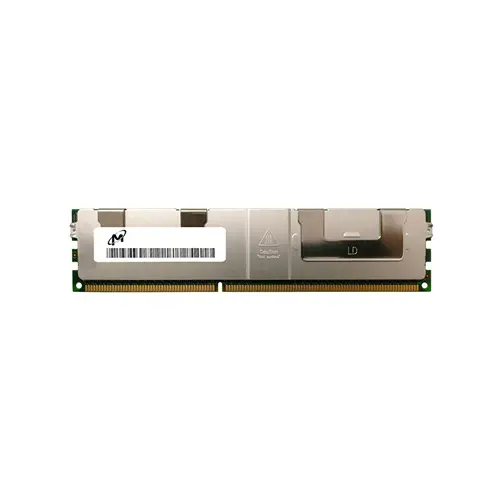
As a Registered DIMM engineered for server environments, the Micron MT72KSZS4G72LZ-1G4D translates its design directly into operational confidence for IT architects. Its ECC memory technology is not just error checking; it is your last line of defense against silent data corruption caused by cosmic rays or electrical drift. In a dense virtualization cluster hosting dozens of mission-critical VMs, a single uncorrected bit flip can cascade into hypervisor crash, threatening entire service chains—ECC ensures data integrity so your consolidation strategy never becomes a liability. Equally vital is the registered signal buffer, which stabilizes command and address lines when populating all memory channels across multiple DIMMs per server. For an in-memory database like Redis or SAP HANA, where terabyte-scale datasets demand quad-rank 32GB modules for maximal capacity, this buffering eliminates signal anxiety, letting you scale to massive footprints without intermittent memory training failures. Furthermore, the 1.35V low-voltage DDR3-1333 operation directly cuts power draw in a fully loaded rack by thousands of watts annually, easing thermal load and TCO in always-on data centers. This is the difference between a fragile memory subsystem and one that underpins relentless uptime and predictable performance.
This ECC Registered DDR3-1333 RDIMM is a quad-rank server memory module built for multi-socket systems. The 1.35V low-voltage operation and 32GB capacity demand careful population planning around quad-rank limitations.
General Virtualization
Install at least one DIMM per memory channel to enable interleaving. A typical dual-processor server with two 32GB modules per CPU (total 128GB) comfortably hosts 20–30 general-purpose VMs. Limit each channel to a maximum of two quad-rank DIMMs; exceeding this forces a speed downgrade below 1066MHz and can degrade VM responsiveness.
In-Memory Database
For the lowest latency, populate one DIMM per channel to maintain the full 1333MHz speed—a dual-socket server with four channels per socket yields 256GB. When capacity must grow beyond that, you can double to two DIMMs per channel (up to 512GB), but expect the memory bus to drop to 800MHz. Validate that your database engine’s performance remains acceptable at the reduced bandwidth.
High-Performance Computing (HPC)
HPC codes thrive on peak memory bandwidth, so use only one quad-rank DIMM per channel. A dual-channel compute node typically runs with two modules (64GB) matching core counts at 1333MHz. Adding a second DIMM per channel cuts speed to 1066 or 800MT/s, directly impacting floating-point throughput. Right-size capacity tightly to the working set so each node stays at one DIMM per channel.
Rigorously tested server memory, compatible with Dell R720/R620, HPE DL380p Gen8, Lenovo x3650 M4.
Q: Can I mix this MT72KSZS4G72LZ-1G4D with other memory modules of different brands or speeds?
A: Mixing registered ECC DIMMs of different brands or speeds is not recommended. To ensure signal integrity and system stability, always install identical part numbers in the same server.
Q: Is this memory compatible with my system?
A: It is designed for servers with DDR3 Registered ECC support, such as Intel Xeon E5-2600 v1/v2 or AMD Opteron 6300 series platforms. Verify quad-rank, 1.35V RDIMM acceptance in your server's qualified vendor list.
Q: What is the recommended DIMM population order for optimal performance?
A: Follow the platform-specific population guide. Typically, populate identically across memory channels, starting with the slot farthest from the CPU. Quad-rank DIMMs may require reduced speed or specific slots per the server manual.
Q: Does this module support overclocking or XMP profiles?
A: No. This server-grade RDIMM operates strictly at JEDEC standard DDR3-1333 with CL9 timings for maximum reliability. Overclocking and XMP are not supported to maintain data integrity in enterprise environments.
Q: What warranty and typical failure rate can I expect?
A: This module includes a 1-year warranty. As an enterprise-class RDIMM, its annualized failure rate (AFR) is exceptionally low, typically below 0.3%, reflecting high reliability suited for mission-critical deployments.