











 Secure payments
Standard refund policy
Trade Assurance
Secure payments
Standard refund policy
Trade Assurance
| Product Type | Memory Module |
|---|---|
| Memory Capacity | 32 GB |
| Memory Technology | DDR3 |
| Product Voltage | 1.5V |
| RAM Speed | 1600MHz |
| RAM Standard | DDR3-1600/PC3-12800 |
| Error Identifying | ECC |
| Signal Type | Registered |
| Column Access Strobe (CAS) | CL11 |
| Rank | Quad Rank x4 |
| Quantity of Pins | 276-pin |
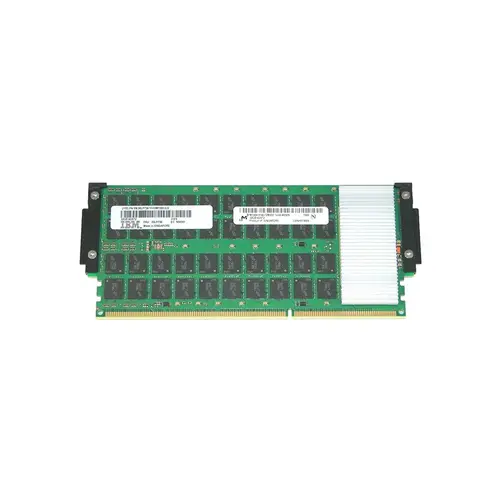
| RAM Genre | CDIMM |
This registered, ECC-enabled CDIMM leverages a buffered signal type and quad-rank x4 organization to deliver robust data integrity and stable operation under heavy load, making it ideal for legacy server deployments running virtualization or in-memory databases. Its 32 GB capacity at DDR3-1600 with CL11 latency provides a dense, responsive memory pool that helps sustain performance in memory-constrained enterprise environments.
1. Registered signal buffering stabilizes high-density memory configurations, enabling fully populated server nodes to run demanding hypervisor workloads without signal degradation.
2. Error-correcting code protection proactively detects and corrects single-bit memory errors, safeguarding financial transactions and sensitive databases from silent data corruption.
3. Expansive memory capacity accommodates large-scale virtualization and containerized microservices, dramatically reducing the need for storage-backed swap and preserving application responsiveness under peak consolidation.
4. Quad Rank x4 organization packs maximum memory devices into each channel while managing electrical loading, allowing substantial in-memory dataset scaling for real-time analytics.
5. Elevated clock frequency drives higher memory bandwidth, keeping multi-socket servers fed with low-latency data streams during parallel processing of business intelligence queries.
This 32 GB DDR3 module is purpose-built for enterprise servers where data integrity and uptime are non-negotiable. Its ECC technology detects and corrects single-bit memory errors in real time, preventing silent data corruption that could crash a virtualized cluster or propagate into financial records. The Registered signal type buffers command and address lines, stabilizing the electrical load when you populate all 24 DIMM slots in a rack server—without it, signal degradation leads to random reboots under heavy consolidation workloads. Quad Rank x4 organization packs four ranks on a single module, maximizing capacity in platforms limited by rank count per channel. In an in-memory database like SAP HANA, that means fitting larger operational datasets without sacrificing rank interleaving bandwidth, which directly accelerates OLAP queries and concurrent user load. At 1600 MHz with CL11 latency, the module balances solid throughput with thermal and power predictability inside dense chassis, giving your database and hypervisor hosts the reliable, consistent performance that 24/7 operations demand.
General Virtualization
For consolidating numerous virtual machines, install one 32GB DDR3-1600 registered quad-rank DIMM per memory channel (e.g., four modules for 128GB on a quad-channel server). This approach sustains the full 1600MHz speed; placing two quad-rank modules on the same channel forces a downgrade to 1066MHz or 800MHz, which undermines VM responsiveness under heavy load.
In-Memory Database
Maximise capacity by populating all available slots. A dual-socket server with two modules per channel can reach 512GB, though the memory bus drops to 1066MHz. When lower latency is critical, equip each channel with a single 32GB module to retain 1600MHz operation, and activate memory mirroring or rank sparing for robust data integrity.
High-Performance Computing
HPC workloads demand peak bandwidth. Install one 32GB quad-rank module per channel to maintain the 1600MT/s data rate and full channel interleaving. Adding a second module per channel reduces both frequency and effective throughput, directly impacting tightly coupled simulation performance.
Rigorously tested server memory; compatible with Dell PowerEdge R720/R620, HP DL380p Gen8, IBM x3650 M4.
Q: Can I mix this MT80KHF4G72M3DZ-1G6E4B50A with other memory modules of different brands or speeds?
A: Mixing is strongly discouraged. Registered ECC modules must match generation, rank, and timings. Mixing brands or speeds may cause POST failures or stability issues in server environments. Always use identical kits.
Q: Is this memory compatible with my Intel Xeon E5-2600 v2 or AMD Opteron 6300 series platform?
A: This is a DDR3 Registered ECC CDIMM for servers. It is compatible with platforms supporting 32GB 1600MHz Quad Rank x4 modules, such as Intel E5-2600 v1/v2 and AMD Opteron 6300 series. Verify OEM QVL lists for exact validation.
Q: What is the recommended DIMM population order for optimal performance with this Quad Rank module?
A: Quad Rank modules consume significant resources. Populate the first slot in each memory channel, typically A1/E1, to balance interleaving. Avoid mixing with lower-rank DIMMs in the same channel; consult your motherboard memory configuration guide.
Q: Does this module support overclocking or XMP profiles?
A: No. This is a JEDEC-compliant DDR3-1600 CL11 registered server memory at 1.5V. It does not support XMP or overclocking, as stability and data integrity are paramount in server environments. It operates at standard JEDEC timings.
Q: What warranty and typical failure rate can I expect for this memory?
A: This module includes a 1-year warranty. Typical AFR for enterprise-grade server memory is very low, around 0.5%–1.5% annually under proper operating conditions. We ensure rigorous testing to maintain high reliability.