











 Secure payments
Standard refund policy
Trade Assurance
Secure payments
Standard refund policy
Trade Assurance
| Product Type | Memory Module |
|---|---|
| Memory Capacity | 32 GB |
| Memory Technology | DDR3 |
| Product Voltage | 1.5V |
| RAM Speed | 1600MHz |
| RAM Standard | DDR3-1600/PC3-12800 |
| Error Identifying | ECC |
| Signal Type | Registered |
| Column Access Strobe (CAS) | CL11 |
| Rank | Quad Rank x4 |
| Quantity of Pins | 276-pin |
| RAM Genre | CDIMM |
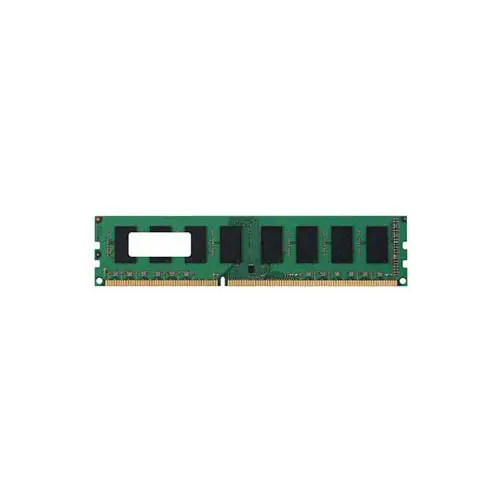
This 32GB DDR3-1600 Registered ECC CDIMM is engineered for server platforms handling memory-intensive workloads such as virtualization and in-memory databases, where its Quad Rank x4 configuration delivers high density and the ECC capability ensures end-to-end data integrity. The registered signal type stabilizes large memory arrays, and the PC3-12800 specification with CL11 timings provides reliable, consistent throughput in multi-DIMM server deployments.
1. A 32 GB capacity per module maximizes memory density in server nodes, enabling more virtual machines per host without sacrificing performance under heavy consolidation.
2. ECC protection silently corrects single-bit errors caused by cosmic radiation, preserving long-term data integrity in mission-critical databases and 24/7 uptime environments.
3. Registered signal architecture buffers command and address lines, stabilizing multi-DIMM configurations so large-scale memory pools can scale reliably across many channels.
4. Quad Rank x4 organization packs highest density per DIMM to saturate server memory slots, but demands careful population rules to maintain full 1600 MT/s speed under all loads.
5. Standard 1.5 V operation aligns with legacy DDR3 server power budgets, delivering predictable thermal dissipation in dense rack deployments without requiring exotic cooling.
In enterprise servers powering virtualization clusters, every virtual machine demands isolated, error-free memory—one undetected bit flip can cascade into application crashes or silent data corruption in your financial or customer records. The ECC on this 32 GB DDR3-1600 module continuously detects and corrects single-bit errors in real time, giving you ironclad data integrity and preventing unexplained reboots or transaction loss. As you scale to hundreds of gigabytes, signal integrity becomes the silent bottleneck; the registered buffer on this CDIMM actively reclocks and amplifies command and address signals, allowing you to populate every DIMM slot with confidence while maintaining stability under heavy load. Its Quad Rank x4 organization packs 32 GB per stick, meaning fewer modules to reach extreme capacities and more available slots for future growth in dense server chassis. Moreover, rank interleaving leverages the four independent ranks to parallelize memory accesses, boosting effective bandwidth for latency-sensitive in-memory databases like Redis or large-scale SQL analytics. Together with the 1600 MHz clock and CL11 latency, this module delivers predictable response times—so your virtualized workloads and real-time data sets operate with consistent speed and zero tolerance for error, ensuring mission-critical services stay up and trusted.
This is server-specific memory — DDR3 Registered ECC with quad-rank x4 organization at 1.5 V. Capacity planning must account for memory channel limitations and speed penalties when populating multiple quad-rank DIMMs.
General Virtualization
Deploy four 32 GB modules (128 GB total) evenly across two channels per processor for balanced performance, comfortably hosting 20–30 lightweight VMs. For higher consolidation ratios, add four more modules (256 GB) while keeping one quad-rank DIMM per channel to maintain 1600 MHz.
In-Memory Database
Populate each channel with a single 32 GB RDIMM to maximize interleaving; an eight-channel server provides 256 GB, ideal for Redis or Memcached. Expanding to two DIMMs per channel reaches 512 GB but can reduce speed to 1333 MHz — always benchmark critical queries before committing.
High-Performance Computing
Equip all channels with one 32 GB module per CPU to sustain 1600 MHz, yielding 128–256 GB per node. This uniform configuration prevents bandwidth bottlenecks. Increase capacity by adding identical DIMMs only if your workload tolerates the clock-speed drop.
Rigorously tested and compatible with Lenovo System x3850 X5, x3950 X5, and IBM BladeCenter HX5.
Q: Can I mix this MT80KHF4G72MDZ-1G6 with other memory modules of different brands or speeds?
A: Mixing registered ECC modules is not recommended. Different brands, speeds, or ranks can cause signal integrity issues or force the memory controller to downclock, risking stability on server platforms.
Q: Is this memory compatible with my system?
A: This 276-pin DDR3 CDIMM is designed for specific server boards, often Cisco UCS. Verify your server's qualified vendor list, chipset support for registered ECC, and 1.5V quad-rank x4 module compatibility.
Q: What is the recommended DIMM population order for optimal performance?
A: For quad-rank registered DIMMs, populate identical modules starting from the furthest channel slot per CPU. Follow your server manual; typically, fill blue or white slots first to balance interleaving and minimize loading.
Q: Does this module support overclocking or XMP profiles?
A: No. This is a server-grade registered ECC DDR3 DIMM running at standard JEDEC timings (1600MHz CL11). It does not support overclocking, XMP, or voltage adjustments to ensure 24/7 data integrity.
Q: What warranty and typical failure rate can I expect?
A: This module is covered by a 1-year warranty. Enterprise registered ECC memory typically exhibits an extremely low annualized failure rate, well under 0.5%, when operated within specified thermal and voltage limits.