











 Secure payments
Standard refund policy
Trade Assurance
Secure payments
Standard refund policy
Trade Assurance
| Product Type | Memory Module |
|---|---|
| Compliance Standards | RoHS |
| Memory Capacity | 32 GB |
| Memory Technology | DDR3 |
| Product Voltage | 1.5V |
| RAM Speed | 1866MHz |
| RAM Standard | DDR3-1866/PC3-14900 |
| Error Identifying | ECC |
| Signal Type | Registered |
| Column Access Strobe (CAS) | CL13 |
| Rank | Quad Rank x4 |
| Quantity of Pins | 240-pin |
| RAM Genre | RDIMM |
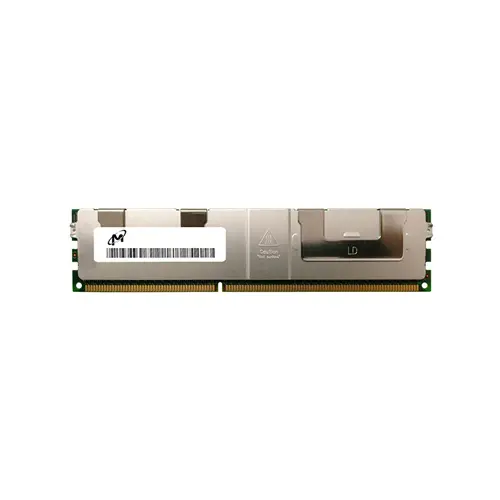
This 32GB DDR3-1866 Registered ECC module (PC3-14900, Quad Rank x4) is engineered for legacy enterprise servers and high-density virtualization platforms where data integrity is paramount, as its error-correcting code and registered signal type ensure rock-solid stability under fully loaded memory channels. The Quad Rank x4 configuration maximizes capacity per channel, while the CL13 latency at 1866MHz delivers a balanced blend of responsiveness and throughput ideal for memory-resident databases and virtual machine consolidation.
1. ECC protection continuously corrects single-bit memory errors, eliminating silent data corruption that could crash virtualized database workloads or compromise transactional integrity.
2. Registered signaling buffers command and address lines, allowing the server to support high-capacity memory configurations across multiple DIMMs per channel without signal degradation.
3. Quad Rank x4 organization places multiple banks of DRAM on a single module, keeping memory channels saturated and delivering consistent throughput for memory-centric analytics platforms.
4. Generous per-module capacity enables dense virtualization footprints, letting a single server host more VMs and in-memory caches before requiring costly chassis expansions.
5. The elevated data rate accelerates access to frequently used data sets, cutting latency in real-time business intelligence queries and batch processing pipelines.
When powering mission‑critical server environments, the MT72JSZS4G72LZ‑1G9 RDIMM directly addresses the silent threats that keep IT managers awake. Its ECC capability is not just a specification—it actively corrects single‑bit memory errors caused by cosmic radiation, preventing silent data corruption in virtualized clusters where a single uncaught flip could crash dozens of VMs or distort financial records. The registered signal buffer amplifies command and address signals, enabling the server to populate all memory channels with confidence; that means you can scale up to multiple 32 GB modules without signal degradation, a non‑negotiable requirement for an in‑memory database like SAP HANA that must hold terabytes of hot data absolutely stable. Quad‑rank x4 organization further turns density into performance through rank interleaving, overlapping memory accesses to sustain higher bandwidth under the heavy, concurrent read/write demands of a busy virtualization host. Combined with a swift DDR3‑1866 speed that delivers up to 14.9 GB/s, this module ensures that your SQL queries and live migrations complete faster, turning potential downtime into reliable throughput—so your infrastructure never becomes the bottleneck.
Capacity Planning for 32GB DDR3-1866 Registered ECC RDIMMs
This memory module—a 32GB DDR3-1866 Registered ECC RDIMM with quad-rank x4 organization and CL13—is designed for legacy server platforms requiring high capacity and data integrity. Capacity planning should leverage its ECC and registered nature for stability-demanding workloads, while acknowledging the constraints of the DDR3 generation.
General Virtualization
For hypervisors like VMware vSphere or Hyper-V on older generation servers, populate at least four identical modules to enable balanced memory channels and maximize density per socket. The 32GB capacity per DIMM allows 128GB with four modules, supporting moderate virtual machine consolidation. Use ECC to guard against silent data corruption in multi-tenant environments.
In-Memory Database
In-memory databases such as Redis or SAP HANA on DDR3 platforms benefit from the highest capacity configurations. Deploy eight or more modules per server to reach 256GB–512GB, ensuring full memory channel population for bandwidth. Quad-rank DIMMs do impose speed reductions when multiple ranks are installed, so plan for possible clock-speed stepping back to 1600MHz or 1333MHz—validate against the server’s population guidelines.
High Performance Computing
For compute-bound HPC nodes where memory bandwidth is critical, install one DIMM per channel (e.g., four modules in a quad-channel system) to run at the rated 1866MHz. The registered buffer helps maintain signal integrity in dense clusters. If capacity overshadows bandwidth needs, a second identical set can be added, but expect a slight latency penalty and ensure BIOS/firmware tuning for quad-rank configurations.
Rigorously tested for compatibility: works with Dell PowerEdge R720, HP DL380p Gen8, Lenovo x3650 M4.
Q: Can I mix this MT72JSZS4G72LZ-1G9 with other memory modules of different brands or speeds?
A: Mixing is not recommended. Server Registered DIMMs require identical part numbers to ensure signal integrity and ECC functionality. Different speeds will force all modules to the lowest common speed, impacting performance.
Q: Is this memory compatible with my system?
A: It is compatible with servers supporting DDR3-1866 Registered ECC memory, such as Intel Xeon E5-2600 v2 or select AMD Opteron platforms. Verify your motherboard's qualified vendor list for 1.5V RDIMM support.
Q: What is the recommended DIMM population order for optimal performance?
A: Follow your server motherboard’s manual. Typically, populate the farthest blue slot per channel first. For this quad-rank RDIMM, you may need to balance ranks across channels to maximize throughput and avoid performance penalties.
Q: Does this module support overclocking or XMP profiles?
A: No. Server-grade Registered ECC memory prioritizes data integrity and stability. It adheres strictly to JEDEC DDR3-1866 specifications and does not support overclocking or Intel XMP profiles.
Q: What warranty and typical failure rate can I expect?
A: This module includes a 1-year warranty. As an enterprise-class RDIMM built for 24/7 operation, it offers high reliability with a very low annualized failure rate under specified conditions.