











 Secure payments
Standard refund policy
Trade Assurance
Secure payments
Standard refund policy
Trade Assurance
| Product Type | Memory Module |
|---|---|
| Compliance Standards | RoHS |
| Memory Capacity | 32 GB |
| Memory Technology | DDR3 |
| Product Voltage | 1.5V |
| RAM Speed | 1866MHz |
| RAM Standard | DDR3-1866/PC3-14900 |
| Error Identifying | ECC |
| Signal Type | Registered |
| Column Access Strobe (CAS) | CL13 |
| Rank | Quad Rank x4 |
| Quantity of Pins | 240-pin |
| RAM Genre | RDIMM |
This 32GB DDR3-1866 RDIMM with ECC and registered signaling is purpose-built for legacy server platforms handling memory-intensive workloads such as virtualization and in-memory databases, where its Quad Rank x4 configuration maximizes capacity per channel while the CL13 latency ensures responsive data access. The combination of hardware error correction and registered buffering delivers the data integrity and signal stability essential for 24/7 enterprise operations on compatible DDR3-based systems.
1. Generous capacity per module drives higher virtual machine density, letting data centers consolidate more workloads per physical host and defer expensive hardware expansion.
2. Elevated data rate accelerates memory-intensive operations like in-memory databases and real-time analytics, directly shrinking response latency under heavy concurrent access.
3. ECC protection detects and corrects single-bit errors in flight, preserving the integrity of mission-critical transactions where even a flipped bit can trigger regulatory or financial fallout.
4. Registered signaling buffers command and address paths, sustaining clean signal integrity when all memory slots are populated in large-scale server farms running 24/7.
5. Quad Rank x4 organization packs extremely high memory capacity per slot while retaining balanced electrical loading, enabling stable performance for memory-hungry enterprise applications such as SAP HANA or large-scale virtualization.
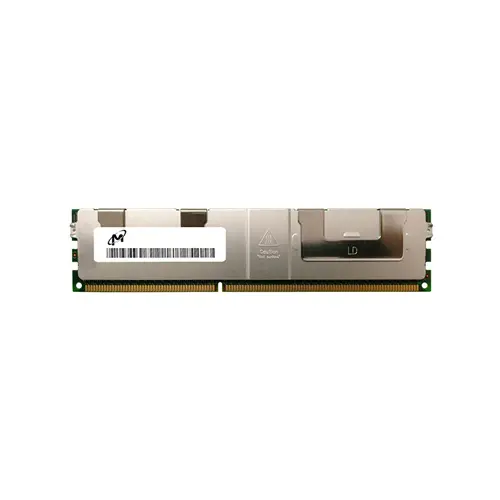
The Micron MT72JSZS4G72LZ-1G9N1 is a 32 GB DDR3-1866 Registered ECC RDIMM purpose‑built for server workloads. In a virtualization cluster running dozens of VMs, your biggest enemies are silent data corruption and memory instability. ECC corrects single‑bit errors in real time, safeguarding financial transactions and database records from cosmic‑ray‑induced bit flips. Registered buffering stabilizes the command and address bus, so you can fill all 24 DIMM slots of a dual‑socket server and still guarantee reliable boot and sustained uptime. The Quad Rank x4 organization packs 32 GB onto a single module, maximizing density for memory‑hungry applications like an in‑memory database (Redis, SAP HANA). Here, the 1866 MHz speed and CL13 latency deliver the sub‑millisecond query responses needed under heavy concurrent access. Without these features, a hypervisor node in a consolidated cluster could crash unexpectedly, or a caching layer could return corrupted data, directly costing revenue. For enterprises running virtualized ERP or real‑time analytics, this module translates into continuous availability, absolute data integrity, and the scalable capacity your SLA demands.
General Virtualization
Deploy identical 32 GB Registered DIMMs in a balanced configuration across all memory channels of each CPU. For a dual‑socket server, installing eight modules per processor yields 512 GB, comfortably supporting 50+ mixed virtual machines. Always follow platform population rules for quad‑rank RDIMMs to sustain the full 1866 MT/s speed and symmetric NUMA access.
In-Memory Database
Maximize capacity by populating every memory channel with one or two modules where the server design permits. A 16‑channel dual‑processor system filled with two quad‑rank DIMMs per channel can reach 1 TB, keeping entire datasets resident in memory. Use identical CL13 ECC modules across all slots and enable memory mirroring or sparing to strengthen mission‑critical data resilience.
High‑Performance Computing
For bandwidth‑bound HPC codes, install a single quad‑rank module per channel to preserve the 1866 MT/s data rate and low CL13 latency. A fully populated 8‑channel‑per‑socket platform provides 512 GB capacity while maintaining balanced NUMA interleaving. Symmetric distribution of identical RDIMMs across sockets prevents remote memory penalties, sustaining consistent throughput during large‑scale parallel runs.
Rigorously tested server memory. Compatible with Dell PowerEdge R720/R820, HP ProLiant DL380p Gen8, Lenovo System x3650 M4.
Q: Can I mix this MT72JSZS4G72LZ-1G9N1 with other memory modules of different brands or speeds?
A: Mixing is not recommended for registered server memory. Different brands, speeds, or ranks can cause signal integrity issues, forcing the system to default to the lowest common speed, often creating instability in critical server environments.
Q: Is this memory compatible with my system?
A: This 32GB DDR3-1866 Registered ECC RDIMM fits servers supporting Intel Xeon E5-2600 v2/v3 or AMD Opteron 6300 series platforms. Verify your board supports quad-rank x4 modules and 1.5V registered DIMMs.
Q: What is the recommended DIMM population order for optimal performance?
A: Populate identical DIMMs evenly across memory channels, starting with the farthest slot from the CPU. For this quad-rank module, expect possible speed reduction to DDR3-1600 when installing two per channel.
Q: Does this module support overclocking or XMP profiles?
A: No. This is a JEDEC-compliant server RDIMM designed for 24/7 stability. It does not support XMP or overclocking; operation outside rated specs is not validated and may compromise data integrity in server workloads.
Q: What warranty and typical failure rate can I expect?
A: It includes a one-year warranty. Built with server-grade components, its typical annualized failure rate (AFR) is extremely low, under 0.5%, ensuring reliable long-term operation in enterprise environments.