











 Secure payments
Standard refund policy
Trade Assurance
Secure payments
Standard refund policy
Trade Assurance
| Product Type | Memory Module |
|---|---|
| Memory Capacity | 32 GB |
| Memory Technology | DDR4 |
| Product Voltage | 1.2V |
| RAM Speed | 2400MHz |
| RAM Standard | DDR4-2400/PC4-19200 |
| Error Identifying | ECC |
| Signal Type | Registered |
| Column Access Strobe (CAS) | CL17 |
| Rank | Dual Rank x4 |
| Quantity of Pins | 288-pin |
| RAM Genre | VLP RDIMM |
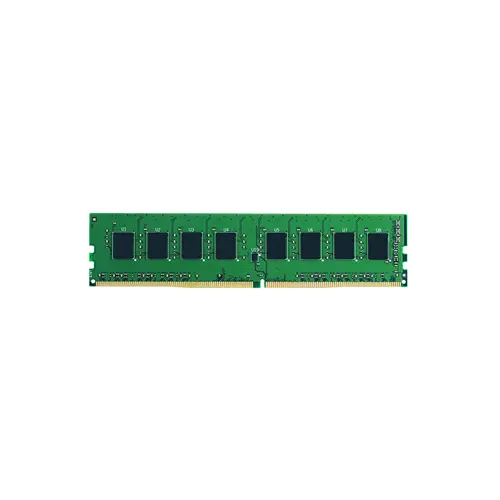
Designed for server platforms requiring maximum memory density and reliability, this 32GB DDR4-2400 VLP RDIMM with ECC and registered signaling ensures data integrity in virtualized environments and in-memory databases. Its dual-rank x4 organization boosts bandwidth efficiency per channel, while the very low-profile form factor enables dense 1U rack deployments without airflow compromise.
1. ECC protection detects and corrects single-bit errors in real time, preserving data integrity for transaction-heavy databases and mission-critical workloads that cannot tolerate silent corruption.
2. Registered signal buffering stabilizes command and address lines, allowing platforms to scale to large memory capacities without signal degradation under simultaneous access from multiple CPUs.
3. VLP (Very Low Profile) form factor reduces the module height dramatically, optimizing airflow and enabling higher storage density in 1U blade servers where every millimeter of clearance matters for cooling.
4. 32 GB capacity per stick provides the headroom needed to support dense virtualization clusters, letting operators pack more VMs and container-based services onto the same physical node without resorting to slower swap.
5. Dual Rank x4 organization leverages rank interleaving to keep memory channels fully utilized, delivering sustained throughput for high-frequency in-memory computing and reducing latency spikes during heavy consolidation.
The Micron MTA36ADS4G72PZ-2G3A1 is a server-class 32GB DDR4-2400 VLP RDIMM purpose-built to remove the primary risks and performance barriers in enterprise data centers. In a dense virtualization cluster hosting hundreds of virtual machines, a silent bit flip in non-ECC memory can corrupt a hypervisor, cascading into application crashes and data loss. This module’s ECC engine actively corrects single-bit errors before they compromise your workloads, directly translating into continuous uptime and transaction integrity you can count on. Its registered architecture places a buffer between the memory controller and the DRAM chips, stabilizing command and address signals when all channels are fully populated. This means your databases and VMs run reliably even at maximum capacity, without the signal degradation that causes mysterious system hangs. For in-memory databases like SAP HANA or Redis, the Dual Rank x4 design becomes a critical performance lever. Rank interleaving lets the memory controller overlap accesses across two ranks, effectively hiding precharge delays and boosting bandwidth for real-time analytics that process millions of operations per second. Finally, the very low profile form factor maximizes airflow in cramped 1U and 2U chassis, sustaining these performance and reliability advantages under non-stop thermal load. In practice, every one of these features moves you from uncertainty to assured, consistent service delivery.
General Virtualization
For general virtualization hosts, a balanced memory-to-core ratio is essential. Populate six or eight of these 32GB RDIMMs per socket to achieve 192GB or 256GB total capacity, which comfortably supports 30–50 average VMs. Leverage the module’s dual-rank design to maximize memory bandwidth while maintaining a low 1.2V power profile, and always install in matched sets across identical memory channels for optimal NUMA performance.
In-Memory Database
In-memory databases like Redis or SAP HANA demand both capacity and data integrity; ECC protection is non-negotiable. Deploy at least eight 32GB modules per CPU for a 256GB working set, scaling to 512GB or 1TB by fully populating all channels with dual-rank x4 DIMMs. The registered buffer and CL17 latency provide the stability required under sustained high-frequency writes, and the VLP form factor helps maintain airflow in densely packed 1U nodes.
High-Performance Computing (HPC)
HPC clusters benefit from high memory bandwidth per core, so populate one DIMM per channel across all six or eight channels to avoid throttling. Using 32GB RDIMMs delivers 192–256GB per node—sufficient for large-scale simulation datasets—while the 2400MT/s speed and 1.2V operation help cap thermal output during multi-day runs. For embarrassingly parallel workloads, favor uniform configurations across all nodes to guarantee predictable inter-node scaling.
Rigorously tested to be compatible with Dell PowerEdge R740/R640, HPE ProLiant DL380 Gen10, DL360 Gen10, Lenovo ThinkSystem SR650.
Q: Can I mix this MTA36ADS4G72PZ-2G3A1 with other memory modules of different brands or speeds?
A: Mixing Registered ECC modules from different vendors or with varying speeds is not recommended. It may cause boot failures or signal integrity issues. For guaranteed stability, populate identical Micron RDIMMs with matching rank and timings.
Q: Is this memory compatible with my system?
A: This VLP RDIMM fits servers with DDR4-2400 Registered ECC support, such as Intel Xeon E5-2600 v4 or Scalable platforms and select AMD EPYC systems. Verify your server’s memory QVL for 288-pin, 1.2V, dual-rank x4 Registered modules.
Q: What is the recommended DIMM population order for optimal performance?
A: Follow your server's manual: populate identical RDIMMs per memory channel, starting with the farthest slot from the CPU. Typically use slots like A1, B1 for dual-channel, balancing capacity and rank across channels to maximize memory bandwidth.
Q: Does this module support overclocking or XMP profiles?
A: No. This is a server-grade Registered ECC memory strictly adhering to JEDEC DDR4-2400 standards. It does not support XMP or overclocking, as enterprise platforms prioritize data integrity and stability over adjustable frequency profiles.
Q: What warranty and typical failure rate can I expect?
A: This Micron module includes a one-year warranty. Enterprise RDIMMs exhibit an extremely low annualized failure rate, typically under 0.5%, when operated within specified temperature ranges and voltage limits in validated server environments.