











 Secure payments
Standard refund policy
Trade Assurance
Secure payments
Standard refund policy
Trade Assurance
| Product Type | Memory Module |
|---|---|
| Memory Capacity | 32 GB |
| Memory Technology | DDR4 |
| Product Voltage | 1.2V |
| RAM Speed | 2400MHz |
| RAM Standard | DDR4-2400/PC4-19200 |
| Error Identifying | ECC |
| Signal Type | Registered |
| Column Access Strobe (CAS) | CL17 |
| Rank | Dual Rank x4 |
| Quantity of Pins | 288-pin |
| RAM Genre | RDIMM |
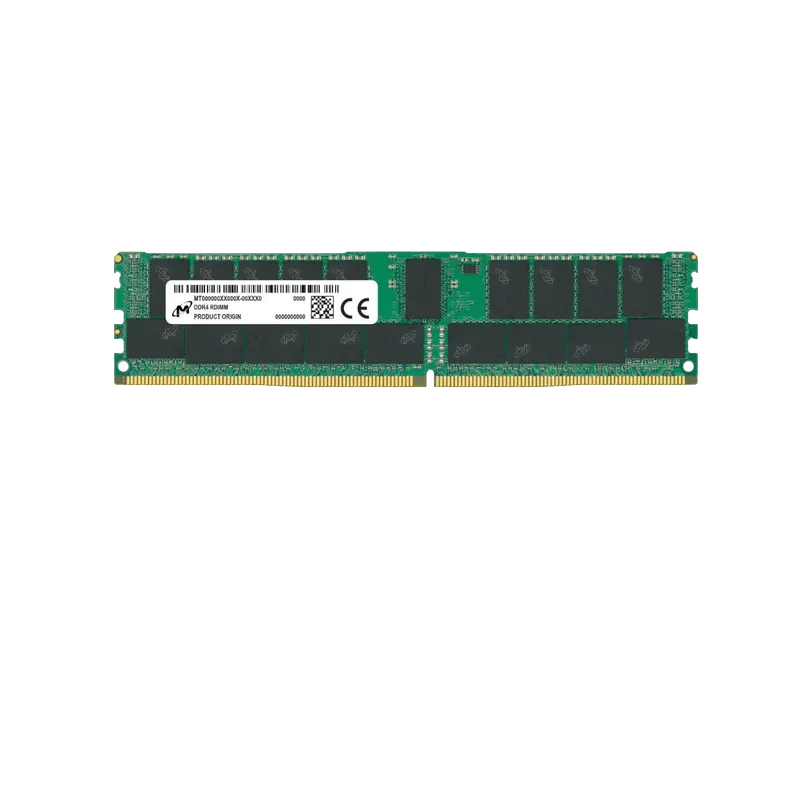
This RDIMM is engineered for enterprise server platforms, providing 32GB of DDR4-2400 capacity with ECC and a registered signal type to ensure data integrity and signal stability in high-density memory configurations. Its dual-rank x4 organization and CL17 latency make it an optimal choice for virtualization, in-memory databases, and other mission-critical workloads where reliable throughput under sustained load is paramount.
1. ECC protection continuously corrects single-bit errors and detects multi-bit faults, safeguarding data integrity for mission-critical enterprise applications where memory errors can silently corrupt financial or analytics workloads.
2. Registered signal buffering stabilizes command and address lines across dense server configurations, enabling fully populated memory channels without signal degradation for maximum virtualization scale.
3. 32-gigabyte module density allows packing substantial DRAM onto a single stick, raising the memory ceiling in 1U and 2U servers to support more VMs and larger in-memory databases per node.
4. Dual Rank x4 organization interleaves bank accesses to keep the ranks busy, delivering higher sustained throughput that feeds modern multi-core server CPUs efficiently under parallel query loads.
5. DDR4-2400 bandwidth provides ample headroom for concurrent streaming of large datasets, reducing latency spikes when multiple containers or tenants hammer the memory bus simultaneously.
At the heart of modern data centers, the Micron MTA36ASF4G72PZ-2G3A1II is a 32GB DDR4-2400 Registered DIMM engineered specifically for server platforms where uptime and data fidelity are non-negotiable. In a dense virtualization cluster hosting dozens of virtual machines, a single undetected bit flip in memory can corrupt a transactional database or trigger a cascade of failures across tenants. The built-in ECC technology silently corrects single-bit errors and detects multi-bit faults, protecting your workloads from cosmic radiation or electrical noise that commodity desktop memory simply ignores. If the DIMM were unbuffered, the memory controller would need to drive every chip directly, severely limiting how many modules you can install. The registered design uses an onboard register to buffer address and command signals, stabilizing the electrical load so you can populate all 24 slots in a dual‑socket server without sacrificing signal integrity or risking boot failures. When you run an in‑memory database like Redis or SAP HANA, memory bandwidth and latency directly dictate transaction throughput. The dual‑rank x4 organization interleaves accesses across two internal ranks, overlapping precharge and activation cycles to deliver measurably lower latency under concurrent I/O pressure than a single‑rank alternative. That means your real‑time analytics queries return faster, and your in‑memory cache sustains higher request rates without throttling. With a JEDEC‑standard 1.2V operating voltage, this module also helps keep the thermal footprint in check inside dense 1U or blade chassis, reducing cooling costs without sacrificing the reliability your critical services demand.
General Virtualization
For a balanced virtualization host, populate six to eight of these 32GB RDIMMs across all memory channels to reach 192–256GB total. This density comfortably supports 20–30 moderate VMs, while registered ECC ensures data integrity during live migration. Distribute DIMMs evenly per CPU socket to maximize bandwidth and avoid NUMA penalties.
In-Memory Database
In-memory databases like Redis or SAP HANA demand capacity and fault tolerance. Deploy at least eight modules (256GB) in a dual-socket server, leaving slots free for future scaling. The dual-rank x4 design improves bank-level parallelism, while ECC corrects single-bit errors silently—critical when the entire dataset lives in RAM.
High-Performance Computing
HPC workloads benefit from all-channel population for peak memory bandwidth. Install one 32GB RDIMM per channel across all available channels, typically yielding 192GB or 384GB configurations. The 2400MHz speed at CL17 with registered buffering maintains signal integrity under sustained parallel I/O, and dual-rank modules boost throughput per channel for simulation or modelling tasks.
This rigorously tested server memory is validated for Dell PowerEdge R760, HPE ProLiant DL380 Gen10, and Lenovo ThinkSystem SR650.
Q: Can I mix this MTA36ASF4G72PZ-2G3A1II with other memory modules of different brands or speeds?
A: Mixing RDIMMs of different brands or speeds is strongly discouraged. Mismatched modules can cause system instability, POST failures, or signal integrity issues. Use identical modules for validated server configurations.
Q: Is this memory compatible with my system?
A: This 32GB DDR4-2400 ECC RDIMM is designed for Intel Xeon Scalable, Xeon E5-2600 v3/v4, and select AMD EPYC platforms. Please confirm your server board explicitly supports registered ECC DDR4-2400 modules.
Q: What is the recommended DIMM population order for optimal performance?
A: Install identical DIMMs per channel, populating slots farthest from the CPU first. Follow your server motherboard’s manual for balanced memory configuration to maintain proper rank interleaving and memory bandwidth.
Q: Does this module support overclocking or XMP profiles?
A: No. This is a JEDEC-standard registered server DIMM. It runs exclusively at fixed 2400MHz with CL17 timings. Overclocking and XMP profiles are not supported, ensuring enterprise-grade reliability.
Q: What warranty and typical failure rate can I expect?
A: It includes a 1-year warranty. Enterprise RDIMMs like this Micron module typically exhibit an annualized failure rate (AFR) below 0.5%, providing excellent reliability under continuous operation.