











 Secure payments
Standard refund policy
Trade Assurance
Secure payments
Standard refund policy
Trade Assurance
| Product Type | Memory Module |
|---|---|
| Memory Capacity | 32 GB |
| Memory Technology | DDR4 |
| Product Voltage | 1.2V |
| RAM Speed | 2666MHz |
| RAM Standard | DDR4-2666/PC4-21300 |
| Error Identifying | ECC |
| Signal Type | Registered |
| Column Access Strobe (CAS) | CL19 |
| Rank | Dual Rank x4 |
| Quantity of Pins | 288-pin |
| RAM Genre | RDIMM |
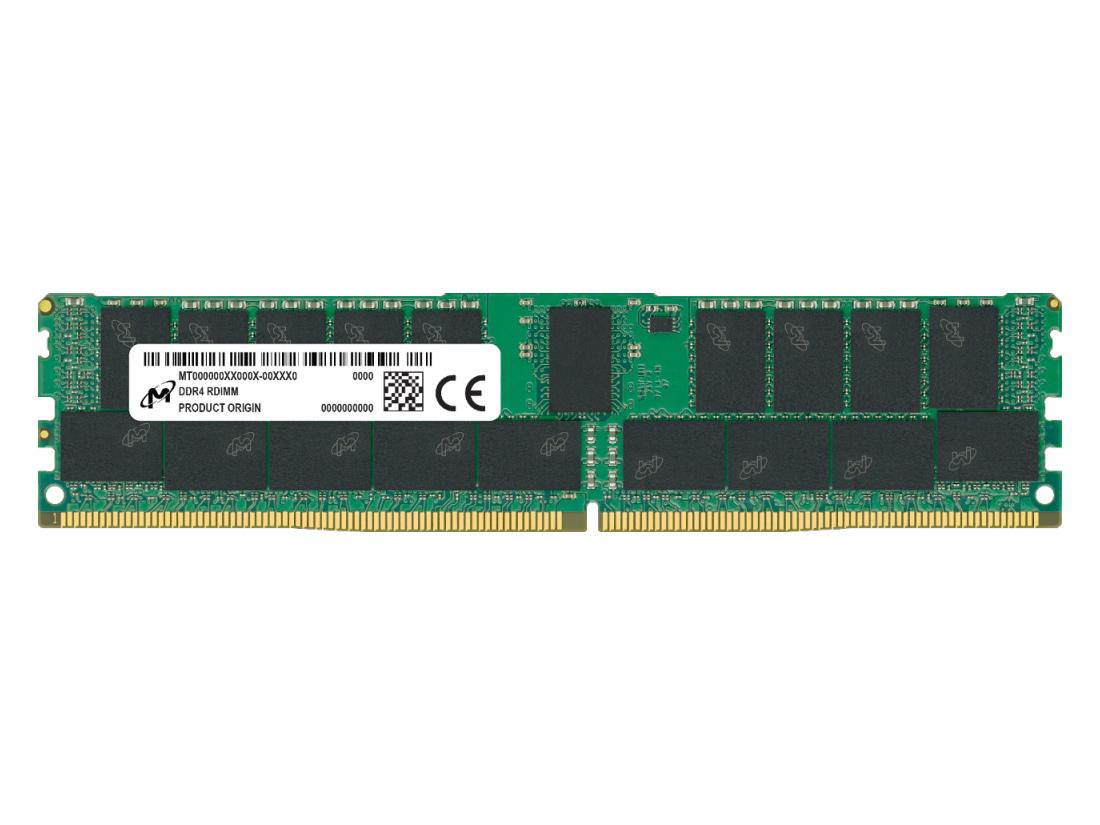
This 32GB DDR4-2666 RDIMM equipped with ECC and registered signaling is purpose-built for server platforms handling virtualization, in-memory databases, and data-critical applications where absolute data integrity and uptime are paramount. Its dual-rank x4 organization maximizes memory interleaving and throughput, while the registered buffer and CL19 latency ensure reliable, stable operation even in fully populated multi-DIMM configurations under sustained heavy loads.
1. ECC memory actively detects and corrects single-bit errors, safeguarding data integrity in financial transactions and long-running analytics where undetected bit flips could cascade into costly failures.
2. Registered signal buffering stabilizes high-density memory buses, allowing multi-socket servers to support massive RAM footprints without compromising command-address reliability.
3. Dual Rank x4 organization interleaves accesses to saturate memory channels efficiently, delivering more predictable throughput for hypervisors juggling dozens of latency-sensitive VMs.
4. This speed grade hits an efficient balance between bandwidth and power, accelerating in-memory databases and real-time stream processing under continuous server workloads.
5. The module’s substantial capacity per stick doubles the compute-per-node potential, packing more containers and persistent memory caches into the same rack space while reducing per-GB energy costs.
Judging by the RDIMM form factor, ECC, and registered signal type, this is unequivocally server-class memory. The MTA36ASF4G72PZ-2G6H1RQK module transforms how your infrastructure handles mission‑critical workloads, and its four defining characteristics directly answer the toughest data‑center pain points.
First, ECC error correction eliminates the silent threat of bit flips. In an in‑memory database like SAP HANA, a single cosmic‑ray‑induced corruption can cascade into financial miscalculations or transactional inconsistencies; ECC catches and repairs those errors in real time, preserving data integrity at an atomic level. Second, the registered buffer stabilizes signal distribution across densely populated motherboards. When you pack a virtualization cluster with 24 DIMMs per host, unbuffered memory would suffer signal degradation, but registered logic cleans and re‑drives commands, letting you confidently scale to 1 TB or more without intermittent crashes during live VM migration.
Third, the dual‑rank x4 organization interleaves data accesses across internal banks, substantially increasing bandwidth efficiency. For a VMware farm juggling hundreds of containers, this reduces memory‑wait states and keeps CPU pipelines saturated, translating directly into more virtual machines per server before latency spikes. Finally, the 32 GB capacity at 2666 MT/s balances density and power: 1.2 V operation lowers thermal overhead inside 1U enclosures, extending long‑term reliability while delivering the throughput to accelerate in‑memory analytics. Together, these features mean fewer unexplained outages, denser consolidation, and a platform that runs 24/7 with uncompromising predictability.
General Virtualization
This 32GB Registered ECC DDR4-2666 module is ideal for moderate-density virtualization hosts. For a typical two-socket server, deploying eight matching modules per CPU (16 total) in balanced memory channels enables 512GB of resilient capacity, comfortably running 20–30 light-to-medium VMs per host. Always populate identical RDIMMs symmetrically across all memory channels to maintain uniform latency and maximum throughput.
In-Memory Database
In-memory databases like Redis or SAP HANA demand absolute data integrity and low latency, making ECC registered memory essential. A configuration of 16×32GB RDIMMs provides 512GB, well-suited for medium-sized in-memory datasets, while fully loading all 24 DIMM slots in a dual-socket system yields 768GB for larger working sets. Prioritize populating all channels with identical dual-rank modules to avoid performance penalties from rank imbalance.
High-Performance Computing
HPC workloads such as CFD and molecular dynamics thrive on memory bandwidth, so balanced configurations are critical. For bandwidth-sensitive applications, install one dual‑rank 32GB RDIMM per channel across all available channels—typically 8 modules per CPU—to maximize data transfer rates. Capacity-driven HPC tasks can scale to 16×32GB (512GB) per node; always use homogeneous registered ECC modules to ensure predictable performance and prevent silent data corruption during long-running compute jobs.
Rigorously tested server memory for Dell PowerEdge R760, HPE ProLiant DL380 Gen10, Lenovo ThinkSystem SR650.
Q: Can I mix this MTA36ASF4G72PZ-2G6H1RQK with other memory modules of different brands or speeds?
A: Mixing RDIMMs of different brands or speeds is not recommended. They may cause system instability or fail to POST. For guaranteed compatibility, install identical modules with the same Micron part number across all channels.
Q: Is this memory compatible with my system?
A: This DDR4-2666 registered ECC RDIMM is designed for server platforms supporting the DDR4-2666 standard, such as Intel Xeon Scalable (Purley) and AMD EPYC (Naples/Rome). Verify your board's qualified vendor list for support.
Q: What is the recommended DIMM population order for optimal performance?
A: Follow your server board's population guide. Generally, populate identical DIMMs per channel, starting with the farthest slot from the CPU, to balance memory channels and maintain full bandwidth for this dual-rank x4 module.
Q: Does this module support overclocking or XMP profiles?
A: No. This RDIMM is engineered for JEDEC-compliant operation at 2666MHz. It does not support overclocking or XMP profiles, prioritizing enterprise-grade stability and data integrity in 24/7 server environments.
Q: What warranty and typical failure rate can I expect?
A: This Micron module includes a 1-year warranty. As an enterprise RDIMM built to stringent standards, its annualized failure rate (AFR) is extremely low, delivering the reliability required for mission-critical server workloads.