











 Secure payments
Standard refund policy
Trade Assurance
Secure payments
Standard refund policy
Trade Assurance
| Product Type | Memory Module |
|---|---|
| Memory Capacity | 32 GB |
| Memory Technology | DDR4 |
| Product Voltage | 1.2V |
| RAM Standard | DDR4-2666/PC4-21300 |
| Error Identifying | ECC |
| Signal Type | Registered |
| Column Access Strobe (CAS) | CL19 |
| Rank | Dual Rank x4 |
| Quantity of Pins | 288-pin |
| RAM Genre | RDIMM |
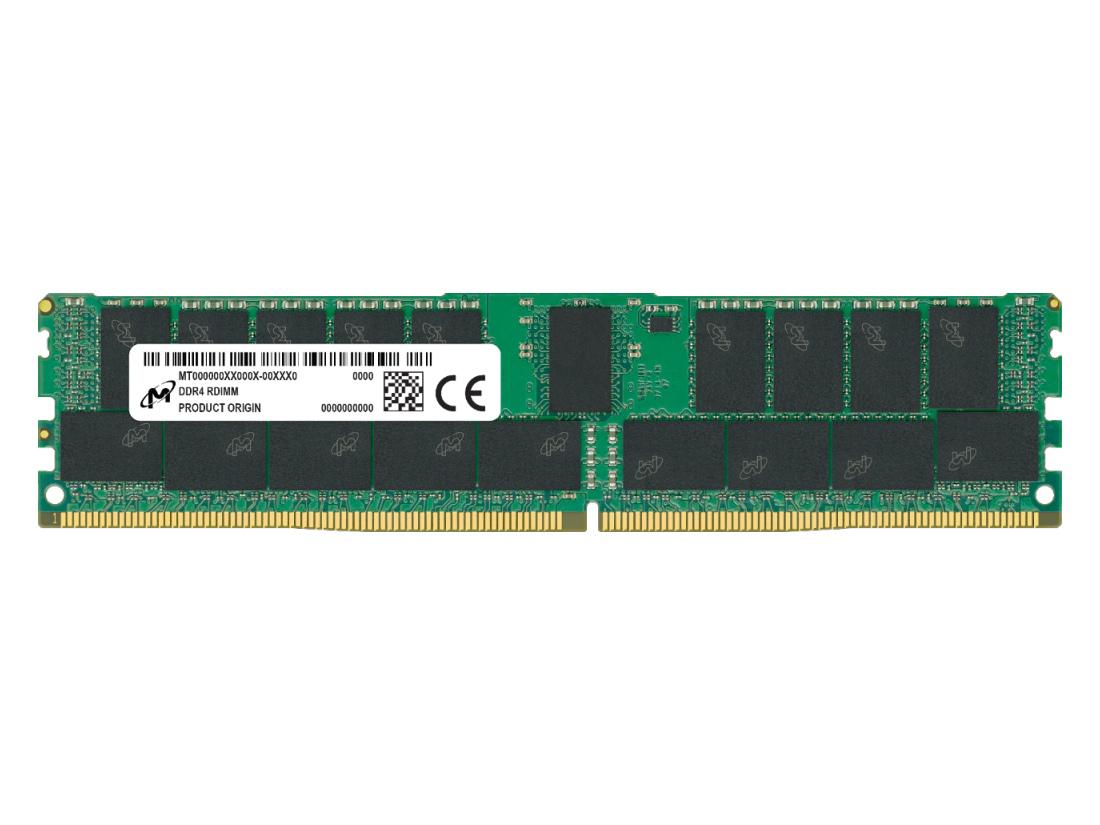
This DDR4-2666 Registered ECC RDIMM, featuring a dual-rank x4 configuration, is engineered for server platforms running memory-intensive workloads like virtualization and in-memory databases where data integrity is non-negotiable. The registered signal type stabilizes command and address lines under heavy channel loading, while the 1.2V ECC memory excels at single-bit error correction to prevent silent data corruption in mission-critical enterprise environments.
1. 32GB per module enables higher virtual machine density, letting a single server host more memory-hungry instances without swapping to storage and maintaining responsive multi-tenant services.
2. DDR4-2666 operation delivers 21.3GB/s peak throughput, crucial for accelerating in-memory databases and real-time analytics under heavy query concurrency.
3. ECC transparently detects and corrects single-bit errors, preventing silent data corruption that could compromise results in long-running scientific simulations or financial ledgers.
4. Registered buffering enhances signal integrity across fully populated memory channels, ensuring non-stop operational stability when scaling up to multi-terabyte server footprints.
5. Dual Rank x4 interleaving keeps memory banks fully utilized, providing the steady bandwidth needed for consistent transaction processing response times during peak loads.
The Micron MTA36ASF4G72PZ-2G6H1RSG, a 32GB DDR4-2666 RDIMM, fortifies enterprise servers against data corruption and instability. Its ECC engine silently corrects single-bit errors that would otherwise cause unpredictable failures in virtualization clusters—imagine a single cosmic-ray-induced bit flip corrupting a database transaction or crashing multiple VMs. Registered buffering doubles down on reliability: it eliminates signal degradation when all memory slots are populated, so you can scale to 512GB or more without compromising bus integrity, essential for hypervisors hosting business-critical workloads. For in-memory databases like SAP HANA, the dual-rank x4 design unleashes higher bank-level parallelism, which lowers effective latency and accelerates real-time analytics. Crucially, operating at 1.2V, this module draws less power per gigabyte; across a server farm, the cumulative energy savings reduce cooling costs and release power for compute. In short, this memory directly translates into fewer unexplained outages, faster transaction processing, and a greener data center—benefits that every infrastructure manager values.
General Virtualization
For a typical hypervisor hosting multiple VMs, populate the server with at least eight of these 32 GB RDIMMs to reach 256 GB total memory, ensuring balanced capacity across memory channels. Deploy modules in matched sets per CPU socket—for example, six or eight identical DIMMs per processor—to maintain symmetric memory access and maximize throughput. Avoid mixing ranks or speeds, as this 2Rx4 registered ECC part runs at 1.2 V and CL19, delivering reliable error correction essential for dense consolidation workloads.
In-Memory Database
In-memory databases such as SAP HANA or Redis demand large, contiguous memory pools; a minimum configuration of 12 × 32 GB (384 GB) is recommended for entry-level production nodes. Use all available memory channels per CPU with identical dual-rank x4 RDIMMs to sustain high bandwidth and low latency under extreme read/write pressure. These 32 GB registered ECC modules with 2666 MT/s speed and CAS 19 provide the data integrity and predictable response times required for transactional processing and real-time analytics.
High-Performance Computing
HPC clusters benefit from high memory bandwidth per core; equip each compute node with 16 × 32 GB (512 GB total) by fully populating all 8 channels per socket in a dual-socket platform. The 2Rx4 configuration on these RDIMMs offers a good balance of capacity and rank interleaving, while registered ECC ensures silent data corruption is avoided during long-running simulations. For capacity‑biased workloads, this setup lets you scale to 1 TB per node by moving to higher-density RDIMMs while keeping the same memory topology.
Rigorously tested server memory, compatible with Dell PowerEdge R740, HPE ProLiant DL380 Gen10, Lenovo ThinkSystem SR650, and similar systems.
Q: Can I mix this MTA36ASF4G72PZ-2G6H1RSG with other memory modules of different brands or speeds?
A: Mixing RDIMMs of different brands, speeds, or ranks is not recommended for servers due to strict signal integrity requirements. It may cause instability, POST failures, or silent data corruption.
Q: Is this memory compatible with my Intel Xeon Scalable or AMD EPYC server platform?
A: This DDR4-2666 ECC Registered DIMM is validated for Intel Xeon Scalable and AMD EPYC 7000/7002 series platforms. Please verify your motherboard's QVL and support for 32GB Dual Rank x4 RDIMMs.
Q: What is the recommended DIMM population order for optimal performance with this RDIMM?
A: Follow the server board's memory slot numbering: populate identical DIMMs in matched channels first, typically starting with slot 1 per channel. Adhere to balanced configurations across memory controllers for best throughput.
Q: Does this module support overclocking or XMP profiles?
A: No. This is a JEDEC-compliant server-grade RDIMM with fixed CL19 timings. It does not support overclocking, XMP, or any manual latency tuning, as server stability and data integrity are paramount.
Q: What warranty and typical failure rate can I expect for this memory?
A: This module includes a 1-year warranty. As a premium RDIMM, it features an extremely low AFR of less than 0.3% annually under specified operating conditions, ensuring reliable 24/7 enterprise operation.