











 Secure payments
Standard refund policy
Trade Assurance
Secure payments
Standard refund policy
Trade Assurance
| Product Type | Memory Module |
|---|---|
| Memory Capacity | 32 GB |
| Memory Technology | DDR4 |
| Product Voltage | 1.2 V |
| RAM Speed | 2666 MHz |
| RAM Standard | DDR4-2666/PC4-21300 |
| Error Identifying | ECC |
| Signal Type | Registered |
| Column Access Strobe (CAS) | CL19 |
| Rank | Dual Rank x4 |
| Quantity of Pins | 288-pin |
| RAM Genre | RDIMM |
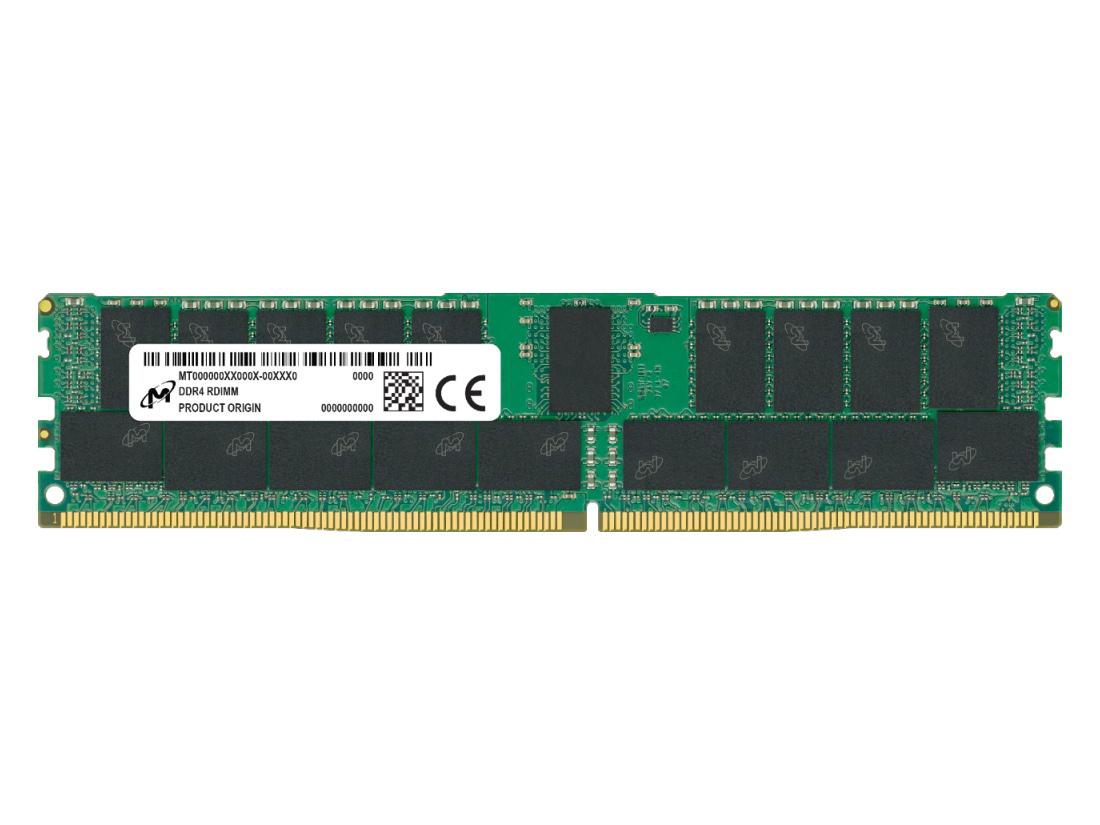
Engineered for enterprise environments, this 32GB DDR4-2666 RDIMM with ECC and registered signaling delivers the data integrity and stability essential for virtualization clusters, in-memory databases, and mission-critical workloads. Its dual-rank x4 configuration balances capacity with bank-level parallelism to sustain throughput under heavy load, while CL19 latency keeps response times predictable in high-density server deployments.
1. High-density capacity equips virtualization hosts with ample memory headroom, allowing a greater number of simultaneous VMs without swapping-induced latency.
2. ECC protection continuously corrects single-bit errors in the background, preserving data integrity for transaction-heavy databases and compliance-sensitive workloads.
3. Registered buffering regenerates command and address signals, ensuring rock-solid stability when every DIMM slot in the server is populated.
4. Dual-rank interleaving keeps the memory pipeline fully utilized, boosting sustained bandwidth for real-time analytics and heavy consolidation environments.
5. Low-voltage operation shrinks power draw and thermal output across densely packed server racks, helping data centers hit efficiency targets without compromising uptime.
In a server environment, the Micron MTA36ASF4G72PZ-2G6R is defined by four features that directly address the most pressing data-center challenges: ECC, registered architecture, dual-rank x4 construction, and a generous 32GB capacity per module. ECC corrects single-bit errors on the fly, which is absolutely critical in virtualized clusters where a silent bit-flip can corrupt a hypervisor or propagate across dozens of guest VMs, causing unpredictable outages. The registered buffer ensures signal integrity when populating all DIMM slots; this lets you deploy large, multi-node platforms without sacrificing stability. The dual-rank design interleaves memory banks to deliver higher sustained bandwidth — an immediate advantage for in-memory databases like Redis or SAP HANA, where every nanosecond shaved from cache misses translates into faster transaction processing. The 32GB density lets you achieve 512GB or more per server with fewer modules, lowering latency and power per gigabyte. Together, these capabilities turn a spec sheet into mission-critical reliability and performance.
This is a server-class DDR4-2666 Registered ECC RDIMM (288-pin, Dual Rank x4, CL19). Capacity planning using this 32 GB module should always respect symmetric population and memory channel balancing.
General Virtualization
Populate all memory channels identically with one 32 GB RDIMM per channel (1DPC) to deliver balanced capacity and bandwidth. For a dual‑socket server with six channels per CPU, twelve modules provide 384 GB — ample for dozens of VMs. Stick to identical dual‑rank modules to guarantee consistent performance under mixed workloads.
In‑Memory Database
Maximize capacity by fully populating every DIMM slot with these 32 GB RDIMMs; a 2DPC configuration is acceptable when total memory must reach 768 GB or more. Use identical Dual Rank x4 parts throughout to preserve ECC integrity and avoid instability. If speed is critical, prefer 1DPC per channel, but capacity‑driven deployments tolerate the slight frequency drop of 2DPC.
High Performance Computing
Install exactly one 32 GB RDIMM per channel across all memory controllers to achieve peak bandwidth and lowest latency — essential for HPC codes. On a dual‑socket platform with eight channels per CPU, sixteen modules deliver 512 GB and fully saturate the memory bus. Maintain strict symmetry, as uneven population introduces NUMA imbalances that degrade parallel computation.
Validated for servers: Dell PowerEdge R740, HPE ProLiant DL380 Gen10, Lenovo ThinkSystem SR650. Rigorously tested.
Q: Can I mix this MTA36ASF4G72PZ-2G6R with other memory modules of different brands or speeds?
A: Mixing is not recommended. Mismatched brands, speeds, or ranks can cause instability on server platforms. For guaranteed reliability, use identical modules with the same Micron part number in all populated slots.
Q: Is this memory compatible with my system?
A: This RDIMM is compatible with Intel Xeon Scalable and AMD EPYC platforms using DDR4-2666. Always confirm placement on your server's qualified vendor list (QVL) for exact board and CPU compatibility before purchase.
Q: What is the recommended DIMM population order for optimal performance?
A: Populate identical modules symmetrically across memory channels, starting with the farthest slot per channel. Refer to your server motherboard manual. For this dual-rank x4 RDIMM, balanced channel loading maximizes throughput and signal integrity.
Q: Does this module support overclocking or XMP profiles?
A: No. This is a server-grade RDIMM built to JEDEC DDR4-2666 standards. It does not support XMP or overclocking. It operates at fixed 1.2V and CL19 timing for consistent, error-free enterprise performance.
Q: What warranty and typical failure rate can I expect?
A: This module includes a one-year warranty. It meets strict MTBF requirements typical for enterprise memory, with an extremely low failure rate when operated within specified temperature and voltage conditions.